Showing posts with label family law cases. Show all posts

Tuesday, August 28, 2018

14th Court of Appeals Justices splits on procedural treatment of counselor's immunity under the Texas Family Code

Thibodeau v. Lyles, No. 14-17-00028-CV (Tex.App. - Houston [14th Dist.] Aug. 14, 2018) 


Reversed and Remanded and Majority Opinion and Concurring and
Dissenting Opinion filed August 14, 2018.

In The
Fourteenth Court of Appeals 

NO. 14-17-00028-CV
TIM THIBODEAU, AS LEGAL GUARDIAN OF G.A.W.T., A MINOR
CHILD, Appellant
V.
DR. MARY LYLES AND KATY FAMILY COUNSELING, PLLC, Appellees
On Appeal from the 268th District Court
Fort Bend County, Texas
Trial Court Cause No. 16-DCV-235475 


TIM THIBODEAU, AS LEGAL GUARDIAN OF G.A.W.T., A MINOR CHILD, Appellant,

v.
DR. MARY LYLES AND KATY FAMILY COUNSELING, PLLC, Appellees.

No. 14-17-00028-CV.
Court of Appeals of Texas, Fourteenth District, Houston.

Opinion filed August 14, 2018.

On Appeal from the 268th District Court, Fort Bend County, Texas, Trial Court Cause No. 16-DCV-235475.

Reversed and Remanded.

Panel consists of Chief Justice Frost and Justices Boyce and Jewell. (Frost, C.J., concurring and dissenting).

                                                        M A J O R I T Y    O P I N I O N 

WILLIAM J. BOYCE, Justice.

A father brought tort claims on behalf of his daughter against a therapist and the therapist's professional limited liability company. On appeal, the father challenges a final order in which the trial court simultaneously granted both the defendants' plea to the jurisdiction and their motion to dismiss under Texas Rule of Civil Procedure 91a. The defendants based the plea to the jurisdiction and the Rule 91a motion solely on their purported immunity under section 261.106(a) of the Family Code, which they read to establish immunity from suit that deprives the trial court of subject matter jurisdiction. See Tex. Fam. Code Ann. § 261.106(a) (Vernon 2014).
We reject this reading. Even if the defendants were entitled to immunity under Family Code section 261.106(a), we conclude that this statute provides only immunity from liability. Therefore, this statute cannot deprive the trial court of subject matter jurisdiction. We reverse and remand because the trial court erred in dismissing the case for lack of subject matter jurisdiction.

BACKGROUND

Appellant/plaintiff Tim Thibodeau, as legal guardian of G.A.W.T., a minor child, sued appellees/defendants Dr. Mary Lyles and Katy Family Counseling, PLLC (collectively "the Lyles Parties"), asserting negligence and intentional infliction of emotional distress claims based on Dr. Lyles's alleged acts and omissions while allegedly acting as the child's therapist and evaluator.
The Lyles Parties filed a plea to the jurisdiction combined with a motion to dismiss under Texas Rule of Civil Procedure 91a, which provides for the dismissal of baseless claims. The Lyles Parties assert that all of Thibodeau's claims arise from Dr. Lyles's reporting of suspected child abuse and her testifying as to the same and that therefore the Lyles Parties enjoy immunity under Family Code section 261.106(a). In their plea to the jurisdiction, the Lyles Parties contend that this statutory immunity is an immunity from suit that operates to strip the trial court of subject matter jurisdiction.
In the alternative, the Lyles Parties also moved to dismiss under Rule 91a, arguing that Thibodeau's claims have no basis in law because the Lyles Parties enjoy immunity under section 261.106(a).
The trial court signed a single order granting both the plea to the jurisdiction and the Rule 91a motion to dismiss. Thibodeau challenges this order on appeal.

ANALYSIS

In his first issue, Thibodeau asserts that the immunity provided by section 261.106(a) is immunity from liability. He challenges the trial court's grant of the Lyles Parties' plea to the jurisdiction arguing that, even if the Lyles Parties enjoyed immunity under section 261.106(a), they would have only an immunity from liability, not an immunity from suit. Thus, Thibodeau argues, the trial court erred in granting the plea to the jurisdiction and concluding that the court lacked jurisdiction. In his second issue, Thibodeau contends that this immunity instead operates as an affirmative defense that must be pleaded and proven by a preponderance of the evidence. In his third and fourth issues, Thibodeau challenges the trial court's simultaneous granting of the Lyles Parties' motion to dismiss under Rule 91a.
The Lyles Parties purported to assert both a plea to the jurisdiction and a motion to dismiss under Rule 91a in a single instrument filed in the trial court.
We pause to consider the nature of this instrument before addressing whether the trial court erred in dismissing the case. We do so to examine its substance as well as its title and form, and to confirm that the Lyles Parties sought a dismissal of Thibodeau's claims based on an alleged lack of subject matter jurisdiction. We give effect to the substance of the document the Lyles' Parties filed rather than its title or form. See State Bar of Tex. v. Heard, 603 S.W.2d 829, 833 (Tex. 1980)(orig. proceeding).
Asserting in the plea to the jurisdiction that all of Thibodeau's claims arise from Dr. Lyles's reporting of suspected child abuse and her testifying as to the same, the Lyles Parties claim to have section 261.106(a) immunity. They assert that this statutory immunity is an immunity from suit that strips the trial court of subject matter jurisdiction. In the part of the instrument denominated as a plea to the jurisdiction, they do not refer to any other legal standard, rule, or procedural device.
As a threshold matter, we conclude that the substance of this part of the instrument is a plea to the jurisdiction based solely on the Lyles Parties' alleged immunity from suit under Family Code section 261.106(a).
We also conclude that the portion of this instrument denominated as a Rule 91a motion is an alternative vehicle for asserting the same basis for dismissal — predicated on an asserted lack of subject matter jurisdiction — that was asserted in the plea to the jurisdiction. The Rule 91a motion does not assert a basis for dismissal distinct from lack of subject matter jurisdiction.[1]
The Rule 91a motion merely reasserts that "Dr. Lyles has immunity for her report as well as her involvement in the Minor Plaintiff's custody case under Texas Family Code 261.106(a)." The motion asserts that immunity "deprives Plaintiff of the relief sought and renders the negligence, negligence per se and intentional infliction of emotional distress claims without a [basis] . . . in law." The motion does not attempt to articulate a contention that appellees are immune from liability even if they are not immune from suit — or any other basis for dismissal on grounds other than lack of subject matter jurisdiction. The Lyles Parties' invocation of Rule 91a in the trial court does not by itself indicate that dismissal is being sought on a merits basis that is distinct from lack of subject matter jurisdiction. This court has recognized that Rule 91a can be used to obtain dismissal based on lack of subject matter jurisdiction. See, e.g., Univ. of Tex.-MD Anderson Cancer Ctr. v. Porter, No. 14-17-00107-CV, 2017 WL 5196146, at *1 (Tex. App.-Houston [14th Dist.] Nov. 2, 2017, no pet.) (mem. op.).
The Lyles Parties' brief in this court also does not articulate a basis for dismissal under Rule 91a that is distinct from their contention that subject matter jurisdiction is lacking. Their appellate brief does not assert any basis for dismissal under Rule 91a at all. Instead, the brief argues that (1) dismissal is warranted based on lack of subject matter jurisdiction; and (2) any asserted dispute regarding whether the Lyles Parties established good faith in making a report of child abuse is moot.
Looking at its substance rather than form, we conclude that the instrument filed by the Lyles Parties asserts a single ground for dismissal based on lack of subject matter jurisdiction. We now turn to Thibodeau's first issue.

I. Section 261.106(a) Does Not Defeat Subject Matter Jurisdiction

The parties have not cited and research has not revealed any case from the Supreme Court of Texas or this court addressing whether the immunity provided by section 261.106(a) is immunity from suit that deprives the courts of subject matter jurisdiction or immunity from liability that does not deprive the courts of jurisdiction. To answer the question, we look to the statutory text.
Section 261.106(a) of the Texas Family Code states:
A person acting in good faith who reports or assists in the investigation of a report of alleged child abuse or neglect or who testifies or otherwise participates in a judicial proceeding arising from a report, petition, or investigation of alleged child abuse or neglect is immune from civil or criminal liability that might otherwise be incurred or imposed.
We review the trial court's interpretation of applicable statutes de novo. See Johnson v. City of Fort Worth, 774 S.W.2d 653, 655-56 (Tex. 1989). In construing a statute, we seek to give effect to the Legislature's intent. See Nat'l Liab. & Fire Ins. Co. v. Allen, 15 S.W.3d 525, 527 (Tex. 2000). If possible, we must ascertain that intent from the language the Legislature used in the statute and not look to extraneous matters for an intent the statute does not state. Id. If the meaning of the statutory language is unambiguous, we adopt the interpretation supported by the plain meaning of the provision's words. St. Luke's Episcopal Hosp. v. Agbor,952 S.W.2d 503, 505 (Tex. 1997). We must not engage in forced or strained construction; instead, we must yield to the plain sense of the words the Legislature chose. See id.
On its face, section 261.106(a) is unambiguous, so we need not and do not venture into extraneous matters to determine the Legislature's intent. After setting out the class of people entitled to the immunity, the Legislature's text plainly characterizes the immunity as immunity from liability. No language in the statute states that the people who fall within the statute's scope enjoy immunity from suit or should be treated as if they were governmental actors. Under its unambiguous wording, the statute does not provide that courts lack jurisdiction over claims in which a plaintiff seeks to establish civil liability against a person covered by the statute.
The Lyles Parties have not cited, and we have not found, any cases in which a court holds that section 261.106(a) confers immunity from suit or deprives courts of jurisdiction over claims against a person covered by the statute.
The First Court of Appeals has concluded that the immunity provided under section 261.106(a) does not deprive courts of jurisdiction over any claims because the immunity is immunity from liability and not immunity from suit. See Miranda v. Byles, 390 S.W.3d 543, 551 (Tex. App.-Houston [1st Dist.] 2012, pet. denied). We agree with our sister court that immunity under section 261.106(a) does not deprive courts of jurisdiction over any claims and thus would not provide a basis for granting a plea to the jurisdiction. See id. Presuming without deciding that the Lyles Parties enjoy immunity under section 261.106(a) as to all of Thibodeau's claims, we conclude that this immunity does not deprive the courts of jurisdiction over these claims. See id. Therefore, the trial court erred in dismissing this case based on a lack of subject matter jurisdiction. We sustain Thibodeau's first issue.[2]

II. The Bird Privilege Does Not Defeat Subject Matter Jurisdiction

The Lyles Parties argue on appeal that the trial court properly dismissed Thibodeau's claims for lack of subject matter jurisdiction based on the common-law privilege the Supreme Court of Texas described in Bird v. W.C.W., 868 S.W.2d 767, 771 (Tex. 1994). According to the Lyles Parties, this privilege confers on them an immunity from suit that deprives the courts of subject matter jurisdiction over Thibodeau's claims. The Lyles Parties did not assert this argument in the trial court. Nonetheless, if this privilege would deprive the trial court of subject matter jurisdiction over Thibodeau's claims, we would have to consider the merits of this argument despite the Lyles Parties' failure to raise it in the trial court. See Waco Indep. Sch. Dist. v. Gibson, 22 S.W.3d 849, 850-51 (Tex. 2000)Tex. Dep't of Transp. v. Olivares, 316 S.W.3d 89, 95 (Tex. App.-Houston [14th Dist.] 2010, no pet.).
Communications made during the course of judicial proceedings are privileged. See Bird, 868 S.W.2d at 771. The privilege extends to pre-trial proceedings and covers affidavits filed with the court. See id. If the essence of a claim is libel or slander based on a person's communications in the context of judicial proceedings, this absolute privilege applies to shield the person from liability. See id. The Bird court did not state that this privilege confers immunity from suit or that the privilege deprives courts of subject matter jurisdiction over such claims. See id.at 771-72. Instead, this privilege results in a defense to the merits of such claims rather than a dismissal for lack of subject matter jurisdiction. See id. at 768 (rendering a take-nothing judgment on the claims to which the privilege applied rather than dismissing for lack of subject matter jurisdiction).
Presuming without deciding that the Lyles Parties are correct and the Bird privilege applies to all of Thibodeau's claims, we conclude that this privilege does not deprive the courts of jurisdiction over these claims. See id. Therefore, this privilege does not provide a possible basis for affirming the trial court's dismissal of Thibodeau's claims.[3]

CONCLUSION

Presuming without deciding that the Lyles Parties enjoy immunity under Family Code section 261.106(a) as to all of Thibodeau's claims, this immunity does not deprive the courts of jurisdiction over these claims. Therefore, the trial court erred in dismissing this case. Thus, we reverse the trial court's final order and remand for further proceedings.

                      C O N C U R R I N G    A N D    D I S S E N T I N G    O P I N I O N 

KEM THOMPSON FROST, Chief Justice.

The majority correctly construes the statutory immunity under Texas Family Code section 261.106(a), holding that the statute provides immunity from liability, not immunity from suit. I agree with the majority's conclusion that the trial court erred in granting the plea to the jurisdiction filed by appellees Dr. Mary Lyles and Katy Family Counseling, PLLC (the "Lyles Parties"). And, I agree with the reasoning and conclusion in Sections I and II of the majority opinion, to the extent those sections address the Lyles Parties' argument in the jurisdictional plea that the trial court lacks subject-matter jurisdiction over Thibodeau's claims. But, I respectfully disagree with the majority's reading and treatment of the Lyles Parties' filings and the court's failure to address the trial court's dismissal on the merits under Texas Rule of Appellate Procedure 91a.
Though this court has said that a party may seek a dismissal under Rule 91a based on lack of subject matter jurisdiction, this court must decide whether the Lyles Parties did so in today's case.[1] The court must construe the Lyles Parties' two-pronged filing — a single instrument containing both a plea to the jurisdiction and a Rule 91a motion. In discerning the true nature of a pleading, the law calls us to look to the substance — not to the form or title — of the plea for relief.[2] The majority reads the Lyles Parties' Rule 91a motion as not asserting a basis for dismissal distinct from lack of subject matter jurisdiction. The substance of the instrument belies that notion.
In the two-part instrument the Lyles Parties assert two grounds for dismissal, not one. While both the plea and the motion take root in the alleged factual applicability of section 261.016(a) immunity, they differ in the substance of the relief requested. The distinction becomes most apparent at the dovetail, where the Lyles Parties state:
Immunity for reporting suspected child abuse is critical to the successful prevention of child abuse and should be treated as immunity from suit, stripping the court of jurisdiction.
Alternatively, Defendants move for dismissal pursuant to Rule 91a of the Texas Rules of Civil Procedure because it has no basis in law.
In the second part of the document, the Lyles Parties' Rule 91a motion, they never asserted that the statute gave them immunity from suit or deprived the trial court of jurisdiction. Instead, the Lyles Parties asserted that section 261.016(a) immunity "deprives Plaintiff of the relief sought and renders the [torts claims asserted by Thibodeau] without a base [sic] in law." The Lyles Parties did not request attorney's fees under Rule 91a, and they would not be entitled to recover attorney's fees under their plea to the jurisdiction. In this context, if the Lyles Parties sought a Rule 91a dismissal on the basis that immunity under Family Code section 261.106(a) deprived the trial court of jurisdiction, the Rule 91a motion would entitle them to the same relief as the plea to the jurisdiction.
Though parties may seek dismissal under Rule 91a on the basis that the trial court lacks jurisdiction, the Lyles Parties did not do so in the trial court. Rather, the substance of the Lyles Parties' filing is a plea to the jurisdiction based on the premise that section 261.106(a) deprived the trial court of jurisdiction, and an alternative Rule 91a motion in the event the trial court concluded that this statutory immunity was an immunity from liability that did not deprive the trial court of jurisdiction.[3]
In their appellees' brief in this court, the Lyles Parties argue only that "the trial court properly granted [the Lyles Parties'] Plea to the Jurisdiction." Though the Lyles Parties do not assert on appeal that the trial court properly granted their Rule 91a motion, they are not required to brief whether the trial court properly granted this motion, nor does their failure to argue the Rule 91a motion mean that in this motion the Lyles Parties sought a jurisdictional dismissal, as the majority suggests.[4]
Under the clear text of the Lyles Parties' filing and of the trial court's order, the trial court granted the plea to the jurisdiction, dismissing Thibodeau's claims for lack of subject-matter jurisdiction, and, with the same stroke of the pen, also granted the Lyles Parties' motion to dismiss under Rule 91a, dismissing the claims on the merits as having no basis in law.[5]
Uncertain as to whether section 261.016(a) immunity provided immunity from suit or immunity from liability, the Lyles Parties filed a two-headed motion, addressing both possibilities. They did not, as the majority concludes, attempt to get dismissed on jurisdictional grounds twice. The law treats the two pleas for relief differently — one is a jurisdictional dismissal and the other is not. Thus, after concluding that the trial court erred in granting the plea to the jurisdiction, the court should address the trial court's dismissal on the merits under Rule 91a. Because the majority fails to do so, I respectfully dissent.

[1] Based on this determination, we need not address Thibodeau's third and fourth issues.
[2] We need not and do not address whether either of the Lyles Parties is entitled to immunity from liability under Texas Family Code section 261.106(a). We need not address Thibodeau's second issue.
[3] We need not and do not address whether this privilege applies in this case so as to preclude liability as to any of Thibodeau's claims.
[1] See, e.g., Univ. of Tex.—MD Anderson Cancer Ctr. v. Porter, No. 14-17-00107-CV, 2017 WL 5196146, at *1-4 (Tex. App.-Houston [14th Dist.] Nov. 2, 2017, no pet.) (mem. op.).
[3] See id.

[5] See Tex. R. Civ. P. 91a.1.


Friday, August 10, 2018

Grandparent standing established by agreement on appeal, case remanded to trial court

Standing is a jurisdictional issue. If there is no jurisdiction, the court can't grant any relief. Jurisdiction cannot normally be created by agreement, but there are exceptions, as illustrated by this case, where the parties agreed on appeal that facts existed to allow grandparent to pursue a suit affecting the parent-child relationship even though it had already been dismissed by the trial court for lack of standing. The agreement the parties reached was in the form of a Mediated Settlement Agreement. Johnson v Hardy, No. 01-17-00640-CV (Tex.App. - Houston, Aug. 9, 2018)

MEDIATED SETTLEMENT AGREEMENT IN GRANDPARENT ACCESS SUIT

Opinion issued August 9, 2018

In The
Court of Appeals
For The
First District of Texas
————————————
NO. 01-17-00640-CV
———————————
STEPHANIE JOHNSON, Appellant
V.
BARRY HARDY AND SHAUN HARDY, Appellees

On Appeal from the County Court at Law No. 2
Galveston County, Texas
Trial Court Case No. 14-FD-2773

MEMORANDUM OPINION

This is an appeal from the dismissal of a suit for lack of evidence to support a grandparent’s standing under Section 102.004(a)(1) of the Family Code. On appeal, the parties have entered into a mediated settlement agreement, in which the appellees agree that appellant “has standing to pursue her claim,” meaning the parties agree that adequate facts exist to support standing under Section 102.004(a)(1), and further agree that the matter should be remanded for appellant to pursue her claims. See TEX. FAM. CODE § 102.004(a)(1). We therefore vacate the trial court’s judgment of dismissal and remand the case for further proceedings consistent with the parties’ mediated settlement agreement. See TEX. R. APP. P.42.1(a)(2).

The appeal is dismissed as moot. See TEX. R. APP. P. 43.2(f).

PER CURIAM

Panel consists of Justices Massengale, Brown, and Caughey.


Tuesday, May 1, 2012

When the divorce attorney gets off the case just in time for trial...


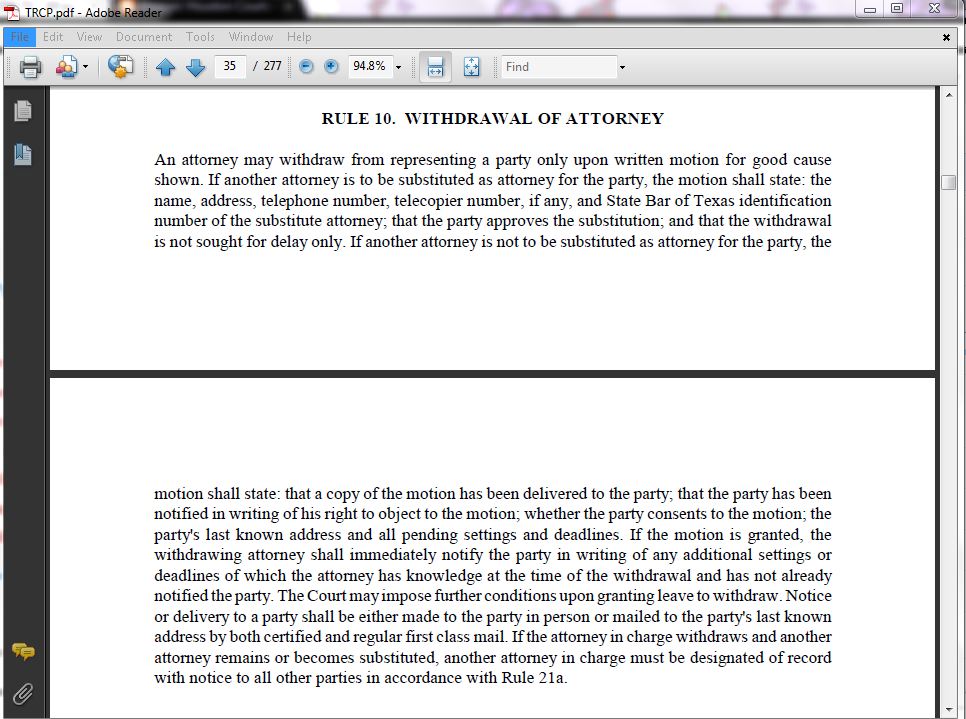
ATTORNEY WITHDRAWAL UNDER TRCP 10 ON THE EVE OF TRIAL  .... Is it a valid ground to postpone (continue) the trial?
Family court judge found to have abused discretion by denying wife's motion for continuance after permitting her trial counsel to withdraw from representing her -- over her objection -- shortly before trial based on nonpayment of an unspecified fee amount. Wife went through a series of lawyers in contested divorce case and ended up pro se, with a list of attorneys who wouldn’t take the case at the last minute.    


EXCERPT FROM SUBSTITUTE OPINION BY JUSTICE BOYCE
  
[names of parties replaced with “WIFE” and “HUSBAND”]
  
Standards Governing Withdrawal and Continuance  

An attorney may withdraw from representing a party only upon written motion for good cause shown. See Tex. R. Civ. P. 10. Texas Rule of Civil Procedure 10, entitled "Withdrawal of Attorney," does not define "good cause." Id. However, the Texas Disciplinary Rules of Professional Conduct articulate considerations relevant to the consideration of Rule 10 motions. See Tex. Disciplinary Rules Prof'l Conduct R. 1.15, reprinted in Tex. Gov't Code Ann., tit. 2, subtit. G, app. A (Vernon 2005); In re A.R., 236 S.W.3d 460, 474 (Tex. App.-Dallas 2007, no pet.) (op. on rehearing); In re Posadas USA, Inc., 100 S.W.3d 254, 257 (Tex. App.-San Antonio 2001, orig. proceeding). Thus, "[b]efore a trial court allows an attorney to withdraw, it should see that the attorney has complied with the Code of Professional Responsibility." Villegas v. Carter, 711 S.W.2d 624, 626 (Tex. 1986).
   
Texas Disciplinary Rule of Professional Conduct 1.15, entitled "Declining or Terminating Representation," provides, among other things, that a lawyer shall not withdraw from representing a client "unless withdrawal can be accomplished without material adverse effect on the interests of the client;" the client "fails substantially to fulfill an obligation to the lawyer regarding the lawyer's services, including an obligation to pay the lawyer's fee as agreed, and has been given reasonable warning that the lawyer will withdraw unless the obligation is fulfilled;" and the representation "will result in an unreasonable financial burden on the lawyer or has been rendered unreasonably difficult by the client." Tex. Disciplinary Rules Prof'l Conduct R. 1.15(b)(1), (5), (6).
  
When the ground for a continuance is the withdrawal of counsel, the movant must show that the failure to be represented at trial was not due to her own fault or negligence. Villegas, 711 S.W.2d at 626. Because the right to counsel is a valuable right, its unwarranted denial is reversible. Id. "[W]hen a trial court allows an attorney to withdraw, it must give the party time to secure new counsel and time for the new counsel to investigate the case and prepare for trial." Id.
  
Relying on Villegas, WIFE argues that the trial court should have (1) denied Nass's motion to withdraw; or (2) granted her motion for continuance after allowing Nass to withdraw. She contends that failure to be represented by counsel at trial was not due to her own fault or negligence.
  
Relying on Texas Disciplinary Rule of Professional Conduct 1.15 and In re Daniels, 138 S.W.3d 31, 33-35 (Tex. App.-San Antonio 2004, orig. proceeding), HUSBAND argues that the trial court acted within its discretion when it granted Nass's motion to withdraw because (1) WIFE failed to pay Nass's fees; (2) continuing "representation through a trial would have been financially burdensome" to Nass; (3) WIFE did not show she had tried to borrow funds to pay Nass; and (4) "[o]ver the course of two full years, from February 11, 2008, to February 10, 2010, neither WIFE nor Nass presented a motion to the trial court seeking the payment of fees beyond the $91,000 Nass had already received."
  
HUSBAND argues that the trial court acted within its discretion in denying a continuance after Nass withdrew as WIFE's counsel because (1) WIFE had 55 days' notice of Nass's motion to withdraw, the trial court granted Nass's motion to withdraw 40 days before trial, and WIFE received her file from Nass after his withdrawal; (2) WIFE never made a motion for interim fees or showed any effort that she attempted to borrow money to pay the fees; (3) the trial court was allowed to consider the history of this case and the fact that WIFE had retained six attorneys, including Nass, and "was not a novice at hiring lawyers;" and (4) WIFE was not deprived of her right to be represented by counsel at trial, but simply failed to secure counsel.
 
III. Application of Standards
 
A. Withdrawal of Representation

  
Nass filed a motion to withdraw as WIFE's counsel on January 26, 2010, asserting that "[g]ood cause exists for withdrawal" because WIFE "represents that she does not have the financial resources to satisfy the contractual obligation to pay the firm." On February 10, 2010, the trial court held a hearing on Nass's motion to withdraw. HUSBAND appeared at this hearing with his counsel, as did amicus attorney Hughes. Nass did not appear at the hearing. Instead, a firm associate, Courtney Hoff, appeared at the hearing to argue Nass's motion.
  
Hoff argued that the Nass firm had not been paid attorney's fees since February 2008, and stated that the firm was not in a position to continue representing WIFE. HUSBAND did not object to Nass's withdrawal, provided that the case proceeded to trial as scheduled on March 22, 2010. Amicus attorney Hughes also did not oppose Nass's motion to withdraw "provided it does not delay the trial setting."
 
WIFE strenuously opposed Nass's motion throughout the hearing. WIFE argued that she and HUSBAND had attempted to reconcile and had agreed that all attorneys would be paid. She stated that HUSBAND paid his attorney and WIFE's attorney from a joint account; according to WIFE, HUSBAND paid Nass about $90,000 for representing WIFE between January 19, 2007, and February 11, 2008. She stated that $5,000 remained to be paid to Nass.
 
WIFE also stated that, when she spoke to Nass in January 2010, he asked her to appear before the trial court and request that fees be awarded so he "would continue" to represent her. WIFE stated that "Nass was supposed to appear" at the withdrawal hearing and question her before the court. WIFE asked the trial court to award her interim fees from a Wells Fargo joint account so she could pay Nass. HUSBAND opposed the request for interim fees at the hearing because no motion for interim fees had been filed before the hearing; he asserted that the parties are "in the middle of trial" and fees "can be handled at the time of trial."
  
Hoff stated that she did not believe HUSBAND had paid the firm $90,000; she recalled that the parties entered into a Rule 11 agreement and believed that HUSBAND had paid the firm approximately $30,000. Relying on a docket sheet entry, the trial court stated that payment of $40,000 was ordered to Nass on February 5, 2008. HUSBAND confirmed that, on or before February 20, 2008, his attorney's fees were paid and WIFE's fees also were paid based on the invoices Nass submitted. HUSBAND stated he had not "heard anything about the fees until now."
  
The trial court asked WIFE if she disputed Nass's contention that she had not followed "the fee agreement or fee contract with Mr. Nass and his firm." WIFE responded that (1) she believed she had "followed" the agreement; (2) Nass "just wants money;" (3) HUSBAND had "total access and control to all our money, and that has kept [WIFE] from gaining counsel in a way that [HUSBAND] is able to;" (4) she had to borrow $40,000 from a friend to pay one attorney and had to borrow money from another friend to pay another attorney; (5) the parties "should have a level field of being able to pay our attorneys so hopefully we can bring finality to his case;" and (6) not having counsel "a month or six weeks before trial would gravely prejudice" her and the parties' children.
  
HUSBAND contended that "there has been a level playing field." He noted that Nass was WIFE's sixth attorney, and asserted that the case could not be resolved if WIFE was allowed to retain "a new lawyer and then that new lawyer obviously needs an opportunity to get brought up to speed." WIFE responded, "[HUSBAND]'s answer, that's what I'm arguing. I'm actually arguing [HUSBAND's] argument, that a new attorney not be placed on this case. Mr. Nass has an overwhelming amount of knowledge; and, again, I believe it's around about $90,000 that he was paid for three weeks . . . And it hasn't been a level playing field because I haven't had the money to hire my — to pay attorneys."
  
Hoff contended that the firm had not received payment from WIFE in two years, and that Nass did not want to withdraw sooner because "the case was put on hold for a period of time" and the firm wanted to give WIFE the "opportunity to figure out if she was going to be able to find the funds for us or if she was going to find another lawyer." Hoff did not know the exact amount WIFE owed the firm, but claimed that WIFE owed more than $5,000. Hoff did not present any unpaid invoices reflecting fees owed to Nass, nor did Hoff indicate what sum, if any, Nass had requested in order to continue representing WIFE in the divorce action.
  
The trial court granted Nass's motion to withdraw and ordered the parties to attend mediation. The trial court signed the order allowing Nass's withdrawal on March 2, 2010; the trial court expressly found that good cause existed for Nass's withdrawal as counsel.

To support his contention that the trial court did not abuse its discretion by granting Nass's motion to withdraw, HUSBAND argues that Disciplinary Rule 1.15 allows an attorney to withdraw for nonpayment of fees "even though the withdrawal may have a material adverse effect upon the interests of the client." However, Rule 1.15 addresses more than the nonpayment of fees; Rule 1.15 also provides that an attorney "shall not withdraw from representing a client unless the client fails substantially to fulfill an obligation" to pay an attorney for services. Tex. Disciplinary Rules Prof'l Conduct R. 1.15(b)(5) (emphasis added).
  
For two reasons, this record raises significant questions about whether WIFE substantially failed to fulfill her obligation to pay Nass.
  
First, it is unclear how much Nass had been paid at the time of the February 10, 2010 hearing. WIFE claimed that HUSBAND had paid Nass approximately $90,000 for services performed between January 19, 2007 and February 8, 2008. Hoff could not state the amount Nass had been paid, but stated that she "believed" HUSBAND's counsel "was saying that they had given my office" about $30,000. The trial court stated, "I see a docket sheet entry from February 5th, '08 ordering that Mr. Nass be paid $40,000 from some specific account." HUSBAND agreed with the trial court at the time and stated that he paid Nass according to the invoices Nass's office submitted. HUSBAND asserts on appeal that Nass already had received $91,000 at the time of the withdrawal hearing.
  
Second, it is unclear how much WIFE still owed to Nass and how much he required to continue participating in the case. WIFE claimed that she owed Nass $5,000. Hoff disputed that amount. When the trial court questioned her regarding the amount Nass was owed, Hoff answered, "I don't have the exact number with me." Hoff did not present any invoices. Hoff did not state how much money, if any, Nass requested for continued representation.
  
Again relying on Disciplinary Rule 1.15, HUSBAND contends that the trial court acted within its discretion by granting Nass's motion to withdraw because continuing the representation through a trial "would have been financially burdensome." Disciplinary Rule 1.15(b)(6) provides that an attorney "shall not withdraw from representing a client unless the representation will result in an unreasonable financial burden" on the attorney. Id. 1.15(b)(6) (emphasis added). Nass did not argue in his motion to withdraw that continuing to represent WIFE would result in an unreasonable financial burden. Nor did Hoff argue that continuing to represent WIFE would result in an unreasonable financial burden.
  
HUSBAND further argues that WIFE "provided absolutely no testimony of any nature indicating efforts she had made to borrow funds to pay Nass the fees he required for continued representation." He emphasizes that WIFE had borrowed money in the past from friends and family to pay attorney's fees. HUSBAND also emphasizes that neither WIFE nor Nass had presented a motion for payment of fees since February 11, 2008.
   
The case was called to trial on February 11, 2008; however, WIFE and HUSBAND almost immediately asked the trial court for a recess to attempt reconciliation. On May 11, 2009, WIFE and HUSBAND agreed to reset trial to March 22, 2010. During this period, the parties technically remained "in trial." The record is unclear as to how long the parties actually attempted to reconcile, whether Nass provided any services between February 2008 and February 2010, and what fees were owed for such services. Hoff argued that the firm had not "received any money from [WIFE] in two years; and since that time the case was put on hold for a period of time, and that's why we didn't withdraw sooner. We were giving her the opportunity to figure out if she was going to be able to find the funds for us or if she was going to find another lawyer."
   
Nass bore the burden to show good cause for withdrawal. See Tex. R. Civ. P. 10. Nothing in the record suggests that WIFE was unwilling to pay attorney's fees or was able to borrow funds for fees but unwilling to do so. WIFE argued that she had no access to funds because HUSBAND "has total access and control to all our money." Although the trial court had awarded interim fees on February 5, 2008, Nass did not file a motion requesting interim fees in connection with the March 2010 trial setting. The record indicates that instead of filing a motion for interim fees, Nass instructed WIFE to ask the trial court to award fees at the February 10, 2010 withdrawal hearing. HUSBAND opposed the request for an award of interim fees at the hearing because no motion for interim fees was before the court; he asserted that the parties are "in the middle of trial" and fees "can be handled at the time of trial."
   
The record does not reveal why no request for interim fees was filed. The trial court did not order interim fees on its own motion. See Tex. Fam. Code Ann. § 6.502(a)(4).
   
The upshot is that Nass was allowed to withdraw after invoking WIFE's lack of "financial resources to satisfy the contractual obligation to pay the firm" 40 days before a recessed trial was scheduled to resume in a highly contentious divorce involving substantial assets and a custody dispute. Neither the amount already paid to Nass nor the amount still owed to Nass ever was clearly established. No motion seeking interim fees was filed before the February 2010 hearing. While we are not prepared to say that allowing Nass to withdraw under these circumstances was an abuse of discretion, we note that allowing withdrawal in this instance approaches the outer limits of discretion.
   
The trial court's exercise of discretion in allowing Nass's withdrawal under these circumstances informs our review of the accompanying decision to deny a continuance following Nass's withdrawal — and, in particular, the analysis of whether WIFE was at fault for the withdrawal of her attorney shortly before the trial was scheduled to resume.
  
B. Continuance   
  
WIFE argues that allowing Nass to "withdraw from representing her 40 days before trial against her wishes, and denying her subsequent motion for continuance" was an abuse of discretion. She contends that the trial court should have granted her motion for continuance because she demonstrated that Nass's withdrawal was not her fault or caused by her negligence.
  
After the trial court granted Nass's motion to withdraw over WIFE's objection on February 10, 2010, WIFE filed a motion for continuance on March 2, 2010. In her motion, she asserted that (1) she is a stay-at-home mom, and that HUSBAND had sole access and control over the couple's financial accounts out of which he paid his own attorney; (2) she "was astonished that Mr. Nash failed to appear at the [withdrawal] hearing after he informed her that he would personally appear so that he could petition the court by questioning [her] for additional fees;" (3) she requested interim attorney's fees at the withdrawal hearing but HUSBAND objected to her request and the trial court did not award her attorney's fees; (4) HUSBAND claimed that she delayed the February 2008 trial date but in fact HUSBAND asked for the trial date to be reset from February 2008 to September 2008 and then to June 2009; (5) she "counseled with several attorneys in an effort to retain representation before the March 22, 2010 trial date" but no attorney was willing to represent her without at least a six-month continuance; (6) good cause existed for a continuance because the absence of her attorney was not caused by WIFE or by her negligence; and (7) forcing her to represent herself at trial would impede her right to a fair trial.
   
In her motion for continuance, WIFE also recounted the list of attorneys who had represented her since HUSBAND filed for divorce. WIFE was represented by (1) Robert Piro from January 2006 to November 2006 for the purpose of obtaining a protective order; (2) Bobby Newman from November 2006 to March 2007; (3) Joan Jenkins from March 2007 to September 2007; (4) Michael Phillips from October 2007 to December 2007; (5) Bucky Allshouse from December 2007 to January 2008; and (6) Joel Nass from January 18, 2008, until the trial court granted Nass's motion to withdraw on February 10, 2010, and signed its order on March 2, 2010.
  
WIFE filed her first amended motion for continuance on March 8, 2010. In addition to asserting her previously asserted grounds for a continuance, WIFE argued that she had a right to be represented by qualified counsel and that she was not qualified to represent herself because she never practiced family law and "never participated in a trial as a lawyer." The trial court held a hearing on WIFE's motion for continuance on March 9, 2010. During the hearing, WIFE asked the trial court to grant her motion because she "fervently" had objected to Nass's withdrawal and had asked the trial court to award interim fees to pay Nass so he could remain her counsel and the case could proceed with trial as set. WIFE stated she had been unable to find another attorney to represent her on the eve of trial because the attorneys she contacted were afraid to "place themselves in a malpractice liability position" by taking her case.
  
HUSBAND opposed WIFE's motion for continuance, arguing that (1) it was not his fault that WIFE "has been through six lawyers;" (2) he and his counsel as well as amicus attorney Hughes had cleared their schedules to proceed with trial as scheduled; and (3) his witnesses and experts were ready to appear. Amicus attorney Hughes also opposed WIFE's continuance motion, arguing that the parties and the children needed finality. The trial court denied WIFE's motion for continuance and ordered the parties to attend mediation before the scheduled trial.
  
WIFE points to Villegas in arguing that she was entitled to a continuance to secure new counsel after the trial court allowed Nass to withdraw over objection shortly before trial because she was not at fault for causing Nass's withdrawal. See Villegas, 711 S.W.2d at 626. In that case, Villegas was represented by two attorneys; one attorney withdrew 22 days before trial and the second attorney was allowed to withdraw two days before trial. Id. at 625. Villegas asked for a continuance so he could retain a new attorney to represent him at trial, but the trial court refused Villegas's request for a continuance. Id. at 625-26. The supreme court held that "the trial court abused its discretion because the evidence shows Villegas was not negligent or at fault in causing his attorney's withdrawal" and too little time remained for Villegas to "find a new attorney and for that new attorney to investigate the case and prepare for trial." Id. Concluding that "the trial court should either have denied the attorney's motion to withdraw or granted the party's motion for continuance," the supreme court reversed and remanded for a new trial. Id.
   
HUSBAND emphasizes that trial counsel in Villegas withdrew two days before trial and refused to turn over the client's case file. According to HUSBAND, the "circumstances are not comparable to WIFE's case" because WIFE had 55 days' notice of Nass's motion to withdraw; the motion was granted 40 days before trial; WIFE received her file from Nass after his withdrawal; WIFE never made a motion for interim fees; and WIFE showed no efforts to borrow money from friends to pay her fees as she had done in the past. HUSBAND supports his argument by citing State v. Crank, 666 S.W.2d 91, 95 (Tex. 1984), Gillie v. Boulas, 65 S.W.3d 219, 223 (Tex. App.-Dallas 2001, pet. denied), and Van Sickle v. Stroud, 467 S.W.2d 509, 511 (Tex. Civ. App.-Fort Worth 1971, no writ).
  
Crank does not support HUSBAND's argument. The supreme court held that the trial court acted within its discretion when it denied Crank's motion for continuance after he "voluntarily discharged his attorney and reaffirmed the discharge after his requested continuance was denied." Crank, 666 S.W.2d at 94-95. The supreme court noted that counsel had not withdrawn voluntarily due to an emergency; rather, Crank knew of the scheduled hearing but waited until the morning of the hearing to discharge his attorney and ask for a continuance. Id. at 94. Here, in contrast, WIFE did not discharge Nass; she strenuously opposed Nass's withdrawal and filed a motion for continuance after trying without success to retain another attorney.
  
Relying on Gillie, HUSBAND argues that "WIFE was not deprived of her right to be represented by counsel at trial; rather WIFE failed to secure counsel." He misplaces his reliance on this case. In Gillie, the court of appeals held that the trial court did not abuse its discretion by denying Gillie's motion for continuance after allowing his counsel to withdraw because the "trial court allowed almost four months for Gillie to obtain new counsel and for the new counsel to investigate the case and prepare for trial." 65 S.W.3d at 222. Here, in contrast, the trial court did not allow WIFE four months to secure new counsel after allowing Nass to withdraw; WIFE had 40 days to secure new counsel.
  
Van Sickle does not support HUSBAND's contention that the trial court acted within its discretion by denying WIFE's motion for continuance "even assuming WIFE's claim of lack of fault." Van Sickle's trial counsel withdrew ten days before the case was called for trial. 467 S.W.2d 509, 511. Van Sickle failed to appear at trial. Id. Van Sickle later retained new counsel who filed a motion for new trial but never complained of the absence of counsel at trial. Id. The court noted that Van Sickle had been represented by four sets of attorneys and concluded he knew how to obtain counsel; yet, Van Sickle presented no evidence about why he "failed to make arrangements for counsel" once his trial counsel was allowed to withdraw. Id. The court concluded that, in the absence of evidence showing that Van Sickle was not at fault for his trial counsel's withdrawal and was diligent in finding new counsel, the trial court acted within its discretion in denying Van Sickle's motion for continuance. Id. Here, in contrast, WIFE unsuccessfully attempted to retain new counsel; none of the multiple attorneys she contacted would agree to represent her.
  
Nothing in the record suggests that WIFE was able to pay Nass's fees but refused to do so. Nothing in the record suggests that she was able to borrow money to pay Nass's fees but refrained from doing so. In assessing WIFE's level of fault, we note that a mechanism was available to allow Nass to seek attorney's fees and address the circumstances he invoked to justify his withdrawal. This mechanism was not used. The record contains no indication that this mechanism could not have been utilized and no explanation as to why this mechanism was unavailable. Nass filed a motion to withdraw claiming nonpayment of fees shortly before trial was scheduled and — according to WIFE — instructed WIFE to ask for fees at the withdrawal hearing. Nass did not appear at the withdrawal hearing.
   
The record does not reveal why a motion for interim fees was not filed in connection with the March 2010 trial setting even though the trial court had awarded interim fees in February 2008. See Tex. Fam. Code Ann. § 6.502(a)(4). When WIFE asked for an award of interim fees during the February 10, 2010, hearing, HUSBAND objected on grounds that no motion requesting such fees had been filed. This objection prompted the trial court to state: "Well, I can't consider a Motion for Fees at this time."
    
If fault is to be assigned for the failure to seek interim fees under these circumstances, we do not believe that such fault properly can be assigned to the client. We are not persuaded that WIFE was at fault because she failed to file a written motion for interim fees before the February 10, 2010, withdrawal hearing.[1] WIFE was represented by counsel before the hearing. WIFE stated that she followed Nass's instructions and asked the trial court for interim fees at the withdrawal hearing. She stated that she was "astonished that Mr. Nass failed to appear at the [withdrawal] hearing after he informed her that he would personally appear so that he could petition the court" for additional fees by questioning WIFE. These statements are uncontroverted on this record. Because nonpayment of fees was the stated reason for Nass's withdrawal on the eve of trial and because there is no contention that interim fees were unavailable, the absence of a motion for interim fees indicates that reasonable steps to avoid prejudice to WIFE were not taken. See Villegas, 711 S.W.2d at 626.
   
We are not persuaded by an argument that WIFE had more notice of her attorney's intent to withdraw and more time to find new counsel than Villegas did. Villegas requires that a party be given "time to secure new counsel and time for the new counsel to investigate the case and prepare for trial." Villegas, 711 S.W.2d at 626. Arguably, the circumstances here were even more prejudicial than the circumstances in Villegas; if the parties really were "in trial" during the February 10, 2010, hearing, then Nass was allowed to withdraw in the middle of trial. In any event, the timing causes concern even if March 22, 2010, is the operative date.
  
Forty days is a substantially shorter period than the almost four months allowed the client in Gillie to find a new attorney. See Gillie, 65 S.W.3d at 222. Unlike the client in Crank, 666 S.W.2d at 94-95, WIFE did not fire her attorney. Unlike the client in Van Sickle, 467 S.W.2d at 511, WIFE detailed her unsuccessful efforts to find a new attorney. Being mindful of the Texas Supreme Court's observation that "Villegas' attorney did not take reasonable steps to avoid foreseeable prejudice to the client" when he withdrew, we conclude that the holding in Villegas applies with equal force here: "The trial court should either have denied the attorney's motion to withdraw or granted the party's motion for continuance; it did neither." Villegas, 711 S.W.2d at 627.
  
HUSBAND also argues that the trial court was allowed to consider the history of this case and the fact that WIFE had retained six attorneys, including Nass. During the February 10, 2010, hearing, HUSBAND argued that an attorney substitution occurs "every time we get down here and get ready for trial."
   
Serial hiring and firing of attorneys for dilatory purposes would be a legitimate concern to be balanced against a requested continuance in appropriate circumstances. However, this record reveals no evidence that the case was delayed because WIFE had hired five attorneys before Nass. Nothing in the record establishes that a continuance was granted or requested in connection with the withdrawal of any of her prior attorneys. The record does not reflect that WIFE used the withdrawal of her attorneys as a dilatory tactic. The primary source of delay in this case appears to be an attempted reconciliation. WIFE's history of prior representation by other attorneys indicates that she could find attorneys to represent her under the circumstances in which they were retained; this history says nothing about her ability to retain a new attorney on the eve of trial after the withdrawal of her attorney based on the asserted nonpayment of fees.
   
Conclusion  
   
Based on the record before us, we conclude that the trial court abused its discretion by denying WIFE's motion for continuance after allowing her trial counsel to withdraw over her objection shortly before trial based on nonpayment of an unspecified fee amount. Following Villegas, 711 S.W.2d at 627, we sustain WIFE's first issue. We affirm the trial court's divorce decree in so far as it grants the divorce, but we reverse the remainder of the trial court's divorce decree and remand for a new trial.[2]
   
[1] WIFE filed a written motion for interim fees on March 12, 2010, asking the trial court to award her interim fees because she is not "in control of sufficient community assets to pay attorney's fees and anticipated expenses." The trial court declined to consider the motion.
[2] In light of our disposition of WIFE's first issue, we need not address WIFE's remaining issues.

Wednesday, December 7, 2011

Immediate appeal of temporary orders not available in SAPCR cases

  
Houston Court of Appeals again dismisses a premature appeal, holding that unlike temporary injunction orders in civil cases, temporary orders in family law cases governed by the Texas Family Code cannot be challenged in an interlocutory appeal.

MEMORANDUM OPINION

Appellant [in family law case - name omitted] filed her initial brief on August 15, 2011 and her amended brief on October 11, 2011. Neither brief complies with Texas Rule of Appellate Procedure 38.1. Specifically, neither contains "a clear and concise argument for the contentions made, with appropriate citations to authorities and to the record." Tex. R. App. P. 38.1(i). The appendix does not comply either. See Tex. R. App. P. 38.1(k)(1).

The briefs fail to identify any error; they simply request a different result. See Tex. R. App. P. 38.1(f), (j). It does not appear that Appellant sought the clarifications and modifications of the agreed orders that she requests in her brief from the trial court in the first instance. As a court of appeals, we may only review the trial court’s judgments or other rulings as permitted under statute; we cannot undertake the duties assigned to the trial court. See Tex. R. App. P. 43.2 (limiting courts of appeals to affirming, modifying, reversing, or vacating trial court judgment, or dismissing appeal); see also In re B.L.D., 113 S.W.3d 340, 350 (Tex.2003) ("Requiring parties to raise complaints at trial conserves judicial resources by giving trial judges the opportunity to correct an error before an appeal proceeds.") (citing In re C.O.S., 988 S.W.2d 760, 765 (Tex.1999)).

Appellant’s first brief addresses the trial court’s agreed order in suit to modify the parent-child relationship signed on October 13, 2010. Her amended brief addresses recent agreed temporary orders signed August 2, 2011, which are contained in a recently filed supplement to the clerk’s record. Those temporary orders address the same subject matter and thus appear to supersede the earlier agreed order at issue in this appeal. The Texas Family Code specifically precludes the interlocutory appeal of temporary orders in suits affecting the parent-child relationship. See Tex. Fam. Code Ann. § 105.001(e) (West 2008); see also Tex. Fam. Code Ann. § 6.507 (West 2006) (specifically precluding interlocutory appeal of temporary orders, except those appointing receiver); Mason v. Mason, 256 SW3d 716, 718 (Tex. App.—Houston [14th Dist.] 2008, no pet.) (citing Marley v. Marley, No. 01-05-00992-CV, 2006 WL 3094325, at *2 (Tex. App.—Houston [1st Dist.] 2006, pet. denied) (mem. op) (holding that section 51.014(4) of Civil Practice and Remedies Code permitting appeals from temporary injunctions did not control over statutory prohibition of interlocutory appeals from temporary orders in Family Code). Because Appellant has not identified any issue over which this Court can exercise jurisdiction, we dismiss this appeal.

PER CURIAM

Panel consists of Chief Justice Radack and Justices Bland and Huddle.

SOURCE: HOUSTON COURT OF APPEALS -
01-10-00966-CV - 12/1/11

Sunday, February 28, 2010

Appeal from Partial Summary Judgment in Bill-of-Review Proceeding Dismissed for Want of Jurisdiction


First Court of Appeals finds that it does not have jurisdiction to entertain merits of attempted appeal from a partial summary judgment in a bill of review suit, absent proper severance. Bill of review petition in family law dispute challenged two separate orders in a single case, and trial court granted summary judgment only with respect to one, leaving the second one pending and precluding a final judgment from with a regular appeal could properly be taken. No statute otherwise authorized interlocutory appeal from the partial summary judgment order.


MEMORANDUM OPINION BY JUSTICE JIM SHARP

Appellant, Marsha Whyte, is appealing the trial court’s grant of appellee’s, Lawrence Robert Whyte’s, motion for partial summary judgment. We dismiss for want of jurisdiction.

BACKGROUND

When Marsha and Lawrence were divorced in 1998, they were named joint managing conservators of N.W. (trial court cause number 1995-44409). Lawrence subsequently filed a petition seeking to modify custody. He also filed a second, separate, petition for interference with child custody. Both petitions were filed under cause number 1995-44409. In 2001, the trial court granted Lawrence’s first petition, modified the Whytes’ divorce decree and awarded Lawrence full custody of N.W. (“2001 Custody Order”). In 2002, the trial court granted Lawrence’s motion to sever his pending petition for interference with child custody from cause number 1995-44409 and move it into a separate cause number. The next year, the trial court awarded Lawrence monetary damages against Marsha in the severed suit for interference with child custody (“2003 Interference Judgment”).[1] Marsha, who did not enter an appearance in either proceeding, filed an Original Petition for Bill of Review in 2004 (trial court cause number 2004-51912) asking the trial court to set aside both the 2001 Custody Order and the 2003 Interference Judgment. Three years later, in 2007, she filed her First Amended Petition for Bill of Review, which is substantively identical to her original petition. Lawrence then filed a motion for partial summary judgment in the Bill of Review case with respect to the 2003 Interference Judgment only. On August 8, 2008, the trial court granted Lawrence’s motion for partial summary judgment. Marsha is now attempting to appeal that order. Lawrence has filed a motion to dismiss Marsha’s appeal for lack of jurisdiction.

JURISDICTION

As a preliminary matter, we address whether this court has jurisdiction with respect to Marsha’s appeal of the trial court’s granting of Lawrence’s motion for partial summary judgment in her bill of review case. A bill of review is an independent, equitable proceeding to set aside a judgment that is not void on the face of the record but is no longer appealable or subject to a motion for new trial. See King Ranch, Inc. v. Chapman, 118 S.W.3d 742, 751 (Tex. 2003). “[A] bill of review is a separate proceeding from the underlying suit.” Ross v. Nat’l Ctr. for the Employment of the Disabled, 197 S.W.3d 795, 798 (Tex. 2006) (per curiam). Accordingly, we evaluate our jurisdiction over this appeal with respect to the bill of review itself, rather than the underlying suit. See In re L.N.M., 182 S.W.3d 470, 474 (Tex. App.—Dallas 2006, no pet.) (holding that appellate court jurisdiction with respect to appeal of denial of bill of review seeking to set aside termination order is to be determined under general rules of appellate procedure).

With few exceptions, an appeal may only be taken from a final judgment. Lehmann v. Har-Con Corp., 39 S.W.3d 191, 195 (Tex. 2001). When there has been no conventional trial on the merits, an order or judgment is not final for purposes of appeal unless it actually disposes of every pending claim and party or clearly and unequivocally states that it finally disposes of all claims and parties. Id. at 205. Here, the August 8, 2008 order being appealed granted Lawrence’s motion for partial summary judgment with respect to the 2003 Interference Judgment only; the order did not dispose of, nor did it state that it disposed of, Marsha’s claim with respect to the 2001 Custody Order.

Marsha contends that the August 8, 2008 order is a final order with respect to the 2003 Interference Judgment and that severance of her 2001 Custody Order claim is unnecessary to render the order final because the 2003 Interference Judgment cause of action had already been severed (2002) from the 2001 Custody Order cause of action. Although both the 2003 Interference Judgment and the 2001 Custody Order are final and were appealable at the time they were issued, Marsha is not attempting to directly appeal either of these judgments. Instead, Marsha is attempting to have both set aside through a separate, independent proceeding—a bill of review. See King Ranch, Inc., 118 S.W.3d at 751. While Marsha could have filed separate bills of review, she chose instead to combine her challenges to both the 2003 Interference Judgment and the 2001 Custody Order together into one bill of review (trial court cause number 2004-51912). In doing so, she filed a single petition that raised two separate claims. Although an order disposing of one of those two claims is interlocutory, it may be rendered final if the disposed of claim is later severed. The record before us reflects that there has been no severance of the two claims raised in this bill of review proceeding (trial court cause number 2004-51912) and no disposition of Marsha’s remaining cause of action for a bill of review relating to the 2001 Custody Order. Accordingly, the August 8, 2008 order is a non-appealable, interlocutory order.

Appellant does not cite, nor have we found, any statutory basis for our jurisdiction to consider her interlocutory appeal. See Tex. Civ. Prac. & Rem. Code Ann. § 51.014(a) (Vernon Supp. 2009) (listing interlocutory orders from which interlocutory appeal may be taken); Jack B. Anglin Co. v. Tipps, 842 S.W.2d 266, 272 (Tex. 1992) (holding that Texas appellate courts only have appellate jurisdiction over appeals from final orders or judgments, unless statute permits appeal from interlocutory order). Accordingly, we do not have jurisdiction to consider this appeal. See Tex. R. App. P. 42.3(c) (allowing involuntary dismissal of appeal for lack of jurisdiction upon party’s motion).

We grant Lawrence’s motion to dismiss.

Whyte v. Whyte (Tex.App.- Houston [1st Dist.] Feb. 25, 2010)(Sharp)
(
bill of review, partial summary judgment, no interlocutory appellate jurisdiction)
DISMISS APPEAL: Opinion by
Justice Sharp
Before Justices Keyes, Sharp and Massengale
01-08-00834-CV Marsha Whyte v. Lawrence Whyte
Appeal from 247th District Court of Harris County
Trial Court Judge: Hon.
Bonnie Hellums


TAGS: Dismissal for want of jurisdiction (DWOJ) | interlocutory appeal not authorized |

Tuesday, February 23, 2010

Protective Order Against Ex-Girlfriend Affirmed

LADY JUSTICES DO THEIR PART TO RESTRAIN A MERCURIAL fiancée

A female-majority panel of the 14th Court of Appeals today affirmed (as modified) a protective order granted by a Harris County Family Court Judge in favor of a man against his ex-girlfriend, who went at him with a knife, burned him with a cigarette, and hit him on the head in a bar.

Justice Leslie Brock Yates wrote separately to approve the denial of a jury trial in case of his nature. The majority would not have reached the issue whether the denial of a jury trial under the relevant domestic violence provisions of the Texas Family Code, which call for a hearing within 14 days after an application is filed whereas a jury demand requires a 30-day lead time, is constitutional.

MAJORITY OPINION BY JUSTICE KEM FROST

This is an appeal from a protective order entered against a man’s former girlfriend after the trial court determined that the former girlfriend committed family violence against him and was likely to commit family violence in the future. In four issues, the former girlfriend challenges (1) the constitutionality of the statute under which the protective order was issued, (2) a recitation in the judgment that the parties were “intimate partners” pursuant to 18 U.S.C. §§ 922(g)(8) & 921(a)(32), (3) the legal and factual sufficiency of the evidence to support a finding that the former girlfriend was a household member, and (4) the legal and factual sufficiency of the evidence to support a finding that family violence is likely to occur in the future. We modify the judgment to delete the intimate-partners finding and we affirm the trial court’s judgment as modified.

Factual and Procedural Background

Appellant Ashleigh Elise Teel and appellee Kenneth Richard Shiflett began dating in April 2007. Sometime after they met, they learned that Teel was pregnant, and they planned to marry each other on July 7, 2007. In anticipation of the marriage, Teel moved her belongings into Shiflett’s house on July 4, 2007. The next day Shiflett left the house to go to work, but when he realized he had left his wallet at home, he returned home to retrieve it. Teel told Shiflett that she had taken the wallet. Teel testified that she was angry with Shiflett so she hid his wallet from him. Teel began throwing items in the house and kicked Shiflett’s dog. She also picked up a knife and moved toward Shiflett. As Shiflett struggled with Teel to take the knife away, his hand was cut. After Shiflett took the knife, Teel left the house. When Teel returned later the same day, she burned Shiflett’s arm with the cigarette she had been smoking. Teel and Shiflett struggled, and Teel kicked Shiflett in the groin. She retrieved the knife from the kitchen and began slashing Shiflett’s clothes and other belongings. After Shiflett called the police, Teel locked herself in a bedroom. When the police arrived Teel refused to put down the knife until the police officers used a taser to subdue her.

On March 8, 2008, Shiflett went to a bar called Molly’s with some friends. When he arrived, someone told him Teel had been in Molly’s, so he and his friends left Molly’s and went to ZZ Gators bar. After Shiflett entered ZZ Gators, Teel approached him and hit him in the head. Teel and Shiflett engaged in a heated discussion, and the bartender asked Teel to leave the bar.

On April 18, 2008, Shiflett filed an application for a protective order alleging that he and Teel lived in the same household and that Teel had engaged in conduct that constituted family violence as defined in section 71.004(1) of the Texas Family Code. Shiflett requested that this application be served on Teel; however, our record does not reflect when any service was accomplished. On April 23, 2008, the trial court signed a temporary protective order. In this order, the trial court directed the district clerk to give notice to Teel regarding the hearing on Shiflett’s application. The appellate record reflects that this order was mailed to Teel on April 23, 2008.

On May 19, 2008, Teel demanded a jury trial and paid the jury fee. On that same day, Teel filed a motion to dismiss and an original answer. On June 3, 2008, the trial court conducted a hearing on Shiflett’s application. Teel’s counsel noted that, under the Texas Family Code, the trial court, rather than a jury, must make the findings regarding an applicant’s entitlement to a protective order regarding family violence; however, Teel’s counsel asserted that this statute is unconstitutional to the extent it deprived Teel of a jury trial regarding Shiflett’s application for a protective order. The trial court denied Teel’s request for a jury trial.

At trial, Teel testified and admitted that she had burned Shiflett’s arm with a cigarette and brandished a knife on July 5, 2007. She further admitted that she hit Teel at ZZ Gators on March 8, 2008. Teel maintained that her actions on both occasions were necessary to defend herself.

At the conclusion of the hearing, the trial court found that Teel and Shiflett had formed a household and that Teel was a member of the household. The court further found that Teel committed family violence on two occasions (July 5, 2007 and March 8, 2008) and was likely to commit family violence in the future. The trial court’s written order reflected its oral findings, but also included the additional finding that Teel and Shiflett “were intimate partners pursuant to Title 18, United States Code, sections 922(g)(8) and 921(a)(32).”

Constitutional Challenge

In her first issue, Teel argues that she was entitled to a jury trial because the parts of the Family Code requiring the trial court, rather than a jury, to make the fact findings regarding Shiflett’s application violate Teel’s right to a jury trial under article I, section 15 and article V, section 10 of the Texas Constitution. See Tex. Const. art. I, § 15; Tex. Const. art. V, § 10; Tex. Fam. Code Ann. §§ 81.001, 85.001 (Vernon 2008). We presume that the challenged parts of the Texas Family Code are constitutional. As the party challenging the constitutionality of a statute as applied, Teel had the burden of proving all facts necessary to show that these statutes are unconstitutional as applied to her. See Edgewood Indep. Sch. Dist. v. Meno, 917 S.W.2d 717, 725 (Tex. 1995); Tex-Air Helicopters, Inc. v. Galveston County Appraisal Review Bd., 76 S.W.3d 575, 584–85 (Tex. App.—Houston [14th Dist.] 2002, pet. denied).

Under Texas Rule of Civil Procedure 216, entitled “Request and Fee for Jury Trial,” “[n]o jury trial shall be had in any civil suit, unless a written request for a jury trial is filed with the clerk of the court a reasonable time before the date set for trial of the cause on the non-jury docket, but not less than thirty days in advance.” Tex. R. Civ. P. 216. It is within the discretion of the trial court to deny a jury trial if the party requesting the jury trial does so less than thirty days before trial. See Huddle v. Huddle, 696 S.W.2d 895, 895 (Tex. 1985) (per curiam). Teel has not challenged the constitutionality of Texas Rule of Civil Procedure 216.[1] In this case, the trial occurred forty-six days after Shiflett filed his application and forty-one days after the date the record reflects that the district clerk sent a copy of the temporary protective order to Teel. Teel did not request a jury trial until fifteen days before trial. Teel has neither argued nor proven that she was unable to request a jury trial at least thirty days before trial. Even if the trial court had determined that the challenged statutes otherwise would have unconstitutionally deprived Teel of her right to a jury trial, the trial court still would have had the discretion to deny Teel’s request for a jury trial under Rule 216 based on Teel’s untimely request. See Huddle, 696 S.W.2d at 895. Therefore, Teel did not prove all facts necessary to show that, as applied to her, these statutes unconstitutionally deprived her of the right to a jury trial. See Tex-Air Helicopters, Inc., 76 S.W.3d at 584–88 (holding party challenging constitutionality of statute did not prove all facts necessary to show that the statute was unconstitutional as applied); Williams v. Williams, 19 S.W.3d 544, 546 (Tex. App.—Fort Worth 2000, pet. denied) (holding that trial court did not abuse its discretion by denying jury trial on application for protective order against family violence because request for jury trial was untimely under Rule 216).[2] Accordingly, we overrule Teel’s first issue.

Finding of “Intimate Partners” [section omitted; click on the case style to read the entire opinion]

Standard of Review

Under section 85.001 of the Texas Family Code, the trial court may grant a protective order upon finding that family violence has occurred and is likely to occur again. Tex. Fam. Code Ann. § 85.001(a) (Vernon 2008). In reviewing a trial court’s findings of fact for legal and factual sufficiency, we apply the same standards that we apply in reviewing jury findings. Ulmer v. Ulmer, 130 S.W.3d 294, 299 (Tex. App.—Houston [14th Dist.] 2004, no pet.). When reviewing the legal sufficiency of the evidence, we consider the evidence in the light most favorable to the challenged finding and indulge every reasonable inference that would support it. City of Keller v. Wilson, 168 S.W.3d 802, 823 (Tex.2005). We must credit favorable evidence if a reasonable factfinder could and disregard contrary evidence unless a reasonable factfinder could not. See id. at 827. We must determine whether the evidence at trial would enable reasonable and fair-minded people to find the facts at issue. See id. The factfinder is the only judge of witness credibility and the weight to give to testimony. See id. at 819.

[remainer of standard of review section omitted]

Members-of-Same-Household Evidence

A “household” is a “unit composed of persons living together in the same dwelling, without regard to whether they are related to each other.” Tex. Fam. Code Ann. § 71.005 (Vernon 2008). A “member of a household” includes a person who previously lived in the household. Tex. Fam. Code Ann. § 71.006 (Vernon 2008).

Both parties testified that they intended to marry on July 7, 2007, and that on July 4, 2007, Teel moved her belongings to Shiflett’s house. Shiflett testified that prior to this move, Teel had lived with him for at least one month. Teel testified that she did not intend to live with Shiflett until after their wedding and, despite the fact that she spent several nights at his house and moved her belongings into his house, she did not consider herself as having moved into his house to establish a household because she maintained an apartment at which she received mail. The trial court found that on July 5, 2007, the parties established a household.

Although the parties’ cohabitation was intermittent due to their disagreements, the uncontroverted evidence is that they intended to marry and Teel moved her belongings into Shiflett’s house. Teel gave birth to a child in January 2008, and both parties believe the child was fathered by Shiflett.[3] Under the applicable standards of review, we conclude that the evidence is legally and factually sufficient to support the trial court’s finding that Shiflett and Teel had formed a household. Accordingly, we overrule Teel’s third issue.

Family-Violence-Likely-to-Occur-in-the-Future Evidence

Teel does not challenge the trial court’s finding that family violence occurred; rather, she argues the evidence is legally and factually insufficient to support the trial court’s finding that family violence is likely to occur in the future. Teel points out that Shiflett never testified that he “believed” or “feared” that Teel would commit family violence in the future and argues that Shiflett never presented any objective evidence that would show a likelihood that Teel would commit family violence in the future.

In parental-termination and child-custody cases, “evidence that a parent has engaged in abusive or neglectful conduct in the past permits an inference that the parent will continue this behavior in the future.” In re T.L.S. and R.L.P., 170 S.W.3d 164, 166 (Tex. App.—Waco 2005, no pet.). This principle also applies in cases involving protective orders against family violence. Banargent v. Brent, No. 14-05-00574-CV, 2006 WL 462268, at *1–2 (Tex. App.—Houston [14th Dist.] Feb. 28, 2006, no pet.) (mem. op.). “Oftentimes, past is prologue; therefore, past violent conduct can be competent evidence which is legally and factually sufficient to sustain the award of a protective order.” In re Epperson, 213 S.W.3d 541, 544 (Tex. App.—Texarkana 2007, no pet.). In this case, Shiflett testified to several instances of violence, one in which police officers had to subdue Teel with a taser because she would not relinquish a weapon. The trial court reasonably could have concluded that future violence is likely to occur based on the testimony showing a pattern of violent behavior. See Banargent, 2006 WL 462268, at *1–2; Clements v. Haskovec, 251 S.W.3d 79, 87–88 (Tex. App.—Corpus Christi 2008, no pet.). Under the applicable standards of review, we conclude that the evidence is legally and factually sufficient to support the trial court’s finding that Teel is likely to commit family violence in the future. Accordingly, we overrule Teel’s fourth issue.

We modify the judgment of the trial court to delete the finding that the parties were “intimate partners” pursuant to Title 18, United States Code, sections 922(g)(8) and 921(a)(32). We affirm the judgment as modified.

Teel v. Shifflett (Tex.App.- Houston [14th Dist.] Feb. 23, 2010)(Frost) (protective order against ex-girlfriend, same household finding affirmed, constitutional challenge not properly presented, intimate partner finding not supported by the pleadings or tried by consent)
AFFIRMED AS MODIFIED: Opinion by
Justice Frost
Before Justices Leslie Brock Yates, Kem T. Frost and Jeff Brown
14-08-00836-CV Ashleigh Elise Teel v. Kenneth Richard Shifflett
Appeal from
309th District Court of Harris County
Trial Court Judge:
David D. Farr
Concurring Opinion by Justice Brock Yates in Teel v. Shifflett (no right to jury trial in suit for domestic violence protective order under family code)