Showing posts with label divorce-cases. Show all posts

Tuesday, May 1, 2012

When the divorce attorney gets off the case just in time for trial...


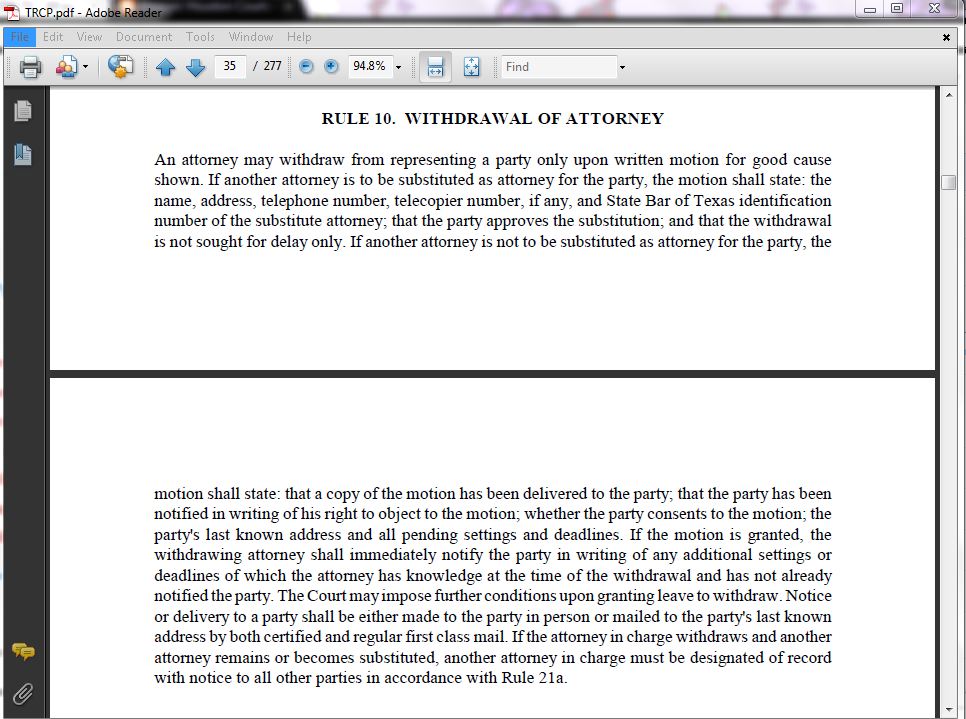
ATTORNEY WITHDRAWAL UNDER TRCP 10 ON THE EVE OF TRIAL  .... Is it a valid ground to postpone (continue) the trial?
Family court judge found to have abused discretion by denying wife's motion for continuance after permitting her trial counsel to withdraw from representing her -- over her objection -- shortly before trial based on nonpayment of an unspecified fee amount. Wife went through a series of lawyers in contested divorce case and ended up pro se, with a list of attorneys who wouldn’t take the case at the last minute.    

EXCERPT FROM SUBSTITUTE OPINION BY JUSTICE BOYCE
  
[names of parties replaced with “WIFE” and “HUSBAND”]
  
Standards Governing Withdrawal and Continuance  

An attorney may withdraw from representing a party only upon written motion for good cause shown. See Tex. R. Civ. P. 10. Texas Rule of Civil Procedure 10, entitled "Withdrawal of Attorney," does not define "good cause." Id. However, the Texas Disciplinary Rules of Professional Conduct articulate considerations relevant to the consideration of Rule 10 motions. See Tex. Disciplinary Rules Prof'l Conduct R. 1.15, reprinted in Tex. Gov't Code Ann., tit. 2, subtit. G, app. A (Vernon 2005); In re A.R., 236 S.W.3d 460, 474 (Tex. App.-Dallas 2007, no pet.) (op. on rehearing); In re Posadas USA, Inc., 100 S.W.3d 254, 257 (Tex. App.-San Antonio 2001, orig. proceeding). Thus, "[b]efore a trial court allows an attorney to withdraw, it should see that the attorney has complied with the Code of Professional Responsibility." Villegas v. Carter, 711 S.W.2d 624, 626 (Tex. 1986).
   
Texas Disciplinary Rule of Professional Conduct 1.15, entitled "Declining or Terminating Representation," provides, among other things, that a lawyer shall not withdraw from representing a client "unless withdrawal can be accomplished without material adverse effect on the interests of the client;" the client "fails substantially to fulfill an obligation to the lawyer regarding the lawyer's services, including an obligation to pay the lawyer's fee as agreed, and has been given reasonable warning that the lawyer will withdraw unless the obligation is fulfilled;" and the representation "will result in an unreasonable financial burden on the lawyer or has been rendered unreasonably difficult by the client." Tex. Disciplinary Rules Prof'l Conduct R. 1.15(b)(1), (5), (6).
  
When the ground for a continuance is the withdrawal of counsel, the movant must show that the failure to be represented at trial was not due to her own fault or negligence. Villegas, 711 S.W.2d at 626. Because the right to counsel is a valuable right, its unwarranted denial is reversible. Id. "[W]hen a trial court allows an attorney to withdraw, it must give the party time to secure new counsel and time for the new counsel to investigate the case and prepare for trial." Id.
  
Relying on Villegas, WIFE argues that the trial court should have (1) denied Nass's motion to withdraw; or (2) granted her motion for continuance after allowing Nass to withdraw. She contends that failure to be represented by counsel at trial was not due to her own fault or negligence.
  
Relying on Texas Disciplinary Rule of Professional Conduct 1.15 and In re Daniels, 138 S.W.3d 31, 33-35 (Tex. App.-San Antonio 2004, orig. proceeding), HUSBAND argues that the trial court acted within its discretion when it granted Nass's motion to withdraw because (1) WIFE failed to pay Nass's fees; (2) continuing "representation through a trial would have been financially burdensome" to Nass; (3) WIFE did not show she had tried to borrow funds to pay Nass; and (4) "[o]ver the course of two full years, from February 11, 2008, to February 10, 2010, neither WIFE nor Nass presented a motion to the trial court seeking the payment of fees beyond the $91,000 Nass had already received."
  
HUSBAND argues that the trial court acted within its discretion in denying a continuance after Nass withdrew as WIFE's counsel because (1) WIFE had 55 days' notice of Nass's motion to withdraw, the trial court granted Nass's motion to withdraw 40 days before trial, and WIFE received her file from Nass after his withdrawal; (2) WIFE never made a motion for interim fees or showed any effort that she attempted to borrow money to pay the fees; (3) the trial court was allowed to consider the history of this case and the fact that WIFE had retained six attorneys, including Nass, and "was not a novice at hiring lawyers;" and (4) WIFE was not deprived of her right to be represented by counsel at trial, but simply failed to secure counsel.
 
III. Application of Standards
 
A. Withdrawal of Representation

  
Nass filed a motion to withdraw as WIFE's counsel on January 26, 2010, asserting that "[g]ood cause exists for withdrawal" because WIFE "represents that she does not have the financial resources to satisfy the contractual obligation to pay the firm." On February 10, 2010, the trial court held a hearing on Nass's motion to withdraw. HUSBAND appeared at this hearing with his counsel, as did amicus attorney Hughes. Nass did not appear at the hearing. Instead, a firm associate, Courtney Hoff, appeared at the hearing to argue Nass's motion.
  
Hoff argued that the Nass firm had not been paid attorney's fees since February 2008, and stated that the firm was not in a position to continue representing WIFE. HUSBAND did not object to Nass's withdrawal, provided that the case proceeded to trial as scheduled on March 22, 2010. Amicus attorney Hughes also did not oppose Nass's motion to withdraw "provided it does not delay the trial setting."
 
WIFE strenuously opposed Nass's motion throughout the hearing. WIFE argued that she and HUSBAND had attempted to reconcile and had agreed that all attorneys would be paid. She stated that HUSBAND paid his attorney and WIFE's attorney from a joint account; according to WIFE, HUSBAND paid Nass about $90,000 for representing WIFE between January 19, 2007, and February 11, 2008. She stated that $5,000 remained to be paid to Nass.
 
WIFE also stated that, when she spoke to Nass in January 2010, he asked her to appear before the trial court and request that fees be awarded so he "would continue" to represent her. WIFE stated that "Nass was supposed to appear" at the withdrawal hearing and question her before the court. WIFE asked the trial court to award her interim fees from a Wells Fargo joint account so she could pay Nass. HUSBAND opposed the request for interim fees at the hearing because no motion for interim fees had been filed before the hearing; he asserted that the parties are "in the middle of trial" and fees "can be handled at the time of trial."
  
Hoff stated that she did not believe HUSBAND had paid the firm $90,000; she recalled that the parties entered into a Rule 11 agreement and believed that HUSBAND had paid the firm approximately $30,000. Relying on a docket sheet entry, the trial court stated that payment of $40,000 was ordered to Nass on February 5, 2008. HUSBAND confirmed that, on or before February 20, 2008, his attorney's fees were paid and WIFE's fees also were paid based on the invoices Nass submitted. HUSBAND stated he had not "heard anything about the fees until now."
  
The trial court asked WIFE if she disputed Nass's contention that she had not followed "the fee agreement or fee contract with Mr. Nass and his firm." WIFE responded that (1) she believed she had "followed" the agreement; (2) Nass "just wants money;" (3) HUSBAND had "total access and control to all our money, and that has kept [WIFE] from gaining counsel in a way that [HUSBAND] is able to;" (4) she had to borrow $40,000 from a friend to pay one attorney and had to borrow money from another friend to pay another attorney; (5) the parties "should have a level field of being able to pay our attorneys so hopefully we can bring finality to his case;" and (6) not having counsel "a month or six weeks before trial would gravely prejudice" her and the parties' children.
  
HUSBAND contended that "there has been a level playing field." He noted that Nass was WIFE's sixth attorney, and asserted that the case could not be resolved if WIFE was allowed to retain "a new lawyer and then that new lawyer obviously needs an opportunity to get brought up to speed." WIFE responded, "[HUSBAND]'s answer, that's what I'm arguing. I'm actually arguing [HUSBAND's] argument, that a new attorney not be placed on this case. Mr. Nass has an overwhelming amount of knowledge; and, again, I believe it's around about $90,000 that he was paid for three weeks . . . And it hasn't been a level playing field because I haven't had the money to hire my — to pay attorneys."
  
Hoff contended that the firm had not received payment from WIFE in two years, and that Nass did not want to withdraw sooner because "the case was put on hold for a period of time" and the firm wanted to give WIFE the "opportunity to figure out if she was going to be able to find the funds for us or if she was going to find another lawyer." Hoff did not know the exact amount WIFE owed the firm, but claimed that WIFE owed more than $5,000. Hoff did not present any unpaid invoices reflecting fees owed to Nass, nor did Hoff indicate what sum, if any, Nass had requested in order to continue representing WIFE in the divorce action.
  
The trial court granted Nass's motion to withdraw and ordered the parties to attend mediation. The trial court signed the order allowing Nass's withdrawal on March 2, 2010; the trial court expressly found that good cause existed for Nass's withdrawal as counsel.

To support his contention that the trial court did not abuse its discretion by granting Nass's motion to withdraw, HUSBAND argues that Disciplinary Rule 1.15 allows an attorney to withdraw for nonpayment of fees "even though the withdrawal may have a material adverse effect upon the interests of the client." However, Rule 1.15 addresses more than the nonpayment of fees; Rule 1.15 also provides that an attorney "shall not withdraw from representing a client unless the client fails substantially to fulfill an obligation" to pay an attorney for services. Tex. Disciplinary Rules Prof'l Conduct R. 1.15(b)(5) (emphasis added).
  
For two reasons, this record raises significant questions about whether WIFE substantially failed to fulfill her obligation to pay Nass.
  
First, it is unclear how much Nass had been paid at the time of the February 10, 2010 hearing. WIFE claimed that HUSBAND had paid Nass approximately $90,000 for services performed between January 19, 2007 and February 8, 2008. Hoff could not state the amount Nass had been paid, but stated that she "believed" HUSBAND's counsel "was saying that they had given my office" about $30,000. The trial court stated, "I see a docket sheet entry from February 5th, '08 ordering that Mr. Nass be paid $40,000 from some specific account." HUSBAND agreed with the trial court at the time and stated that he paid Nass according to the invoices Nass's office submitted. HUSBAND asserts on appeal that Nass already had received $91,000 at the time of the withdrawal hearing.
  
Second, it is unclear how much WIFE still owed to Nass and how much he required to continue participating in the case. WIFE claimed that she owed Nass $5,000. Hoff disputed that amount. When the trial court questioned her regarding the amount Nass was owed, Hoff answered, "I don't have the exact number with me." Hoff did not present any invoices. Hoff did not state how much money, if any, Nass requested for continued representation.
  
Again relying on Disciplinary Rule 1.15, HUSBAND contends that the trial court acted within its discretion by granting Nass's motion to withdraw because continuing the representation through a trial "would have been financially burdensome." Disciplinary Rule 1.15(b)(6) provides that an attorney "shall not withdraw from representing a client unless the representation will result in an unreasonable financial burden" on the attorney. Id. 1.15(b)(6) (emphasis added). Nass did not argue in his motion to withdraw that continuing to represent WIFE would result in an unreasonable financial burden. Nor did Hoff argue that continuing to represent WIFE would result in an unreasonable financial burden.
  
HUSBAND further argues that WIFE "provided absolutely no testimony of any nature indicating efforts she had made to borrow funds to pay Nass the fees he required for continued representation." He emphasizes that WIFE had borrowed money in the past from friends and family to pay attorney's fees. HUSBAND also emphasizes that neither WIFE nor Nass had presented a motion for payment of fees since February 11, 2008.
   
The case was called to trial on February 11, 2008; however, WIFE and HUSBAND almost immediately asked the trial court for a recess to attempt reconciliation. On May 11, 2009, WIFE and HUSBAND agreed to reset trial to March 22, 2010. During this period, the parties technically remained "in trial." The record is unclear as to how long the parties actually attempted to reconcile, whether Nass provided any services between February 2008 and February 2010, and what fees were owed for such services. Hoff argued that the firm had not "received any money from [WIFE] in two years; and since that time the case was put on hold for a period of time, and that's why we didn't withdraw sooner. We were giving her the opportunity to figure out if she was going to be able to find the funds for us or if she was going to find another lawyer."
   
Nass bore the burden to show good cause for withdrawal. See Tex. R. Civ. P. 10. Nothing in the record suggests that WIFE was unwilling to pay attorney's fees or was able to borrow funds for fees but unwilling to do so. WIFE argued that she had no access to funds because HUSBAND "has total access and control to all our money." Although the trial court had awarded interim fees on February 5, 2008, Nass did not file a motion requesting interim fees in connection with the March 2010 trial setting. The record indicates that instead of filing a motion for interim fees, Nass instructed WIFE to ask the trial court to award fees at the February 10, 2010 withdrawal hearing. HUSBAND opposed the request for an award of interim fees at the hearing because no motion for interim fees was before the court; he asserted that the parties are "in the middle of trial" and fees "can be handled at the time of trial."
   
The record does not reveal why no request for interim fees was filed. The trial court did not order interim fees on its own motion. See Tex. Fam. Code Ann. § 6.502(a)(4).
   
The upshot is that Nass was allowed to withdraw after invoking WIFE's lack of "financial resources to satisfy the contractual obligation to pay the firm" 40 days before a recessed trial was scheduled to resume in a highly contentious divorce involving substantial assets and a custody dispute. Neither the amount already paid to Nass nor the amount still owed to Nass ever was clearly established. No motion seeking interim fees was filed before the February 2010 hearing. While we are not prepared to say that allowing Nass to withdraw under these circumstances was an abuse of discretion, we note that allowing withdrawal in this instance approaches the outer limits of discretion.
   
The trial court's exercise of discretion in allowing Nass's withdrawal under these circumstances informs our review of the accompanying decision to deny a continuance following Nass's withdrawal — and, in particular, the analysis of whether WIFE was at fault for the withdrawal of her attorney shortly before the trial was scheduled to resume.
  
B. Continuance   
  
WIFE argues that allowing Nass to "withdraw from representing her 40 days before trial against her wishes, and denying her subsequent motion for continuance" was an abuse of discretion. She contends that the trial court should have granted her motion for continuance because she demonstrated that Nass's withdrawal was not her fault or caused by her negligence.
  
After the trial court granted Nass's motion to withdraw over WIFE's objection on February 10, 2010, WIFE filed a motion for continuance on March 2, 2010. In her motion, she asserted that (1) she is a stay-at-home mom, and that HUSBAND had sole access and control over the couple's financial accounts out of which he paid his own attorney; (2) she "was astonished that Mr. Nash failed to appear at the [withdrawal] hearing after he informed her that he would personally appear so that he could petition the court by questioning [her] for additional fees;" (3) she requested interim attorney's fees at the withdrawal hearing but HUSBAND objected to her request and the trial court did not award her attorney's fees; (4) HUSBAND claimed that she delayed the February 2008 trial date but in fact HUSBAND asked for the trial date to be reset from February 2008 to September 2008 and then to June 2009; (5) she "counseled with several attorneys in an effort to retain representation before the March 22, 2010 trial date" but no attorney was willing to represent her without at least a six-month continuance; (6) good cause existed for a continuance because the absence of her attorney was not caused by WIFE or by her negligence; and (7) forcing her to represent herself at trial would impede her right to a fair trial.
   
In her motion for continuance, WIFE also recounted the list of attorneys who had represented her since HUSBAND filed for divorce. WIFE was represented by (1) Robert Piro from January 2006 to November 2006 for the purpose of obtaining a protective order; (2) Bobby Newman from November 2006 to March 2007; (3) Joan Jenkins from March 2007 to September 2007; (4) Michael Phillips from October 2007 to December 2007; (5) Bucky Allshouse from December 2007 to January 2008; and (6) Joel Nass from January 18, 2008, until the trial court granted Nass's motion to withdraw on February 10, 2010, and signed its order on March 2, 2010.
  
WIFE filed her first amended motion for continuance on March 8, 2010. In addition to asserting her previously asserted grounds for a continuance, WIFE argued that she had a right to be represented by qualified counsel and that she was not qualified to represent herself because she never practiced family law and "never participated in a trial as a lawyer." The trial court held a hearing on WIFE's motion for continuance on March 9, 2010. During the hearing, WIFE asked the trial court to grant her motion because she "fervently" had objected to Nass's withdrawal and had asked the trial court to award interim fees to pay Nass so he could remain her counsel and the case could proceed with trial as set. WIFE stated she had been unable to find another attorney to represent her on the eve of trial because the attorneys she contacted were afraid to "place themselves in a malpractice liability position" by taking her case.
  
HUSBAND opposed WIFE's motion for continuance, arguing that (1) it was not his fault that WIFE "has been through six lawyers;" (2) he and his counsel as well as amicus attorney Hughes had cleared their schedules to proceed with trial as scheduled; and (3) his witnesses and experts were ready to appear. Amicus attorney Hughes also opposed WIFE's continuance motion, arguing that the parties and the children needed finality. The trial court denied WIFE's motion for continuance and ordered the parties to attend mediation before the scheduled trial.
  
WIFE points to Villegas in arguing that she was entitled to a continuance to secure new counsel after the trial court allowed Nass to withdraw over objection shortly before trial because she was not at fault for causing Nass's withdrawal. See Villegas, 711 S.W.2d at 626. In that case, Villegas was represented by two attorneys; one attorney withdrew 22 days before trial and the second attorney was allowed to withdraw two days before trial. Id. at 625. Villegas asked for a continuance so he could retain a new attorney to represent him at trial, but the trial court refused Villegas's request for a continuance. Id. at 625-26. The supreme court held that "the trial court abused its discretion because the evidence shows Villegas was not negligent or at fault in causing his attorney's withdrawal" and too little time remained for Villegas to "find a new attorney and for that new attorney to investigate the case and prepare for trial." Id. Concluding that "the trial court should either have denied the attorney's motion to withdraw or granted the party's motion for continuance," the supreme court reversed and remanded for a new trial. Id.
   
HUSBAND emphasizes that trial counsel in Villegas withdrew two days before trial and refused to turn over the client's case file. According to HUSBAND, the "circumstances are not comparable to WIFE's case" because WIFE had 55 days' notice of Nass's motion to withdraw; the motion was granted 40 days before trial; WIFE received her file from Nass after his withdrawal; WIFE never made a motion for interim fees; and WIFE showed no efforts to borrow money from friends to pay her fees as she had done in the past. HUSBAND supports his argument by citing State v. Crank, 666 S.W.2d 91, 95 (Tex. 1984), Gillie v. Boulas, 65 S.W.3d 219, 223 (Tex. App.-Dallas 2001, pet. denied), and Van Sickle v. Stroud, 467 S.W.2d 509, 511 (Tex. Civ. App.-Fort Worth 1971, no writ).
  
Crank does not support HUSBAND's argument. The supreme court held that the trial court acted within its discretion when it denied Crank's motion for continuance after he "voluntarily discharged his attorney and reaffirmed the discharge after his requested continuance was denied." Crank, 666 S.W.2d at 94-95. The supreme court noted that counsel had not withdrawn voluntarily due to an emergency; rather, Crank knew of the scheduled hearing but waited until the morning of the hearing to discharge his attorney and ask for a continuance. Id. at 94. Here, in contrast, WIFE did not discharge Nass; she strenuously opposed Nass's withdrawal and filed a motion for continuance after trying without success to retain another attorney.
  
Relying on Gillie, HUSBAND argues that "WIFE was not deprived of her right to be represented by counsel at trial; rather WIFE failed to secure counsel." He misplaces his reliance on this case. In Gillie, the court of appeals held that the trial court did not abuse its discretion by denying Gillie's motion for continuance after allowing his counsel to withdraw because the "trial court allowed almost four months for Gillie to obtain new counsel and for the new counsel to investigate the case and prepare for trial." 65 S.W.3d at 222. Here, in contrast, the trial court did not allow WIFE four months to secure new counsel after allowing Nass to withdraw; WIFE had 40 days to secure new counsel.
  
Van Sickle does not support HUSBAND's contention that the trial court acted within its discretion by denying WIFE's motion for continuance "even assuming WIFE's claim of lack of fault." Van Sickle's trial counsel withdrew ten days before the case was called for trial. 467 S.W.2d 509, 511. Van Sickle failed to appear at trial. Id. Van Sickle later retained new counsel who filed a motion for new trial but never complained of the absence of counsel at trial. Id. The court noted that Van Sickle had been represented by four sets of attorneys and concluded he knew how to obtain counsel; yet, Van Sickle presented no evidence about why he "failed to make arrangements for counsel" once his trial counsel was allowed to withdraw. Id. The court concluded that, in the absence of evidence showing that Van Sickle was not at fault for his trial counsel's withdrawal and was diligent in finding new counsel, the trial court acted within its discretion in denying Van Sickle's motion for continuance. Id. Here, in contrast, WIFE unsuccessfully attempted to retain new counsel; none of the multiple attorneys she contacted would agree to represent her.
  
Nothing in the record suggests that WIFE was able to pay Nass's fees but refused to do so. Nothing in the record suggests that she was able to borrow money to pay Nass's fees but refrained from doing so. In assessing WIFE's level of fault, we note that a mechanism was available to allow Nass to seek attorney's fees and address the circumstances he invoked to justify his withdrawal. This mechanism was not used. The record contains no indication that this mechanism could not have been utilized and no explanation as to why this mechanism was unavailable. Nass filed a motion to withdraw claiming nonpayment of fees shortly before trial was scheduled and — according to WIFE — instructed WIFE to ask for fees at the withdrawal hearing. Nass did not appear at the withdrawal hearing.
   
The record does not reveal why a motion for interim fees was not filed in connection with the March 2010 trial setting even though the trial court had awarded interim fees in February 2008. See Tex. Fam. Code Ann. § 6.502(a)(4). When WIFE asked for an award of interim fees during the February 10, 2010, hearing, HUSBAND objected on grounds that no motion requesting such fees had been filed. This objection prompted the trial court to state: "Well, I can't consider a Motion for Fees at this time."
    
If fault is to be assigned for the failure to seek interim fees under these circumstances, we do not believe that such fault properly can be assigned to the client. We are not persuaded that WIFE was at fault because she failed to file a written motion for interim fees before the February 10, 2010, withdrawal hearing.[1] WIFE was represented by counsel before the hearing. WIFE stated that she followed Nass's instructions and asked the trial court for interim fees at the withdrawal hearing. She stated that she was "astonished that Mr. Nass failed to appear at the [withdrawal] hearing after he informed her that he would personally appear so that he could petition the court" for additional fees by questioning WIFE. These statements are uncontroverted on this record. Because nonpayment of fees was the stated reason for Nass's withdrawal on the eve of trial and because there is no contention that interim fees were unavailable, the absence of a motion for interim fees indicates that reasonable steps to avoid prejudice to WIFE were not taken. See Villegas, 711 S.W.2d at 626.
   
We are not persuaded by an argument that WIFE had more notice of her attorney's intent to withdraw and more time to find new counsel than Villegas did. Villegas requires that a party be given "time to secure new counsel and time for the new counsel to investigate the case and prepare for trial." Villegas, 711 S.W.2d at 626. Arguably, the circumstances here were even more prejudicial than the circumstances in Villegas; if the parties really were "in trial" during the February 10, 2010, hearing, then Nass was allowed to withdraw in the middle of trial. In any event, the timing causes concern even if March 22, 2010, is the operative date.
  
Forty days is a substantially shorter period than the almost four months allowed the client in Gillie to find a new attorney. See Gillie, 65 S.W.3d at 222. Unlike the client in Crank, 666 S.W.2d at 94-95, WIFE did not fire her attorney. Unlike the client in Van Sickle, 467 S.W.2d at 511, WIFE detailed her unsuccessful efforts to find a new attorney. Being mindful of the Texas Supreme Court's observation that "Villegas' attorney did not take reasonable steps to avoid foreseeable prejudice to the client" when he withdrew, we conclude that the holding in Villegas applies with equal force here: "The trial court should either have denied the attorney's motion to withdraw or granted the party's motion for continuance; it did neither." Villegas, 711 S.W.2d at 627.
  
HUSBAND also argues that the trial court was allowed to consider the history of this case and the fact that WIFE had retained six attorneys, including Nass. During the February 10, 2010, hearing, HUSBAND argued that an attorney substitution occurs "every time we get down here and get ready for trial."
   
Serial hiring and firing of attorneys for dilatory purposes would be a legitimate concern to be balanced against a requested continuance in appropriate circumstances. However, this record reveals no evidence that the case was delayed because WIFE had hired five attorneys before Nass. Nothing in the record establishes that a continuance was granted or requested in connection with the withdrawal of any of her prior attorneys. The record does not reflect that WIFE used the withdrawal of her attorneys as a dilatory tactic. The primary source of delay in this case appears to be an attempted reconciliation. WIFE's history of prior representation by other attorneys indicates that she could find attorneys to represent her under the circumstances in which they were retained; this history says nothing about her ability to retain a new attorney on the eve of trial after the withdrawal of her attorney based on the asserted nonpayment of fees.
   
Conclusion  
   
Based on the record before us, we conclude that the trial court abused its discretion by denying WIFE's motion for continuance after allowing her trial counsel to withdraw over her objection shortly before trial based on nonpayment of an unspecified fee amount. Following Villegas, 711 S.W.2d at 627, we sustain WIFE's first issue. We affirm the trial court's divorce decree in so far as it grants the divorce, but we reverse the remainder of the trial court's divorce decree and remand for a new trial.[2]
   
[1] WIFE filed a written motion for interim fees on March 12, 2010, asking the trial court to award her interim fees because she is not "in control of sufficient community assets to pay attorney's fees and anticipated expenses." The trial court declined to consider the motion.
[2] In light of our disposition of WIFE's first issue, we need not address WIFE's remaining issues.

Sunday, February 28, 2010

Property division in divorce from foreign tag-along spouse affirmed


WHEN GENDER ROLES ARE REVERSED: CAREER WIFE VS. HOUSE-HUSBAND


Female petroleum engineer's appeal of property division in divorce from nonworking spouse fails. Trial court considered evidence that husband had made career sacrifice for the marriage and followed wife on work assignments to several foreign countries on a spouse visa. Wife also failed to rebut community property presumption and trace separate-property funds to support reimbursement claim against the marital (community-property) estate.

MEMORANDUM OPINION BY JUSTICE JEFF BROWN

Appellant Tammy C. Jensen appeals the property division in a divorce case. Tammy contends that the evidence does not support several of the trial court’s findings of fact and that these findings resulted in a manifestly unjust and unfair property division. She also contends that the trial court abused its discretion by awarding Barry Jensen one-half of the shares of stock from one of her accounts while allocating all of the associated debt to her and by denying her claim for reimbursement of her separate funds used for the down payment on their residence. We affirm.

I

Tammy and Barry met in July 2001 and were married on July 19, 2003. Their only child was born on July 7, 2004. The Jensens separated in May 2007, and were granted a divorce on November 20, 2007.

Tammy and Barry are both Canadian citizens. When the couple met, Tammy had a degree in petroleum engineering and had been working for Schlumberger for three years. Barry had been working as a credit analyst with DaimlerChrysler Financial in Canada for twelve years. Barry resigned his position before he married Tammy, and after they were married, they moved to Brazil, where Tammy was working. Tammy’s job required that she travel frequently. During their marriage, the couple lived in four different countries—Brazil, Trinidad and Tobago, France, and the United States. In 2006, Tammy accepted a job offer with Hess Corporation in Houston and the couple purchased a home in Fort Bend County. Throughout the marriage, Tammy worked continuously, except during her maternity leave, but Barry remained unemployed.

In May 2007, Barry left Tammy and their child and went to Canada. Shortly after that, he returned to Fort Bend County and petitioned for divorce. Tammy filed a counter-petition. Issues concerning the child and the property division were tried in a four-day bench trial. On February 28, 2008, the trial court signed the final decree of divorce. The trial court also made findings of fact and conclusions of law. The trial judge signed an amended final decree of divorce on September 9, 2008. On appeal, Tammy challenges only the property division.

II

Tammy raises four issues: (1) the evidence does not support the trial court’s findings of fact 12.a, d, f, and i concerning Barry’s employment decisions and employment opportunities; (2) the trial court’s erroneous and unsupported findings resulted in a manifestly unjust and unfair division of property; (3) the trial court erred in awarding Barry one-half of her shares of stock from her Mellon One account while allocating one-hundred percent of the debt encumbering the account to her; and (4) the trial court erred in evaluating her claim for reimbursement of $60,000 that she paid from separate funds for their residence. We will address the first three issues together, as Tammy does, and separately address her fourth issue concerning reimbursement.

III

A

The Texas Family Code requires that the trial court “shall order a division of the estate of the parties in a manner that the court deems just and right, having due regard for the rights of each party and any children of the marriage.” Tex. Fam. Code Ann. § 7.001 (Vernon 2006). The trial court has broad discretion when dividing the marital estate. Jacobs v. Jacobs, 687 S.W.2d 731, 733 (Tex. 1985). We presume that the trial court did not abuse its discretion in dividing the estate, and we will not disturb the division on appeal unless appellant demonstrates a clear abuse of discretion. Murff v. Murff, 615 S.W.2d 696, 698 (Tex. 1981). The trial court’s ultimate division need not be equal, so long as it is equitable and so long as the court has some reasonable basis for an unequal division. Zieba v. Martin, 928 S.W.2d 782, 790 (Tex. App.—Houston [14th Dist.] 1996, no writ) (op. on reh’g).

A trial court abuses its discretion when it acts arbitrarily or unreasonably, and without reference to any guiding rules or principles. Worford v. Stamper, 801 S.W.2d 108, 109 (Tex. 1990). A trial court does not abuse its discretion when it bases its decision on conflicting evidence, nor does a trial court abuse its discretion when it bases its decision on some evidence of a substantial and probative character. Zieba, 928 S.W.2d at 787. Under this abuse-of-discretion standard, the legal and factual sufficiency of the evidence are not independent grounds of error but are merely relevant factors in assessing whether the trial court abused its discretion. Id. at 786–87. The trial court’s judgment should be reversed on appeal when the trial court’s abuse of discretion results in a division of property so disproportionate that it is manifestly unjust and unfair. See Hedtke v. Hedtke, 112 Tex. 404, 411, 248 S.W. 21, 23 (1923).

B

In her first three issues, Tammy challenges the sufficiency of the evidence supporting the trial court’s findings of fact 12.a, d, f, and i, and contends that these findings resulted in a manifestly unjust and unfair division of property. In reviewing a trial court’s findings of fact, we apply the same standards that we apply in reviewing jury findings. Ulmer v. Ulmer, 130 S.W.3d 294, 299 (Tex. App.—Houston [14th Dist.] 2004, no pet.).

First, Tammy challenges finding of fact 12.a, contending that the evidence does not support a finding that “Barry Jensen would be unable to continue his education in Canada” and noting that “[t]he proposition that there are numerous educational institutions in Canada is self-evident and can be made no plainer by repetitions or illustrations.” But Tammy’s contention does not accurately reflect finding 12.a. Instead, the trial court found that Barry “would have benefited from the continuation of the marriage as he had enrolled in college to continue his education and he was attempting to gain the skills necessary to change his career to allow for his possible future employment in the same industry and future pay scale as [Tammy].” The court also found that “[w]hen the parties separated, [Barry] had to drop out of the program in the Houston area and return to Canada as he did not have a legal right to remain in the United States once divorced because he was in the Unites States under [Tammy’s] immigration status as a dependent.” It is evident that in its finding, the trial court was referring to the divorce-related interruption in Barry’s education in Houston, and did not state or imply that Barry would be unable to continue his education in Canada. Further, the finding is supported by Barry’s testimony that, before the divorce, he had registered to attend Houston Community College for the 2007 fall semester to advance his education and job skills, but has since withdrawn.

Tammy also complains of the portion of finding 12.a that Barry did not have the legal right to remain in the Unites States after the divorce because he testified that he could legally move to Houston “for six months, then you have to return to Canada for a day and then come back for another six months.” Reviewed in context, however, Barry’s testimony merely reflects that he was explaining a way in which he could change his status. Further, it was undisputed that he was allowed in the various countries where he and Tammy lived based on a spousal visa, rather than his own visa. Therefore, the evidence is sufficient to support the trial court’s finding of fact 12.a.

Tammy next contends that finding of fact 12.d—that Barry’s unemployment during the marriage was due to the number of moves to foreign countries—is not supported by the evidence. The parties presented conflicting testimony on the reasons for Barry’s unemployment. Tammy testified that her employer, Schlumberger, provided job search assistance, but to her knowledge, Barry never submitted a resume to Schlumberger. Tammy also testified that there were jobs available, included a listing with Barry’s former employer DaimlerChrysler, but he refused to talk to DaimlerChrysler. She also testified that most spouses of Schlumberger employees that she knew in Brazil worked. When she went to work for Hess, Tammy testified, Hess provided Barry with job counseling and other resources but he did not take advantage of them. In contrast, Barry testified that he registered with the Schlumberger-related job listing service, but there were no suitable jobs listed in Brazil. He did not know of any spouses in Brazil who had obtained jobs through the service. Barry testified that, while in Brazil, he networked with potential employers and others and enrolled in a Portuguese-language course to improve his skills. He also testified to various efforts he made to find employment while the couple lived in Trinidad and Tobago, and he testified that after he and Tammy moved to Fort Bend County, he made efforts to find employment, including speaking with an immigration lawyer and applying for a position with Amerada Hess. Barry testified that he and Tammy had lived in four different countries in their four-year marriage. Further, Barry testified that he did not have a work visa and was not allowed to work in those countries with only a spousal visa. The credibility of witnesses in a divorce action, including the husband and wife, is solely under the purview of the trial court, not an appellate court. Zagorski v. Zagorski, 116 S.W.3d 309, 318 (Tex. App.—Houston [14th Dist.] 2003, pet. denied) (op. on reh’g). Here, the trial court resolved the disputed evidence in Barry’s favor. Based on our review of record, the evidence is sufficient to support finding of fact 12.d.

Tammy next contends that finding 12.f is against the great weight of the credible evidence. Finding 12.f reflects the following: “Prior to the marriage [Barry] was employed in the finance industry and earning approximately $90,000.00 plus benefits annually, but left his employment to support the development and advancement of [Tammy’s] career.” Tammy complains that the evidence, viewed as a whole, instead “paints the picture of a man who simply showed no interest in working and was perfectly content to live off the earnings of his wife.” She specifically points to her testimony that, in Brazil, Barry was not interested in working for his former employer, DaimlerChrysler, or anyone else, and her testimony that, even before the marriage, Barry took an extended leave of absence to live with Tammy in Indonesia at a place paid for by her employer.

It is undisputed that Barry worked as a credit analyst for DaimlerChrysler for twelve years before the marriage. He testified that that he gave up his career for marriage because Tammy had been offered the position in Brazil and they agreed that she should take the position to advance her career. Barry also testified that after he took the leave of absence to live with Tammy in Indonesia, he returned to his work in Canada in December 2002, and did not leave his job until July 17, 2003, two days before they married. And, as discussed above, Barry testified concerning his ultimately unsuccessful efforts to obtain employment in the places he and Tammy lived. Thus, although the parties disputed whether Barry intended to work during the marriage and the details of Barry’s employment history shortly before the marriage, the trial court, as the fact finder, had the opportunity to observe the witnesses and determine their credibility and the weight of the evidence. See id. at 318. The evidence shows that the couple agreed that they would follow Tammy’s job opportunity in Brazil to advance her career, and the trial court reasonably could have found that that this choice eventually compromised Barry’s own career path. Therefore, finding of fact 12.f is supported by sufficient evidence.

Next, Tammy contends that finding 12.i—that Tammy has greater earning power and potential than Barry does—is “unsupported by the evidence.” Tammy points to that portion of finding 12.f in which the trial court found that Barry was earning $90,000.00 plus benefits annually, and posits that this is evidence that “if [Barry] wants to work and apply himself, he is certainly capable of earning just as much as is his former wife.” But this analysis fails to take into account all of the relevant facts, including the evidence that Barry left his career when he married Tammy, he gained no career experience during the four-year marriage, and he lacked a college degree. In contrast, Tammy had a bachelor’s degree in engineering and was continuously employed as a petroleum engineer with oil companies before and during the marriage. This evidence is sufficient to support the trial court’s finding.

Based on the premise that the evidence was insufficient to support the trial court’s findings of fact 12.a, d, f, and i, Tammy further contends that the trial court’s property division was manifestly unjust and unfair. To illustrate the allegedly unjust and unfair division, Tammy argues that the trial court unfairly awarded Barry fifty percent of the shares in her Mellon One account, but allocated one-hundred percent of the debt encumbering the stock to Tammy. But we have determined that the trial court’s findings were supported by legally and factually sufficient evidence; therefore, the premise upon which Tammy’s argument is based must fail. Moreover, although the trial court divided the account’s 745 community shares roughly equally between the parties, with Barry receiving 373 of these shares, Tammy fails to mention that the court awarded her 1,015 of the shares in the account as her separate property as well as the debt. Barry was not awarded any ownership in, or future benefits from, Tammy’s separate property shares. Also, the trial court had before it testimony and documentary evidence concerning any related debt. A trial court’s division of property “must take into consideration all the equities, the nature of the property, [and] the debts secured by liens on the property awarded to each.” Walker v. Walker, 527 S.W.2d 200, 203 (Tex. Civ. App.—Fort Worth 1975, no writ). On this record, therefore, we cannot say that the trial court erred in awarding the debt to Tammy.

The trial court is authorized to consider many factors, including the disparity of the parties’ incomes and their earning capacities throughout the marriage, when dividing the parties’ estate. See Murff, 615 S.W.2d at 698–99. Tammy has not demonstrated that the trial court’s evaluation of the evidence resulted in an abuse of discretion as required to overturn its property division. See id. Accordingly, we overrule Tammy’s first three issues.

IV

In her fourth issue, Tammy contends that the trial court erred in evaluating her claim for reimbursement of $60,000.00 that she paid from separate funds for the community residence. Therefore, she argues, the trial court’s conclusion of law 18, that Tammy “failed to offer evidence sufficient to support her claims for reimbursement,” is contrary to the evidence and an abuse of discretion. We review the trial court’s conclusions of law de novo. Stavinoha v. Stavinoha, 126 S.W.3d 604, 608 (Tex. App.—Houston [14th Dist.] 2004, no pet.).

A

The Texas Family Code defines separate property as that property owned by a spouse before marriage, acquired during the marriage by gift, devise, or descent, or as a recovery for personal injuries sustained during the marriage. Tex. Fam. Code Ann. § 3.001 (Vernon 2006). In contrast, community property consists of the property, other than separate property, acquired by either spouse during marriage. Tex. Fam. Code Ann. § 3.002 (Vernon 2006). All property possessed by either spouse during or on dissolution of marriage is presumed to be community property. Tex. Fam. Code Ann. § 3.003(a) (Vernon 2006).

To overcome the community-property presumption, a spouse claiming assets as separate property is required to establish their separate character, not merely by a preponderance of the evidence, but by clear and convincing evidence. Tex. Fam. Code Ann. § 3.003(b); Stavinoha, 126 S.W.3d at 607. Clear and convincing evidence means the measure or degree of proof that will produce in the mind of the trier of fact a firm belief or conviction as to the truth of the allegations sought to be established. Stavinoha, 126 S.W.3d at 607.

The party seeking to rebut the community presumption must generally trace and clearly identify property claimed as separate property. McKinley v. McKinley, 496 S.W.2d 540, 543 (Tex. 1973). Mere testimony that the property was purchased with separate funds, without any tracing of the funds, is generally insufficient to rebut the presumption. McElwee v. McElwee, 911 S.W.2d 182, 188 (Tex. App.—Houston [1st Dist.] 1995, writ denied).

Reimbursement is an equitable right that arises when the funds or assets of one estate are used to benefit and enhance another estate without itself receiving some benefit. Vallone v. Vallone, 644 S.W.2d 455, 458–59 (Tex. 1982). The party claiming the right of reimbursement has the burden of pleading and proving that the expenditures were made and that they are reimbursable. Id. at 459. Reimbursement is not available as a matter of law but lies within the discretion of the court. Id. The discretion to be exercised in evaluating a claim for reimbursement is equally as broad as the discretion exercised in making a just and right division of the community estate. Zieba, 928 S.W.2d at 787.

B

Tammy argues that the trial court erred in evaluating her claim for reimbursement of $60,000 she borrowed from her parents to make a down payment on the couple’s home, on the basis that she repaid the loan from her separate property. Tammy contends that she repaid the loan from the parties’ joint Wells Fargo account, into which she had transferred $36,706.52 from her Hansard International account and $102,662.93 from her Schlumberger account. She further contends that the Hansard account was an investment account opened before the marriage. She acknowledges that some of the Schlumberger account contained funds that accumulated during the marriage, but states that “the overwhelming majority . . . was [acquired] prior to the marriage and [is] separate property.” Tammy also points to Barry’s admissions that the Hansard account was an investment account she had before they married and that she took $36,000 out of that account and put it in the joint account to pay back the loan.

Tammy’s Schlumberger separation package consisted of pension-plan contributions, medical, savings, insurance, and stock options, which accrued before and during the marriage, and were paid out in a lump sum when she ceased working for the company. But, significantly, Tammy points to no evidence that shows what portion of the Schlumberger deposit was her separate property and what portion was earned by the community.[1] Tammy then deposited the money from both the Schlumberger and the Hansard accounts into the couple’s Wells Fargo joint checking account, further commingling them. Tammy testified that this joint account was used for community expenses as well as to pay back the loan. Tammy and Barry disputed whether separate or community money was used to pay for certain purchases and expenses.

Concerning the Hansard account, Tammy testified that this was an investment fund account that required a deposit of $1,000.00 per month for five years. She opened the account in November 2001, before the marriage. Tammy testified that the Hansard account totaled $56,000.00, $20,000.00 of which she accumulated before the marriage. Over time, all of the money was transferred to the Wells Fargo joint account. Tammy testified that “[w]e withdrew $39,000 and 3,000 of that was my separate property money that we withdrew.” Tammy thus appears to concede that $36,000 of the money from the Hansard account was community property. The Wells Fargo statement shows a deposit was made in July 2006 of $36,706.52 from Hansard into the couple’s joint account. This is the same $36,000 Barry was questioned about on cross-examination.

Thus, the evidence concerning the separate character of the funds removed from the couple’s joint account to repay the loan for the down payment on their home was not clearly demonstrated. To the extent that Schlumberger account funds may have been used to repay the loan, Tammy produced no evidence to segregate what portion of those funds belonged to her separate estate as opposed to the community estate. Tammy also conceded that at least $36,000 of the money in her Hansard account was community money. Further, the funds Tammy contends were used to repay the loan were first deposited into the parties’ joint checking account, further commingling them, and Tammy did not sufficiently trace them. See McKinley, 496 S.W.2d at 543–44. Because Tammy failed to demonstrate by clear and convincing evidence that she repaid the loan for the down payment on the parties’ home with her separate funds, the trial court did not abuse its discretion in concluding that she failed to offer sufficient evidence to support her claim for reimbursement. We overrule Tammy’s fourth issue.

* * *

The trial court’s judgment is affirmed.

Jensen v. Jensen (Tex.App.- Houston [14th Dist.] Feb. 23, 2010)(Brown) (divorce property division, foreign spouse, international aspects of family/divorce law)(divorce property division affirmed) (community vs. separate property, reimbursement claim)
AFFIRMED: Opinion by Justice Jeff Brown
Before Justices Brock Yates, Frost and Brown
14-08-00221-CV Tammy C. Jensen v. Barry Dale Jensen
Appeal from 328th District Court of Fort Bend County
Trial Court Judge: Ronald R. Pope


TAGS: marriage and divorce, property division, sex roles, gender roles, gender-neutrality, international marriage, foreign spouses, marital estates, community property, separate property, community property presumption, disparity in earnings potential, discrepancy in income

No community property - Nothing for the divorce court to divide


In this divorce action, appellant [husband] challenges the trial court’s failure to award him certain property he owned prior to the marriage. The court affirms.


FROM THE OPINION

Appellee testified that the parties owned no community property and that any property they owned was acquired before the marriage. She testified that she delivered some of appellant’s clothes, paperwork, court files, and “other collectible stuff” to a relative’s house and placed the remainder in a storage facility. Appellee failed to pay the fees for the storage facility and forfeited the property as a result of the failure to pay.

The trial court entered a divorce decree in which it determined that no children were born of the marriage and there was no community property to divide between the parties. Appellant filed an appeal in which he maintains that appellee failed to prove that the items were forfeited from the storage unit.

Standard of Review

In a divorce decree, the trial court shall order a division of the estate of the parties in a manner that the court deems just and right, having due regard for the rights of each party and any children of the marriage. Tex. Fam. Code Ann. § 7.001 (Vernon 2006). The phrase “estate of the parties” means the parties’ community property. Wilson v. Wilson, 44 S.W.3d 597, 600 (Tex. App.—Fort Worth 2001, no pet.) (citing Cameron v. Cameron, 641 S.W.2d 210, 214–15 (Tex. 1982). The trial court has broad discretion in dividing the community estate of the parties, and we will not disturb its decision unless the trial court has clearly abused its discretion. Smith v. Smith, 22 S.W.3d 140, 143 (Tex. App.—Houston [14th Dist.] 2000, no pet.).


Property Division

Here, appellant and appellee did not acquire any community assets. The trial court found that there was no “estate of the parties” to be divided, and appellant does not challenge that finding. Appellant’s complaint centers around the fact that appellee forfeited his separate property that was in the storage facility. Appellee testified under oath that she gave some of appellant’s possessions to his relative and that she forfeited some of them when she failed to pay the fee for the storage facility. Neither appellant, nor his mother, presented any evidence to contradict appellee’s testimony. In granting the divorce and finding that no community property existed, the trial court did not abuse its discretion.

The judgment of the trial court is affirmed.

Baros v. Baros (Tex.App. - Houston [14th Dist.] Feb. 25, 2010)(per curiam)
(
divorce property dispute)(no community property accumulated during short marriage)
AFFIRMED: Per Curiam
Before Justices Brock Yates, Seymore and Brown
14-09-00038-CV Waymond Troy Baros v. Melissa Baros
Appeal from County Court at Law No 1 of Montgomery County

Sunday, November 1, 2009

Voluntary Support Payments to Ex-Wife Treated as Fraud on Subsequent Common-Law Wife


It's been said "No good deed will go unpunished."

Ex-husband continued to support ex-wife so she could finish school. In her own divorce, subsequent common-law wife succeeds (on appeal) in claiming that the payments to ex no. 1 amount to fraud on the community estate. Husband had not agreed to make the monthly payments to the first ex-wife as part of the divorce settlement and was thus under no legal obligation to do so.

The lesson: He should have spent the money on himself!


FROM THE OPINION BY CHIEF JUSTICE ADELE HEDGES:

Payments to Ex-Wife

Monica asserts that the trial court erred in failing to reimburse the community estate for the community funds Bobby used to pay his ex-wife.

A fiduciary duty exists between a husband and a wife as to the community property controlled by each spouse. Zieba, 928 S.W.2d at 789. The breach of a legal or equitable duty which violates this fiduciary relationship existing between spouses is referred to as "fraud on the community," a judicially created concept based on the theory of constructive fraud. Id.

Any such conduct in the marital relationship is termed fraud on the community because, although not actually fraudulent, it has all the consequences and legal effects of actual fraud because such conduct tends to deceive the other spouse or violate confidences that exist as a result of the marriage. Id.

A presumption of constructive fraud arises where one spouse disposes of the other spouse's one-half interest in community property without the other's knowledge or consent. Id.; Jackson v. Smith, 703 S.W.2d 791, 795 (Tex. App.-Dallas 1985, no writ). In that circumstance, the burden of proof to show fairness in disposing of community assets is upon the disposing spouse. See Zieba, 928 S.W.2d at 789; Morrison v. Morrison, 713 S.W.2d 377, 379 (Tex. App.-Dallas 1986, writ dism'd).

In considering a claim of constructive fraud, the court may consider three factors: (1) the size of the gift in relation to the total size of the community estate; (2) the adequacy of the remaining estate; and (3) the relationship of the donor to the donee. Zieba, 928 S.W.2d at 789.

Monica testified that, in May 1996, she discovered that Bobby had been paying his ex-wife $500 a month for approximately eighteen months. She further testified that Bobby's checkbook reflected that he had made the last payment in July 1995. Bobby testified that Monica knew about the payments to his ex-wife when they first began dating, but admitted later telling her that he had stopped the payments. He further admitted that he paid his ex-wife longer than required to do so by the court so that he could help her finish college and obtain a degree. There is no mention of these payments in the final decree or in the court's findings of fact and conclusions of law.

The trial court found that the parties had entered into an informal marriage on July 10, 1994. Monica presented uncontroverted evidence that Bobby paid his ex-wife $500 a month until July 1995. There is no evidence to suggest, nor does Bobby contend, that he used separate property funds to pay his ex-wife and, thus, we presume that community funds were used. See Smith v. Smith, 22 S.W.3d 140, 144 (Tex. App.- Houston [14th Dist.] 2000, no pet.) (noting that to overcome community property presumption, spouse claiming certain property as separate property must trace and clearly identify property claimed to be separate). Although Bobby testified that Monica knew about the payments when they first started dating, there is no evidence that Monica consented to the payments after they became common law married. See
Zieba, 928 S.W.2d at 790 (finding trial court abused its discretion in refusing to reimburse community for husband's $100,000 cash withdrawal from bank account where there was no evidence wife consented to withdrawal although wife testified she knew about withdrawal and did not question husband about it). Moreover, Bobby admitted having deceived Monica about the payments and testified that he continued to pay his ex-wife longer than ordered to do so by the court. Cf. Zieba, 928 S.W.2d at 790 (finding no fault with trial court's refusal to reimburse community for funds spent by husband on obligations arising from prior marriage because obligations were imposed on husband by court order).

When asked why he continued to pay his ex-wife during his marriage to Monica, Bobby testified that his ex-wife was not receiving help from anyone else and he wanted to help her obtain her degree.

We conclude that the trial court should have reimbursed the community for the payments to Bobby's ex-wife made between July 1994 and July 1995, and awarded Monica's community assets one-half of the value.

Its refusal to do so was an abuse of discretion. See id.[9]

Knight v. Knight (Tex.App.- Houston [14th Dist.] Oct. 29, 2009)(Hedges)
(
divorce property division, reimbursement claim, preservation of error for appellate review)
AFFIRMED IN PART; REVERSED & REMANDED IN PART: Opinion by
Chief Justice Hedges
Before Chief Justice Hedges, Justices Brock Yates and Frost
14-08-00424-CV Monica Faye Knight v. Bobby Wayne Knight
Appeal from 246th District Court of Harris County
Trial Court
Judge: Jim York