Showing posts with label motion for continuance. Show all posts

Tuesday, May 1, 2012

When the divorce attorney gets off the case just in time for trial...


ATTORNEY WITHDRAWAL UNDER TRCP 10 ON THE EVE OF TRIAL  .... Is it a valid ground to postpone (continue) the trial?
Family court judge found to have abused discretion by denying wife's motion for continuance after permitting her trial counsel to withdraw from representing her -- over her objection -- shortly before trial based on nonpayment of an unspecified fee amount. Wife went through a series of lawyers in contested divorce case and ended up pro se, with a list of attorneys who wouldn’t take the case at the last minute.    

EXCERPT FROM SUBSTITUTE OPINION BY JUSTICE BOYCE
  
[names of parties replaced with “WIFE” and “HUSBAND”]
  
Standards Governing Withdrawal and Continuance  

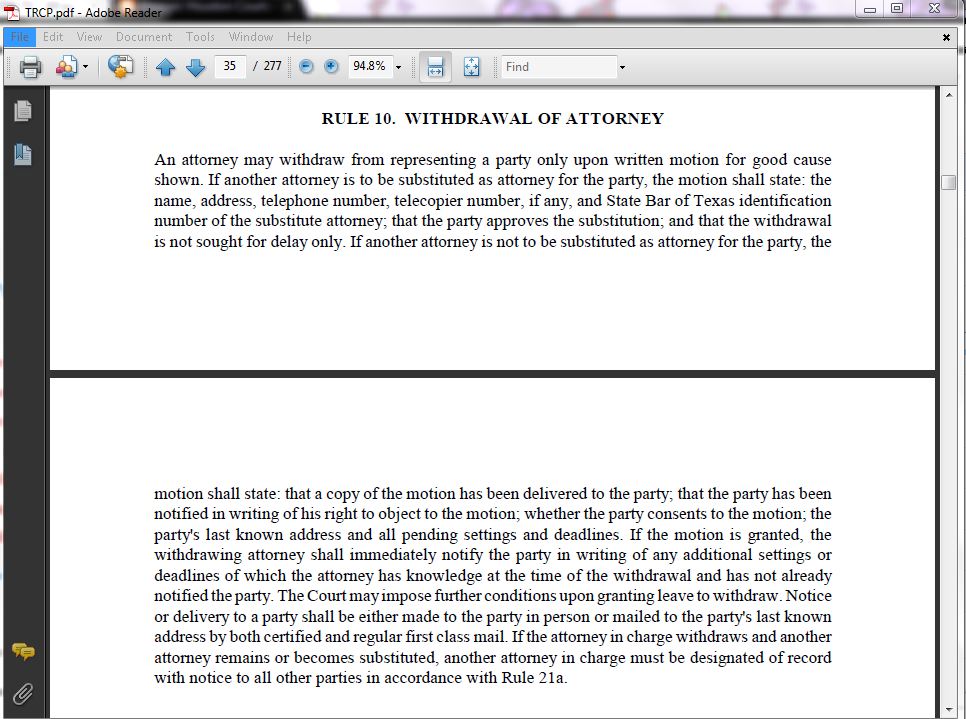
An attorney may withdraw from representing a party only upon written motion for good cause shown. See Tex. R. Civ. P. 10. Texas Rule of Civil Procedure 10, entitled "Withdrawal of Attorney," does not define "good cause." Id. However, the Texas Disciplinary Rules of Professional Conduct articulate considerations relevant to the consideration of Rule 10 motions. See Tex. Disciplinary Rules Prof'l Conduct R. 1.15, reprinted in Tex. Gov't Code Ann., tit. 2, subtit. G, app. A (Vernon 2005); In re A.R., 236 S.W.3d 460, 474 (Tex. App.-Dallas 2007, no pet.) (op. on rehearing); In re Posadas USA, Inc., 100 S.W.3d 254, 257 (Tex. App.-San Antonio 2001, orig. proceeding). Thus, "[b]efore a trial court allows an attorney to withdraw, it should see that the attorney has complied with the Code of Professional Responsibility." Villegas v. Carter, 711 S.W.2d 624, 626 (Tex. 1986).
   
Texas Disciplinary Rule of Professional Conduct 1.15, entitled "Declining or Terminating Representation," provides, among other things, that a lawyer shall not withdraw from representing a client "unless withdrawal can be accomplished without material adverse effect on the interests of the client;" the client "fails substantially to fulfill an obligation to the lawyer regarding the lawyer's services, including an obligation to pay the lawyer's fee as agreed, and has been given reasonable warning that the lawyer will withdraw unless the obligation is fulfilled;" and the representation "will result in an unreasonable financial burden on the lawyer or has been rendered unreasonably difficult by the client." Tex. Disciplinary Rules Prof'l Conduct R. 1.15(b)(1), (5), (6).
  
When the ground for a continuance is the withdrawal of counsel, the movant must show that the failure to be represented at trial was not due to her own fault or negligence. Villegas, 711 S.W.2d at 626. Because the right to counsel is a valuable right, its unwarranted denial is reversible. Id. "[W]hen a trial court allows an attorney to withdraw, it must give the party time to secure new counsel and time for the new counsel to investigate the case and prepare for trial." Id.
  
Relying on Villegas, WIFE argues that the trial court should have (1) denied Nass's motion to withdraw; or (2) granted her motion for continuance after allowing Nass to withdraw. She contends that failure to be represented by counsel at trial was not due to her own fault or negligence.
  
Relying on Texas Disciplinary Rule of Professional Conduct 1.15 and In re Daniels, 138 S.W.3d 31, 33-35 (Tex. App.-San Antonio 2004, orig. proceeding), HUSBAND argues that the trial court acted within its discretion when it granted Nass's motion to withdraw because (1) WIFE failed to pay Nass's fees; (2) continuing "representation through a trial would have been financially burdensome" to Nass; (3) WIFE did not show she had tried to borrow funds to pay Nass; and (4) "[o]ver the course of two full years, from February 11, 2008, to February 10, 2010, neither WIFE nor Nass presented a motion to the trial court seeking the payment of fees beyond the $91,000 Nass had already received."
  
HUSBAND argues that the trial court acted within its discretion in denying a continuance after Nass withdrew as WIFE's counsel because (1) WIFE had 55 days' notice of Nass's motion to withdraw, the trial court granted Nass's motion to withdraw 40 days before trial, and WIFE received her file from Nass after his withdrawal; (2) WIFE never made a motion for interim fees or showed any effort that she attempted to borrow money to pay the fees; (3) the trial court was allowed to consider the history of this case and the fact that WIFE had retained six attorneys, including Nass, and "was not a novice at hiring lawyers;" and (4) WIFE was not deprived of her right to be represented by counsel at trial, but simply failed to secure counsel.
 
III. Application of Standards
 
A. Withdrawal of Representation

  
Nass filed a motion to withdraw as WIFE's counsel on January 26, 2010, asserting that "[g]ood cause exists for withdrawal" because WIFE "represents that she does not have the financial resources to satisfy the contractual obligation to pay the firm." On February 10, 2010, the trial court held a hearing on Nass's motion to withdraw. HUSBAND appeared at this hearing with his counsel, as did amicus attorney Hughes. Nass did not appear at the hearing. Instead, a firm associate, Courtney Hoff, appeared at the hearing to argue Nass's motion.
  
Hoff argued that the Nass firm had not been paid attorney's fees since February 2008, and stated that the firm was not in a position to continue representing WIFE. HUSBAND did not object to Nass's withdrawal, provided that the case proceeded to trial as scheduled on March 22, 2010. Amicus attorney Hughes also did not oppose Nass's motion to withdraw "provided it does not delay the trial setting."
 
WIFE strenuously opposed Nass's motion throughout the hearing. WIFE argued that she and HUSBAND had attempted to reconcile and had agreed that all attorneys would be paid. She stated that HUSBAND paid his attorney and WIFE's attorney from a joint account; according to WIFE, HUSBAND paid Nass about $90,000 for representing WIFE between January 19, 2007, and February 11, 2008. She stated that $5,000 remained to be paid to Nass.
 
WIFE also stated that, when she spoke to Nass in January 2010, he asked her to appear before the trial court and request that fees be awarded so he "would continue" to represent her. WIFE stated that "Nass was supposed to appear" at the withdrawal hearing and question her before the court. WIFE asked the trial court to award her interim fees from a Wells Fargo joint account so she could pay Nass. HUSBAND opposed the request for interim fees at the hearing because no motion for interim fees had been filed before the hearing; he asserted that the parties are "in the middle of trial" and fees "can be handled at the time of trial."
  
Hoff stated that she did not believe HUSBAND had paid the firm $90,000; she recalled that the parties entered into a Rule 11 agreement and believed that HUSBAND had paid the firm approximately $30,000. Relying on a docket sheet entry, the trial court stated that payment of $40,000 was ordered to Nass on February 5, 2008. HUSBAND confirmed that, on or before February 20, 2008, his attorney's fees were paid and WIFE's fees also were paid based on the invoices Nass submitted. HUSBAND stated he had not "heard anything about the fees until now."
  
The trial court asked WIFE if she disputed Nass's contention that she had not followed "the fee agreement or fee contract with Mr. Nass and his firm." WIFE responded that (1) she believed she had "followed" the agreement; (2) Nass "just wants money;" (3) HUSBAND had "total access and control to all our money, and that has kept [WIFE] from gaining counsel in a way that [HUSBAND] is able to;" (4) she had to borrow $40,000 from a friend to pay one attorney and had to borrow money from another friend to pay another attorney; (5) the parties "should have a level field of being able to pay our attorneys so hopefully we can bring finality to his case;" and (6) not having counsel "a month or six weeks before trial would gravely prejudice" her and the parties' children.
  
HUSBAND contended that "there has been a level playing field." He noted that Nass was WIFE's sixth attorney, and asserted that the case could not be resolved if WIFE was allowed to retain "a new lawyer and then that new lawyer obviously needs an opportunity to get brought up to speed." WIFE responded, "[HUSBAND]'s answer, that's what I'm arguing. I'm actually arguing [HUSBAND's] argument, that a new attorney not be placed on this case. Mr. Nass has an overwhelming amount of knowledge; and, again, I believe it's around about $90,000 that he was paid for three weeks . . . And it hasn't been a level playing field because I haven't had the money to hire my — to pay attorneys."
  
Hoff contended that the firm had not received payment from WIFE in two years, and that Nass did not want to withdraw sooner because "the case was put on hold for a period of time" and the firm wanted to give WIFE the "opportunity to figure out if she was going to be able to find the funds for us or if she was going to find another lawyer." Hoff did not know the exact amount WIFE owed the firm, but claimed that WIFE owed more than $5,000. Hoff did not present any unpaid invoices reflecting fees owed to Nass, nor did Hoff indicate what sum, if any, Nass had requested in order to continue representing WIFE in the divorce action.
  
The trial court granted Nass's motion to withdraw and ordered the parties to attend mediation. The trial court signed the order allowing Nass's withdrawal on March 2, 2010; the trial court expressly found that good cause existed for Nass's withdrawal as counsel.

To support his contention that the trial court did not abuse its discretion by granting Nass's motion to withdraw, HUSBAND argues that Disciplinary Rule 1.15 allows an attorney to withdraw for nonpayment of fees "even though the withdrawal may have a material adverse effect upon the interests of the client." However, Rule 1.15 addresses more than the nonpayment of fees; Rule 1.15 also provides that an attorney "shall not withdraw from representing a client unless the client fails substantially to fulfill an obligation" to pay an attorney for services. Tex. Disciplinary Rules Prof'l Conduct R. 1.15(b)(5) (emphasis added).
  
For two reasons, this record raises significant questions about whether WIFE substantially failed to fulfill her obligation to pay Nass.
  
First, it is unclear how much Nass had been paid at the time of the February 10, 2010 hearing. WIFE claimed that HUSBAND had paid Nass approximately $90,000 for services performed between January 19, 2007 and February 8, 2008. Hoff could not state the amount Nass had been paid, but stated that she "believed" HUSBAND's counsel "was saying that they had given my office" about $30,000. The trial court stated, "I see a docket sheet entry from February 5th, '08 ordering that Mr. Nass be paid $40,000 from some specific account." HUSBAND agreed with the trial court at the time and stated that he paid Nass according to the invoices Nass's office submitted. HUSBAND asserts on appeal that Nass already had received $91,000 at the time of the withdrawal hearing.
  
Second, it is unclear how much WIFE still owed to Nass and how much he required to continue participating in the case. WIFE claimed that she owed Nass $5,000. Hoff disputed that amount. When the trial court questioned her regarding the amount Nass was owed, Hoff answered, "I don't have the exact number with me." Hoff did not present any invoices. Hoff did not state how much money, if any, Nass requested for continued representation.
  
Again relying on Disciplinary Rule 1.15, HUSBAND contends that the trial court acted within its discretion by granting Nass's motion to withdraw because continuing the representation through a trial "would have been financially burdensome." Disciplinary Rule 1.15(b)(6) provides that an attorney "shall not withdraw from representing a client unless the representation will result in an unreasonable financial burden" on the attorney. Id. 1.15(b)(6) (emphasis added). Nass did not argue in his motion to withdraw that continuing to represent WIFE would result in an unreasonable financial burden. Nor did Hoff argue that continuing to represent WIFE would result in an unreasonable financial burden.
  
HUSBAND further argues that WIFE "provided absolutely no testimony of any nature indicating efforts she had made to borrow funds to pay Nass the fees he required for continued representation." He emphasizes that WIFE had borrowed money in the past from friends and family to pay attorney's fees. HUSBAND also emphasizes that neither WIFE nor Nass had presented a motion for payment of fees since February 11, 2008.
   
The case was called to trial on February 11, 2008; however, WIFE and HUSBAND almost immediately asked the trial court for a recess to attempt reconciliation. On May 11, 2009, WIFE and HUSBAND agreed to reset trial to March 22, 2010. During this period, the parties technically remained "in trial." The record is unclear as to how long the parties actually attempted to reconcile, whether Nass provided any services between February 2008 and February 2010, and what fees were owed for such services. Hoff argued that the firm had not "received any money from [WIFE] in two years; and since that time the case was put on hold for a period of time, and that's why we didn't withdraw sooner. We were giving her the opportunity to figure out if she was going to be able to find the funds for us or if she was going to find another lawyer."
   
Nass bore the burden to show good cause for withdrawal. See Tex. R. Civ. P. 10. Nothing in the record suggests that WIFE was unwilling to pay attorney's fees or was able to borrow funds for fees but unwilling to do so. WIFE argued that she had no access to funds because HUSBAND "has total access and control to all our money." Although the trial court had awarded interim fees on February 5, 2008, Nass did not file a motion requesting interim fees in connection with the March 2010 trial setting. The record indicates that instead of filing a motion for interim fees, Nass instructed WIFE to ask the trial court to award fees at the February 10, 2010 withdrawal hearing. HUSBAND opposed the request for an award of interim fees at the hearing because no motion for interim fees was before the court; he asserted that the parties are "in the middle of trial" and fees "can be handled at the time of trial."
   
The record does not reveal why no request for interim fees was filed. The trial court did not order interim fees on its own motion. See Tex. Fam. Code Ann. § 6.502(a)(4).
   
The upshot is that Nass was allowed to withdraw after invoking WIFE's lack of "financial resources to satisfy the contractual obligation to pay the firm" 40 days before a recessed trial was scheduled to resume in a highly contentious divorce involving substantial assets and a custody dispute. Neither the amount already paid to Nass nor the amount still owed to Nass ever was clearly established. No motion seeking interim fees was filed before the February 2010 hearing. While we are not prepared to say that allowing Nass to withdraw under these circumstances was an abuse of discretion, we note that allowing withdrawal in this instance approaches the outer limits of discretion.
   
The trial court's exercise of discretion in allowing Nass's withdrawal under these circumstances informs our review of the accompanying decision to deny a continuance following Nass's withdrawal — and, in particular, the analysis of whether WIFE was at fault for the withdrawal of her attorney shortly before the trial was scheduled to resume.
  
B. Continuance   
  
WIFE argues that allowing Nass to "withdraw from representing her 40 days before trial against her wishes, and denying her subsequent motion for continuance" was an abuse of discretion. She contends that the trial court should have granted her motion for continuance because she demonstrated that Nass's withdrawal was not her fault or caused by her negligence.
  
After the trial court granted Nass's motion to withdraw over WIFE's objection on February 10, 2010, WIFE filed a motion for continuance on March 2, 2010. In her motion, she asserted that (1) she is a stay-at-home mom, and that HUSBAND had sole access and control over the couple's financial accounts out of which he paid his own attorney; (2) she "was astonished that Mr. Nash failed to appear at the [withdrawal] hearing after he informed her that he would personally appear so that he could petition the court by questioning [her] for additional fees;" (3) she requested interim attorney's fees at the withdrawal hearing but HUSBAND objected to her request and the trial court did not award her attorney's fees; (4) HUSBAND claimed that she delayed the February 2008 trial date but in fact HUSBAND asked for the trial date to be reset from February 2008 to September 2008 and then to June 2009; (5) she "counseled with several attorneys in an effort to retain representation before the March 22, 2010 trial date" but no attorney was willing to represent her without at least a six-month continuance; (6) good cause existed for a continuance because the absence of her attorney was not caused by WIFE or by her negligence; and (7) forcing her to represent herself at trial would impede her right to a fair trial.
   
In her motion for continuance, WIFE also recounted the list of attorneys who had represented her since HUSBAND filed for divorce. WIFE was represented by (1) Robert Piro from January 2006 to November 2006 for the purpose of obtaining a protective order; (2) Bobby Newman from November 2006 to March 2007; (3) Joan Jenkins from March 2007 to September 2007; (4) Michael Phillips from October 2007 to December 2007; (5) Bucky Allshouse from December 2007 to January 2008; and (6) Joel Nass from January 18, 2008, until the trial court granted Nass's motion to withdraw on February 10, 2010, and signed its order on March 2, 2010.
  
WIFE filed her first amended motion for continuance on March 8, 2010. In addition to asserting her previously asserted grounds for a continuance, WIFE argued that she had a right to be represented by qualified counsel and that she was not qualified to represent herself because she never practiced family law and "never participated in a trial as a lawyer." The trial court held a hearing on WIFE's motion for continuance on March 9, 2010. During the hearing, WIFE asked the trial court to grant her motion because she "fervently" had objected to Nass's withdrawal and had asked the trial court to award interim fees to pay Nass so he could remain her counsel and the case could proceed with trial as set. WIFE stated she had been unable to find another attorney to represent her on the eve of trial because the attorneys she contacted were afraid to "place themselves in a malpractice liability position" by taking her case.
  
HUSBAND opposed WIFE's motion for continuance, arguing that (1) it was not his fault that WIFE "has been through six lawyers;" (2) he and his counsel as well as amicus attorney Hughes had cleared their schedules to proceed with trial as scheduled; and (3) his witnesses and experts were ready to appear. Amicus attorney Hughes also opposed WIFE's continuance motion, arguing that the parties and the children needed finality. The trial court denied WIFE's motion for continuance and ordered the parties to attend mediation before the scheduled trial.
  
WIFE points to Villegas in arguing that she was entitled to a continuance to secure new counsel after the trial court allowed Nass to withdraw over objection shortly before trial because she was not at fault for causing Nass's withdrawal. See Villegas, 711 S.W.2d at 626. In that case, Villegas was represented by two attorneys; one attorney withdrew 22 days before trial and the second attorney was allowed to withdraw two days before trial. Id. at 625. Villegas asked for a continuance so he could retain a new attorney to represent him at trial, but the trial court refused Villegas's request for a continuance. Id. at 625-26. The supreme court held that "the trial court abused its discretion because the evidence shows Villegas was not negligent or at fault in causing his attorney's withdrawal" and too little time remained for Villegas to "find a new attorney and for that new attorney to investigate the case and prepare for trial." Id. Concluding that "the trial court should either have denied the attorney's motion to withdraw or granted the party's motion for continuance," the supreme court reversed and remanded for a new trial. Id.
   
HUSBAND emphasizes that trial counsel in Villegas withdrew two days before trial and refused to turn over the client's case file. According to HUSBAND, the "circumstances are not comparable to WIFE's case" because WIFE had 55 days' notice of Nass's motion to withdraw; the motion was granted 40 days before trial; WIFE received her file from Nass after his withdrawal; WIFE never made a motion for interim fees; and WIFE showed no efforts to borrow money from friends to pay her fees as she had done in the past. HUSBAND supports his argument by citing State v. Crank, 666 S.W.2d 91, 95 (Tex. 1984), Gillie v. Boulas, 65 S.W.3d 219, 223 (Tex. App.-Dallas 2001, pet. denied), and Van Sickle v. Stroud, 467 S.W.2d 509, 511 (Tex. Civ. App.-Fort Worth 1971, no writ).
  
Crank does not support HUSBAND's argument. The supreme court held that the trial court acted within its discretion when it denied Crank's motion for continuance after he "voluntarily discharged his attorney and reaffirmed the discharge after his requested continuance was denied." Crank, 666 S.W.2d at 94-95. The supreme court noted that counsel had not withdrawn voluntarily due to an emergency; rather, Crank knew of the scheduled hearing but waited until the morning of the hearing to discharge his attorney and ask for a continuance. Id. at 94. Here, in contrast, WIFE did not discharge Nass; she strenuously opposed Nass's withdrawal and filed a motion for continuance after trying without success to retain another attorney.
  
Relying on Gillie, HUSBAND argues that "WIFE was not deprived of her right to be represented by counsel at trial; rather WIFE failed to secure counsel." He misplaces his reliance on this case. In Gillie, the court of appeals held that the trial court did not abuse its discretion by denying Gillie's motion for continuance after allowing his counsel to withdraw because the "trial court allowed almost four months for Gillie to obtain new counsel and for the new counsel to investigate the case and prepare for trial." 65 S.W.3d at 222. Here, in contrast, the trial court did not allow WIFE four months to secure new counsel after allowing Nass to withdraw; WIFE had 40 days to secure new counsel.
  
Van Sickle does not support HUSBAND's contention that the trial court acted within its discretion by denying WIFE's motion for continuance "even assuming WIFE's claim of lack of fault." Van Sickle's trial counsel withdrew ten days before the case was called for trial. 467 S.W.2d 509, 511. Van Sickle failed to appear at trial. Id. Van Sickle later retained new counsel who filed a motion for new trial but never complained of the absence of counsel at trial. Id. The court noted that Van Sickle had been represented by four sets of attorneys and concluded he knew how to obtain counsel; yet, Van Sickle presented no evidence about why he "failed to make arrangements for counsel" once his trial counsel was allowed to withdraw. Id. The court concluded that, in the absence of evidence showing that Van Sickle was not at fault for his trial counsel's withdrawal and was diligent in finding new counsel, the trial court acted within its discretion in denying Van Sickle's motion for continuance. Id. Here, in contrast, WIFE unsuccessfully attempted to retain new counsel; none of the multiple attorneys she contacted would agree to represent her.
  
Nothing in the record suggests that WIFE was able to pay Nass's fees but refused to do so. Nothing in the record suggests that she was able to borrow money to pay Nass's fees but refrained from doing so. In assessing WIFE's level of fault, we note that a mechanism was available to allow Nass to seek attorney's fees and address the circumstances he invoked to justify his withdrawal. This mechanism was not used. The record contains no indication that this mechanism could not have been utilized and no explanation as to why this mechanism was unavailable. Nass filed a motion to withdraw claiming nonpayment of fees shortly before trial was scheduled and — according to WIFE — instructed WIFE to ask for fees at the withdrawal hearing. Nass did not appear at the withdrawal hearing.
   
The record does not reveal why a motion for interim fees was not filed in connection with the March 2010 trial setting even though the trial court had awarded interim fees in February 2008. See Tex. Fam. Code Ann. § 6.502(a)(4). When WIFE asked for an award of interim fees during the February 10, 2010, hearing, HUSBAND objected on grounds that no motion requesting such fees had been filed. This objection prompted the trial court to state: "Well, I can't consider a Motion for Fees at this time."
    
If fault is to be assigned for the failure to seek interim fees under these circumstances, we do not believe that such fault properly can be assigned to the client. We are not persuaded that WIFE was at fault because she failed to file a written motion for interim fees before the February 10, 2010, withdrawal hearing.[1] WIFE was represented by counsel before the hearing. WIFE stated that she followed Nass's instructions and asked the trial court for interim fees at the withdrawal hearing. She stated that she was "astonished that Mr. Nass failed to appear at the [withdrawal] hearing after he informed her that he would personally appear so that he could petition the court" for additional fees by questioning WIFE. These statements are uncontroverted on this record. Because nonpayment of fees was the stated reason for Nass's withdrawal on the eve of trial and because there is no contention that interim fees were unavailable, the absence of a motion for interim fees indicates that reasonable steps to avoid prejudice to WIFE were not taken. See Villegas, 711 S.W.2d at 626.
   
We are not persuaded by an argument that WIFE had more notice of her attorney's intent to withdraw and more time to find new counsel than Villegas did. Villegas requires that a party be given "time to secure new counsel and time for the new counsel to investigate the case and prepare for trial." Villegas, 711 S.W.2d at 626. Arguably, the circumstances here were even more prejudicial than the circumstances in Villegas; if the parties really were "in trial" during the February 10, 2010, hearing, then Nass was allowed to withdraw in the middle of trial. In any event, the timing causes concern even if March 22, 2010, is the operative date.
  
Forty days is a substantially shorter period than the almost four months allowed the client in Gillie to find a new attorney. See Gillie, 65 S.W.3d at 222. Unlike the client in Crank, 666 S.W.2d at 94-95, WIFE did not fire her attorney. Unlike the client in Van Sickle, 467 S.W.2d at 511, WIFE detailed her unsuccessful efforts to find a new attorney. Being mindful of the Texas Supreme Court's observation that "Villegas' attorney did not take reasonable steps to avoid foreseeable prejudice to the client" when he withdrew, we conclude that the holding in Villegas applies with equal force here: "The trial court should either have denied the attorney's motion to withdraw or granted the party's motion for continuance; it did neither." Villegas, 711 S.W.2d at 627.
  
HUSBAND also argues that the trial court was allowed to consider the history of this case and the fact that WIFE had retained six attorneys, including Nass. During the February 10, 2010, hearing, HUSBAND argued that an attorney substitution occurs "every time we get down here and get ready for trial."
   
Serial hiring and firing of attorneys for dilatory purposes would be a legitimate concern to be balanced against a requested continuance in appropriate circumstances. However, this record reveals no evidence that the case was delayed because WIFE had hired five attorneys before Nass. Nothing in the record establishes that a continuance was granted or requested in connection with the withdrawal of any of her prior attorneys. The record does not reflect that WIFE used the withdrawal of her attorneys as a dilatory tactic. The primary source of delay in this case appears to be an attempted reconciliation. WIFE's history of prior representation by other attorneys indicates that she could find attorneys to represent her under the circumstances in which they were retained; this history says nothing about her ability to retain a new attorney on the eve of trial after the withdrawal of her attorney based on the asserted nonpayment of fees.
   
Conclusion  
   
Based on the record before us, we conclude that the trial court abused its discretion by denying WIFE's motion for continuance after allowing her trial counsel to withdraw over her objection shortly before trial based on nonpayment of an unspecified fee amount. Following Villegas, 711 S.W.2d at 627, we sustain WIFE's first issue. We affirm the trial court's divorce decree in so far as it grants the divorce, but we reverse the remainder of the trial court's divorce decree and remand for a new trial.[2]
   
[1] WIFE filed a written motion for interim fees on March 12, 2010, asking the trial court to award her interim fees because she is not "in control of sufficient community assets to pay attorney's fees and anticipated expenses." The trial court declined to consider the motion.
[2] In light of our disposition of WIFE's first issue, we need not address WIFE's remaining issues.

Wednesday, November 16, 2011

Lack of Diligence: After more than 4 years, continuance for further discovery was not warranted in debt collection suit brought by Citibank

After the debt collection case had been pending for longer than the limitations period, a continuance of hearing on Citibank's motion for summary judgment for the purpose of taking depositions was not warranted. So found the trial court and the court of appeals agreed. But the motion for continuance by the credit-card debtor/defendant also suffered from formal defects. It was not verified (sworn) as required.

Motion for Continuance

In his second issue,[Credit card holder/defendant] argues that the trial court erred in granting Citibank summary judgment because his motion for continuance "included an affidavit showing sufficient cause for the continuance."

We review for an abuse of discretion a trial court's decision to deny a motion for continuance. Joe v. Two Thirty Nine Joint Venture, 145 S.W.3d 150, 161 (Tex. 2004). The denial will be reversed only if the trial court acted in an arbitrary or unreasonable manner or without reference to any guiding rules or principles. BMC Software Belg., N.V. v. Marchland, 83 S.W.3d 789, 800 (Tex. 2002). The party complaining of an abuse of discretion has the burden to present a record showing the abuse. See Simon v. York Crane & Rigging Co., 739 S.W.2d 793, 795 (Tex. 1987).

When a party contends that it has not had an adequate opportunity for discovery before a summary judgment, it must file either an affidavit explaining the need for further discovery or a verified motion for continuance. Tenneco, Inc. v. Enter. Prods. Co., 925 S.W.2d 640, 647 (Tex. 1996) (citing TEX. R. CIV. P. 166a(g)); see TEX. R. CIV. P. 251 ("No application for a continuance shall be heard before the defendant files his defense, nor shall any continuance be granted except for sufficient cause supported by affidavit, or consent of the parties, or by operation of law."); TEX. R. CIV. P. 252 (providing, among other things, that if motion for continuance is filed on ground of "want of testimony," movant must present affidavit "showing the materiality" of such testimony and that he "used due diligence to procure such testimony" and "stating such diligence, and the cause of failure, if known"). If a motion for continuance is not verified or supported by affidavit, an appellate court must presume that the trial court did not abuse its discretion in denying the motion. City of Houston v. Blackbird, 658 S.W.2d 269, 272 (Tex. App.-Houston [1st Dist.] 1983, writ dism'd). The affidavit or motion must describe the evidence sought, state with particularity the diligence used to obtain the evidence, and explain why the continuance is necessary. Rocha v. Faltys, 69 S.W.3d 315, 319 (Tex. App.-Austin 2002, no pet.). If these requirements are met, then the appellate court considers three non-exclusive factors in determining the propriety of a trial court's ruling on a motion for continuance: (1) the length of time the case was on file; (2) the materiality and purpose of the discovery sought; and (3) whether the party seeking the continuance exercised due diligence to obtain the discovery sought. Joe, 145 S.W.3d at 161.

It is undisputed that[Credit card holder/defendant]'s motion for continuance was not verified and was not supported by an attached affidavit. However,[Credit card holder/defendant] argues that although his motion for continuance did not contain an affidavit "per se," his motion was supported by an affidavit attached to his summary-judgment response in which he listed "the names of the employees of Citibank whom he would seek to depose."

[Credit card holder/defendant] alleged in his motion for continuance that Citibank's representatives "had been effectively non-responsive" to his discovery requests and it was "unclear" whether Citibank's counsel had the "proper want of authority to prosecute this suit." Even assuming that we could consider[Credit card holder/defendant]'s affidavit attached to his summary-judgment response, this affidavit was deficient in multiple respects. See Rocha, 69 S.W.3d at 319. Despite his assertions on appeal, the record reflects that his affidavit did not list the names of the Citibank employees that he wanted to depose, describe the anticipated testimony of these representatives, or explain how such testimony was essential to his summary-judgment response. See West v. SMG, 318 S.W.3d 430, 443-44 (Tex. App.-Houston [1st Dist.] 2010, no pet.). [Credit card holder/defendant]'s motion for continuance also failed to show that he had used due diligence in procuring the desired depositions and that such testimony was material to his summary-judgment response. See TEX. R. CIV. P. 252.

As noted above, Citibank filed its summary-judgment motion more than four and one-half years after the case's commencement, providing [Credit card holder/defendant] more than enough time to conduct discovery and seek the aid of the trial court, if any, in compelling discovery. See Rest. Teams Int'l v. MG Secs. Corp., 95 S.W.3d 336, 339-41 (Tex. App.-Houston [1st Dist.] 2002, no pet.). Accordingly, we hold that the trial court did not abuse its discretion in denying[Credit card holder/defendant]'s motion for continuance.

We overrule[Credit card holder/defendant]'s second issue.

SOURCE: First Court of Appeals Houston - No. 01-10-00768-CV 11/10/11

Thursday, May 15, 2008

Withdrawal of counsel for nonpayment of fees gets clients no sympathy

Denial of Motion for Continuance (made orally in mid-trial) was not error, court of appeals says.

Lofton v. Dyer (Tex.App.- Houston [1st Dist.] May 15, 2008) (Hanks)

In issue two, the Loftons argue that the trial court erred in refusing to allow them sufficient time to retain legal counsel by denying their request to continue the case.

We review the grant or denial of a motion for continuance for an abuse of discretion. Villegas v. Carter, 711 S.W.2d 624, 626 (Tex. 1986). We will not overrule the trial court’s decision unless the trial court acted unreasonably or in an arbitrary manner “without reference to any guiding rules and principles.” Beaumont Bank, N.A. v. Buller, 806 S.W.2d 223, 226 (Tex. 1991) (quoting Downer v. Aquamarine Operators, Inc., 701 S.W.2d 238, 241–42 (Tex. 1985)).

The Loftons’ attorney withdrew from the case. The Loftons contend that they were not notified of the withdrawal hearing or informed that the attorney had withdrawn. Once they were notified, the Loftons represent that they “sought diligently to secure legal representation in the rural and surrounding area where they reside.” They further assert that, due to their “extremely modest means, ethnicity, and lack of sophistication,” they should be given additional time to find competent counsel.

The record reflects that the Loftons’ attorney withdrew because the Loftons had not paid his fees.

It also reflects that the Loftons were aware of his withdrawal more than five months before the trial setting. Furthermore, the Loftons’ request for a continuance was made orally after Dyer had rested his case and after the Loftons had cross-examined two witnesses. Accordingly, we hold that the trial court did not abuse its discretion in denying the oral motion for continuance. See Taherzadeh v. Ghaleh-Assadi, 108 S.W.3d 917, 928 (Tex. App.—Dallas 2003, pet. denied).

We overrule issue two.

Wednesday, December 19, 2007

Mailbox Rule applied to summary judgment response, but evidence of date of mailing attached to brief on appeal was too late

In the absence of a timely response, no-evidence summary judgment was properly granted by default. Court of Appeals also affirms denial of motion for continuance because diligence in conducting discovery prior to summary judgment hearing was not shown.

Landers v. State Farm Lloyd, No. 06-00181-CV (Tex.App. - Houston [1st Dist.] Dec. 13, 2007)(Hanks) (insurance coverage, home owner's insurance, plumbing leak, water damage to home, expert exclusion, MSJ, MFC)
Before Justices Taft, Hanks and Higley01-06-00181-CV E. Dean Landers and Margaret F. Landers v. State Farm Lloyds and Reuben Quintero
Appeal from 280th District Court of Harris County (
Hon. Tony Lindsay)
Disposition: Affirm trial court's no-evidence summary judgment for insurer

O P I N I O N

In this insurance coverage case, the trial court granted State Farm Lloyds’s (“State Farm”) motion to exclude E. Dean and Margaret F. Landers’ (“the Landerses”) experts and then granted State Farm’s no-evidence motions for summary judgment. On appeal, the Landerses contend that the trial court erred (1) in granting the motions for summary judgment because there are genuine issues of material fact, (2) in allowing State Farm’s expert to give new opinions and calculations at the Daubert/Robinson See Daubert v. Merrell Dow Pharms., Inc., 509 U.S. 579, 113 S. Ct. 2786 (1993); E.I.du Pont de Nemours & Co. v. Robinson, 923 S.W.2d 549 (Tex. 1995) (requiring trialjudges to scrutinize evidence for reliability). hearings that had not been timely supplemented and disclosed before the hearings, (3) in striking the Landerses’ experts from testifying at trial, and (4) in not granting the Landerses’ request for a continuance of the hearing on the motions for summary judgment. We affirm.

Procedural and Factual Background

The Landerses are named insureds under a homeowner’s insurance policy issued by State Farm. In August 2001, the Landerses notified State Farm that their home had suffered structural and cosmetic damage as a result of plumbing leaks. State Farm assigned Reuben Quintero as the adjuster for the claim. State Farm also hired a pipe inspection company and an engineering company to inspect the Landerses’ property and to provide a report to State Farm regarding the cause of the damage to the Landerses’ home. Following the completion of its investigation, State Farm determined that the damage claimed by the Landerses was not caused by a plumbing leak and that State Farm did not have a duty under the Landerses’ homeowner’s policy to pay the claim. The Landerses sued State Farm and Quintero for breach of State Farm’s obligations under the homeowner’s policy, breach of the duty of good faith and fair dealing, fraud, and for violations of the Texas Insurance Code and the Texas Deceptive Trade Practice Act (“DTPA”).

State Farm filed a motion to exclude the opinion testimony of Jim Linehan and Jeffery Lineberger, the Landerses’ two expert witnesses on the issue of causation. After two Daubert/Robinson hearings, the motion was granted, and both Linehan and Lineberger were prevented from testifying regarding the cause of the damage to the Landerses’ home.

Two months later, on November 1, 2005, State Farm filed its “Motion for No Evidence Summary Judgment on All of the Plaintiffs’ Claims and Supplement To the Motion for Summary Judgment on Plaintiffs’ Extra-Contractual Claims.” [State Farm had previously filed a traditional motion for partial summary judgment regarding the Landerses’ extra-contractual claims, which also sought the dismissal of Quintero.] This motion was set to be submitted to the trial court at 8:00 a.m. on November 28, 2005. At 9:20 a.m. on the morning of the submission, the district court clerk received the Landerses’ response to the motion. In addition to complaining of the trial court’s striking of their experts, the response also contains a motion seeking continuance of the submission of State Farm’s motion for summary judgment. The response does not contain a motion for leave to file tardy response.

The next day, the trial court, noting that it had found no response to the motions for summary judgment or motions to be considered by the court, granted State Farm’s motions for summary judgment and dismissed the Landerses’ claims against Quintero. A copy of this order was faxed to the Landerses’ counsel.

Eight days later, on December 7, 2005, the Landerses sent a letter to the trail court advising it that it was in error when it stated in the order that they did not file a response to the motions for summary judgment. They stated that a response was timely filed by certified mail, return receipt requested on November 21, 2005. They also stated that a motion for continuance of the hearing on State Farm’s motion for summary judgment was contained in the response.

Loree also states in the letter that, on November 23, 2005, he sent a draft order to thetrial court regarding his motion for a continuance. A copy of the alleged transmittalletter for this order was attached to the letter. Although the attached letter is datedNovember 23, 2005, it is file stamped as having been received by the clerk’s officeon December 13, 2005— almost three weeks after Loree claims to have mailed it tothe trial court.

The letter to the trial court did not include a certified mail receipt demonstrating a timely post mark or an affidavit verifying the facts alleged in his letter regarding the timeliness of the filing of the response.

The Landerses filed a motion for new trial. Although the motion asserts that the Landerses’ response and motion for continuance were timely filed on November 23, 2005, again, there was no copy of a certified mail receipt demonstrating a timely post mark of the United States Postal Service or an affidavit verifying the facts alleged in the motion regarding the timeliness of the filing of the response. The motion was overruled by operation of law, and this appeal followed.
Although Quintero is named in the style of this appeal, the Landerses do not contestthe trial court’s dismissal of Quintero from this suit.

Summary Judgment

In their first and second issues, the Landerses argue that the trial court erred in granting State Farms’s motions for summary judgment because there was summary judgment evidence creating fact issues with respect to all of the Landerses’ causes of action. We disagree.

Standard of Review

We review summary judgments de novo. Valence Operating Co. v. Dorsett, 164 S.W.3d 656, 661 (Tex. 2005). A no-evidence motion for summary judgment must be granted if, after adequate time for discovery, the moving party asserts that there is no evidence of one or more specified elements of a claim or defense on which the adverse party would have the burden of proof at trial and the respondent produces no summary judgment evidence raising a genuine issue of material fact on those elements. Tex. R. Civ. P. 166(a)(i); LMB, Ltd. v Moreno, 201 S.W.3d 686, 688 (Tex. 2006).

A party who files a no-evidence summary judgment motion pursuant to rule 166a(i) has essentially requested a pretrial directed verdict. Mack Trucks, Inc. v. Tamez, 206 S.W.3d 572, 581 (Tex. 2006). When the movant files its motion in proper form, the burden shifts to the nonmovant to defeat the motion by presenting evidence that raises an issue of material fact regarding the elements challenged by the motion. Id. at 582; Weaver v. Highlands Ins. Co., 4 S.W.3d 826, 829 (Tex. App.—Houston [1st Dist.] 1999, no pet.).

Timeliness of the Landerses’ Response

In one pleading, State Farm filed two no-evidence motions for summary judgment. In the motions, State Farm asserts that it is entitled to summary judgment on the Landerses’ breach of contract claim because:

(1) The Landerses have no evidence that any peril or event covered under their policy with State Farm Lloyds was a producing cause of a loss.

(2)The Landerses have no evidence that any peril or event covered under their policy with State Farm Lloyds was a proximate cause of a loss.

(3)The Landerses have no evidence that State Farm Lloyds failed to comply with any of its duties under the homeowner’s policy.

(4)The Landerses have no evidence that any failure by State Farm Lloyds to comply with any of its duties under its contract with the Plaintiffs was a producing cause of damages.

(5)The Landerses have no evidence that any failure by State Farm Lloyds to comply with any of its duties under the homeowner’s policy was a proximate cause of the Landerses’ damages.
State Farm also asserts that, because there was no evidence of causation and no evidence of breach of contract, it had no liability under the Texas Insurance Code.

State Farm also supplemented a previously-filed traditional motion for summary judgment regarding the Landerses’ extra-contractual claims with a no evidence motion on these claims. In the supplement, State Farm asserts that it is entitled to summary judgment on the extra-contractual claims because there cannot be liability under extra-contractual causes of action if, as here, there is no evidence of a breach of the homeowner’s policy by State Farm. In addition, State Farm argues that there is no evidence that the conduct that State Farm allegedly engaged in was extreme or that it produced damages unrelated to or independent of the policy claim.

Pursuant to Texas Rule of Civil Procedure 166a(c), the Landerses had until November 21, 2005, seven days before the hearing on the motions for summary judgment to file either (1) a response to these motions or (2) a motion for leave to file the response out of time. Tex. R. Civ. P. 166a(c). Rule 166a(c) provides, in pertinent part, that, “except on leave of court, the adverse party, not later than seven days prior to the date of the hearing may file and serve opposing affidavits or other written responses.” Tex. R. Civ. P. 166a(c).

The “ mail box” rule of Texas Rule of Civil Procedure 5, applies to responses to motions for summary judgment. Pursuant to this rule, a response, sent to the clerk by first class United States mail on the seventh day prior to the hearing, is deemed timely filed if received by the clerk not more than 10 days after its due date. Tex. R. Civ. P. 5. This rule further states that “a legible post mark affixed by the United States Postal Service shall be prima facie evidence of the date of mailing.” Id. In addition, Texas courts have held that, “in the absence of a proper postmark or certificate of mailing, an attorney’s un-controverted affidavit may be evidence of the date of mailing.” Lofton v. Allstate Ins., 895 S.W.2d 693, 694 (Tex. 1998).

Here, the Landerses’ response to the no-evidence motions for summary judgment was untimely filed. The Landerses did not present the trial court with proof of “a legible postmark affixed by the United States Postal Service” or an affidavit from any competent person establishing that the Landerses’ response to State Farms’s motion for summary judgment was timely mailed. Furthermore, the Landerses did not file a motion for leave to file their untimely response. Under these circumstances, we conclude that the Landerses’ response was filed on the date of the court clerk’s file stamp, November 28, 2005, and the Landerses’ allegations that their response was timely filed are unsupported in the record.

On appeal, the Landerses attach to their reply brief what purports to be a receipt for the delivery of their response to the motions for summary judgment. Attachments of documents as exhibits or appendices to briefs is not a formal inclusion in the recordon appeal. Till v. Thomas, 10 S.W.3d 730, 734 (Tex. App.—Houston [1st Dist.] 1999,no pet.). Therefore, we cannot consider it. Id.

Accordingly, the trial court did not err in granting the pending motions for summary judgment without considering the untimely response. See Atchely v. NCNB Texas Nat’l Bank, 795, S.W.2d, 336, 337 (Tex. App.—Beaumont, 1990, pet. denied) (“Untimely responses to motions for summary judgments are not properly before a trial court at a hearing on such motions.”)

Effect of Untimely Response

The Landerses argue that, even without their response, State Farms’s motions for summary judgment still should have been denied. The Landerses contend that State Farms attached the report of one of their experts, Taylor Sealy, to its earlier-filed traditional motion for partial summary judgment, and Sealy’s report creates a fact issue sufficient to defeat both subsequently-filed no-evidence motions for summary judgment. [The Landerses did not designate Sealy to testify at trial.] We disagree.

Absent a timely response, a trial court must grant a no-evidence motion for summary judgment that meets the requirements of Rule 166a(i). Tex. R. Civ. P. 166a(i). If a nonmovant wishes to assert that, based on the evidence in the record , a fact issue exists to defeat a no-evidence motion for summary judgment, he must timely file a response to the motion raising this issue before the trial court. Id. Before the advent of rule 166a(i), it was well settled that summary judgment could not be rendered based on the default of the opposing party. McConnell v. Southside Sch. Dist., 858 S.W.2d 337, 343 (Tex. 1993); Rizkallah v. Conner, 952 S.W.2d 580, 582–83 (Tex. App.—Houston [1st Dist.] 1997, no pet.). The nonmovant was not required to file a response to defeat the motion for summary judgment because deficiencies in the movant’s own proof or legal theories might defeat the movant’s right to judgment as a matter of law. See City of Houston v. Clear Creek Basin Authority, 589 S.W.2d 671, 678 ( Tex. 1979). However, as Texas courts have repeatedly held, the traditional prohibition against summary judgment by default is inapplicable to motions filed under Rule 166a(i). Roventini v. Ocular Scis., Inc., 111 S.W.3d 719, 723 (Tex. App.—Houston [1st Dist.] 2003, no pet.). As the court held in Jackson v. Fiesta Mart Inc.,

On appeal, [nonmovant] argues that the trial court may not grant a summary judgment by default for lack of an answer or response when the movant’s summary judgment proof is legally insufficient. [Nonmovant’s] argument is technically correct when applied to a motion for summary judgment filed under Rule 166a(c). [Movant’s] motion, however, was clearly a no-evidence motion for summary judgment filed under Rule 166a(i), which shifts the burden of raising a genuine issue of material fact to the nonmovant. 979 S.W.2d 68, 71 (Tex. App.—Austin, 1998, no pet.). Accordingly, where as here, the movant has filed a no-evidence motion, identifying the elements as to which there is no evidence, in a form which is neither conclusory nor a general no-evidence challenge, summary judgment must be rendered absent a legally adequate response by the nonmovant. Dow Chem. Co. v. Francis, 46 S.W.3d 237, 242 (Tex. 2001); Roventini, 111 S.W.3d at 722. In this case, because the Landerses did not file a timely response, the trial court did not err in granting the no-evidence motions for summary judgment.

We overrule issues one and two.

Motion for Continuance

In issue five, the Landerses assert that the trial court erred in denying their motion for continuance of the hearing on motions for summary judgment. We disagree.

Standard of Review

We review the grant or denial of a motion for continuance for an abuse of discretion. Villegas v. Carter, 711 S.W.2d 624, 626 (Tex. 1986). We will not overrule the trial court’s decision unless the trial court acted unreasonably or in an arbitrary manner “without reference to any guiding rules and principles.” Beaumont Bank, N.A. v. Buller, 806 S.W.2d 223, 226 (Tex. 1991) (quoting Downer v. Aquamarine Operators, Inc., 701 S.W.2d 238, 241–42 (Tex. 1985)).

The trial court may grant a continuance to a party opposing a motion for summary judgment to permit further discovery if the nonmovant can show the need for such discovery to oppose the motion. Tex. R. Civ. P. 166a(g). A motion for continuance seeking time for discovery must be supported by an affidavit that describes the evidence sought, explains its materiality, and shows that the party requesting the continuance has used due diligence to timely obtain the evidence. Tex. R. Civ. P. 251, 252; see Hatteberg v. Hatteberg, 933 S.W.2d 522, 527 (Tex. App.—Houston [1st Dist.] 1994, no writ). The affidavit of diligence must state with particularity what diligence was used; conclusory allegations of diligence are not sufficient. Gregg v. Cecil, 844 S.W.2d 851, 853 (Tex. App.—Beaumont 1992, no writ). A party who fails to diligently use the rules of discovery is not entitled to a continuance. State v. Wood Oil Distrib., Inc., 751 S.W.2d 863, 865 (Tex. 1988).

As discussed above, the Landerses did not file their motion for continuance until after the deadline had passed for their response. Furthermore, neither the motion nor the affidavit verifying the contents of the motion set forth any facts regarding the Landerses’ diligence in attempting to secure additional expert testimony prior to the deadline to respond to the motion for summary judgment.

The entirety of the Landerses’ motion for continuance states as follows:

Alternatively, Plaintiffs move for continuance so that they can designate another engineer and present evidence that the subject leaks caused damage to Plaintiffs’ home since the court has excluded such evidence from Mr. Linehan and Mr. Lineberger. This continuance would give Plaintiffs the opportunityto present evidence to controvert State Farm’s [sic] no-evidence motion for summary judgment. This continuance is not requested for purposes of delay,but so that justice may be done.

Under these circumstances, we hold that the trial court did not abuse its discretion in denying the motion for continuance. We overrule issue five.

Because we affirm the trial court’s granting of the two motions for summary judgment, we need not reach the remaining issues.

Conclusion

We affirm the trial court’s judgment.

George C. Hanks, Jr.
Justice

Panel consists of Justices Taft, Hanks, and Higley

Sunday, November 11, 2007

Wedding didn't warrant continuance - Chief Justice affirms district court's decision to go forward with trial

Chief Justice Radack finds no abuse of discretion in denial of motion for continuance where case had been on file for several years and compelling excuse for party's absence was not offered. Plaintiff's counsel did not support motion with strong evidence and had not been diligent in bringing case to trial. Judge Brady G. Elliott acted within his discretion in denying continuance. Trial court may take entire history of case into consideration when deciding whether to grant a trial reset. Opinion also cites local rule regarding procedures for calling cases for trial, and obligations of parties and counsel.

Elberger v. Ford Motor Co., No. 01-06-00926-CV (Tex.App.- Houston [1st Dist.] Nov. 8, 2007)(Radack)(dismissal docket, motion for continuance)
Elberger v. Ford Motor Company, Inc., Dub Miller Ford, Inc. and Daryl Waterwall
Appeal from 268th District Court of Fort Bend
Disposition: Trial court's judgment for Defendants affirmed

MEMORANDUM OPINION BY CHIEF JUSTICE SHERRY RADACK

After this case had been set on the dismissal docket and subsequently retained, the trial court denied the motion for continuance that appellants, Robert and Mona Elberger, filed because they were unavailable on the date of trial. In two issues on appeal, appellant acontends that the court (1) gave inadequate notice of a trial reset date and (2) abused its discretion in denying appellants' motion for continuance. We affirm.

Factual Background

Appellants filed their original petition against appellees, Ford Motor Company, Inc., Dub Miller Ford, Inc., and Daryl Waterwall, on August 22, 2002 alleging that they suffered damages because of appellees' failure to repair their vehicle. On September 9, 2002, appellees filed their answer and Rule 194 Request for Disclosure, and appellants responded to the request for disclosure on October 11, 2002.

After October 11, 2002, there was no action taken on the case until 2006. On February 22, 2006, the trial court sent a letter to counsel notifying them that the case had been set on the dismissal docket for May 31, 2006 unless a motion to retain was filed by May 24, 2006.

Appellants filed their motion to retain on May 31, 2006, stating that they were "ready to go to trial." Even though the motion to retain was filed after the deadline set by the court, the court granted the motion on June 15, 2006, and sent a letter to counsel initially setting trial on July 21, 2006 and stating that there would "be no continuances or passes granted." The letter further stated that a hearing could be passed by agreement of the attorneys. The letter also stated that "failure to comply might result in [the] case being dismissed for want of prosecution."

Appellants claim in their motion for a new trial that they contacted the trial court coordinator on July 20, the day before the trial was initially set, to determine whether the case was going to be called to trial on Friday, July 21. Appellants' counsel was involved in a trial in another district, and preferred that the case be heard Monday, July 24. The trial court coordinator initially complied with appellants' request and set the case to be called on July 24, but then called appellants on July 21 to notify appellants that appellees had a conflict with July 24 and that trial was, at that point, set for Friday, July 28. The trial court also sent written notice on July 21 that the trial was set for July 28. Appellants had been scheduled to fly to Atlanta that day to attend a family wedding. Appellants decided, based on the trial court coordinator's recommendation, to file a motion for continuance and have it heard on July 28. Appellants filed their motion for continuance on July 26, 2006, stating that they would be "unavailable for trial because of a pre-planned trip." They also attached an affidavit to the motion, which contained a statement by appellants that said only, "I verify that the facts contained in the attached Motion for Continuance are true and correct."

Appellants' counsel was present in court on July 28th. However, appellants were not present. The court denied the motion for continuance. Appellants' counsel did not proceed with the case because he did not have any witnesses, and the court rendered a judgment in favor of appellees.
On August 8, 2006, appellants filed a motion for new trial. The motion asked only that the court "reconsider its entry of default and grant this motion for new trial." It did not allege lack of, or inadequate, notice of the trial setting.

Notice of Trial Date

In this first issue, appellants argue that the notice assigning the case to trial on July 28, 2006 was not reasonable under Rule of Civil Procedure 245, which provides in part:

The Court may set contested cases on written request of any party, or on the court's own motion, with reasonable notice of not less than forty-five days to the parties of a first setting for trial, or by agreement of the parties; provided, however, that when a case previously has been set for trial, the Court may reset said contested case to a later date on any reasonable notice to the parties or by agreement of the parties. Tex. R. Civ. P. 245 (emphasis added).

Appellants do not argue that they did not receive the 45 days' notice required for an initial trial setting under rule 245. Nor do they argue that moving the case from July 21, 2006 to July 24, 2006 was unreasonable. However, they do contend that moving the case to July 28, 2006 was unreasonable because they had already made travel plans on that date. We disagree.

Rule 3.4.2 of the Local Rules for the District Courts of Fort Bend County provides:
Cases shall be set for trial for a date certain. If a case is not assigned to trial by the Friday after the date it was set, the case will be reset. Unless all parties agree otherwise, the original setting must comply with all requisites of T.R.C.P. 245.

By its very terms, rule 3.4.2 provides notice that any case set for trial in a Fort Bend district court is subject to assignment for trial any day before the Friday after the date it is originally set. In this case, trial was set for Friday, July 21, 2006 and notice was given in accordance with rule 245. At appellants' request, the trial date was moved to Monday, July 24, 2006, and, at appellees' request, the trial date was moved to Friday, July 28, 2006. The July 28, 2006 trial date was on the first Friday after the initial setting--within the time period in which rule 3.4.2 provides for assigning a case to trial. As such, appellants had reasonable notice of the July 28, 2006 trial setting.

Accordingly, we overrule point of error one.

Motion for Continuance

In their second issue, appellants argue that the trial court abused its discretion in denying appellants' motion for continuance. The decision of the trial court in denying a motion for continuance will not be disturbed unless there is a showing of a clear abuse of discretion. Villegas v. Carter, 711 S.W.2d 624, 626 (Tex. 1986); Retzlaff v. Texas Dep't of Criminal Justice, 135 S.W.3d 731, 745 (Tex. App.--Houston [1st Dist.] 2003, no pet.). A trial court abuses its discretion when it acts without reference to any guiding rules or principles. Downer v. Aquamarine Operators, Inc., 701 S.W.2d 238, 241-42 (Tex. 1985); Barkhausen v. Craycom, Inc., 178 S.W.3d 413 (Tex. App.--Houston [1st Dist.] 2005, pet. denied).

Under Rule of Civil Procedure 251, a continuance will not be granted unless there is sufficient cause, supported by affidavit, or by consent of the parties, or by operation of law. Tex. R. Civ. P. 251; Briscoe v. Goodmark Corp., 130 S.W.3d 160, 169 (Tex. App.--El Paso 2003, no pet.).

The mere absence of a party does not entitle him to a continuance. Vickery v. Vickery, 999 S.W.2d 342, 363 (Tex. 1999); Briscoe, 130 S.W.3d at 169. The motion for continuance based on absence of testimony must be supported with an affidavit showing: (1) the substance of the testimony, (2) the materiality of the testimony, and (3) the movant's due diligence to procure such testimony. See Tex. R. Civ. P. 252; Briscoe, 130 S.W.3d at 169; Richards v. Schion, 969 S.W.2d 131, 133 (Tex. App.--Houston [1st Dist.] 1998, no pet.).

Appellants' motion for continuance did not comply with the requirements of rule 252. Appellants argued that they would be "unavailable for trial because of a pre-planned trip," that this trip was planned "with much time in advance," and that they had "already made their travel arrangements and purchased their tickets." However, the motion did not include any information regarding the substance and materiality of their planned testimony.

On the record before us, we cannot say that the trial court abused its discretion in refusing to grant appellants' request for a continuance. Trial courts are to take the entire procedural history of a case into account when making a decision, and are to look at the entire record, not just the sworn motions. See Waste Water, Inc. v. Alpha Finishing and Developing Corp., 874 S.W.2d 940, 944 (Tex. App.--Houston [14th Dist.] 1994, no writ); Gregg v. Cecil, 844 S.W.2d 851, 853 (Tex. App.--Beaumont 1992, no writ).

Given that this case had been on the trial court's docket for almost four years, that appellants had been warned that this was a "try or dismiss date," and that appellants showed little diligence in pursuing the case and chose to be away on the day of trial, the trial court was within its discretion to deny appellants' motion for continuance.

Accordingly, we overrule appellants' second issue.

Conclusion

We affirm the judgment of the trial court.

Sherry Radack
Chief Justice

Panel consists of Chief Justice Radack and Justices Alcala and Bland.

Saturday, August 18, 2007

Robert S. Bennet v. Kelley Coghlan: Court of Appeals affirms judgment in attorneys' fee dispute stemming from anti-trust litigation

Opinion by Chief Justice Radack also holds that right to continuance based on attorney vacation letter under Harris County Local Rules is waived by agreeing to preferential trial setting that conflicts with designated vacation period.

Robert S. Bennett v. Kelly Coghlan, No. 01-04-00104-CV (Tex.App.- Houston [1st Dist.] Aug. 16, 2007)(Opinion by Chief Justice Radack)(attorney's fees)(Before Chief Justice Radack, Justices Alcala and Bland)
Appeal from Co Civil Ct at Law No 2 of Harris
Trial court judge: Hon. Gary Michael Block

MEMORANDUM OPINION

This is an appeal from a judgment awarding attorney's fees in connection with an application for turnover after judgment pursuant to Tex. Civ. Prac. & Rem. Code Ann. § 31.002(e) (Vernon Supp. 2006). In five issues on appeal, appellant contends that (1) the trial court erred in granting a partial summary judgment, (2) the evidence is legally and factually insufficient to support the verdict, (3) the trial court erred in awarding attorney's fees that were incurred after the underlying judgment was paid, (4) the trial court erred in denying his motion for continuance, and (5) the trial court erred in prohibiting adequate discovery. We affirm.

BACKGROUND

In 1996, appellant, Robert "Bob" Bennett and appellee, Kelly Coghlan, were involved in an anti-trust lawsuit involving Mrs. Baird's bakery. (1)

After the Mrs. Baird litigation was settled, Coghlan sent Bennett a bill for $28,000, which Bennett refused to pay. Coghlan then filed suit against Bennett in Gregg County, alleging fraud and breach of contract. (2)

On January 29, 2001, the Gregg County litigation settled, and on August 13,2001, the trial court signed a final judgment awarding Coghlan $86,625 in damages, $20,000 in attorney's fees, and costs.

Unable to collect on the judgment, Coghlan filed an Application for Turnover after Judgment in Harris County Civil Court at Law No. 2, pursuant to section 31.002 of the Texas Civil Practices and Remedies Code. (3) It is the turnover litigation that gives rise to the present appeal.

On January 28, 2003, collection of $ 100,019.20 was reached, thereby satisfying the underlying judgment, but not the attorney's fees that Coghlan claimed he was owed because of the necessity of filing the turnover litigation. See Tex. Civ. Prac. & Rem. Code Ann. § 31.002(e) (Vernon Supp. 2006) ("The judgment creditor [in an application for turnover] is entitled to recover reasonable costs, including attorney's fees."). Bennett requested a jury trial on the issue of section 31.002(e) attorney's fees.

Thereafter, Coghlan filed a motion for partial summary judgment on the issue of a reasonable hourly rate on which the attorney's fees should be calculated. The motion was based on the doctrine of judicial estoppel. Specifically, Coghlan argued that, in the Mrs. Baird litigation, Bennett had represented to the trial court that Coghlan's "historic hourly billing rate" was $325 per hour, and that, based on that representation, Bennett should be estopped from arguing in the turnover litigation that Coghlan's billing rate should be less. Bennett responded, arguing that a reasonable rate for an anti-trust suit is different from the reasonable rate for a collection suit. (4)

The trial court granted Coghlan's motion for partial summary judgment, ruling that Bennett was estopped from denying that $325 an hour was a fair and reasonable hourly rate for Coghlan. (5)

Nevertheless, when the case went to trial, the jury was asked to answer the following two questions: 1. What are the reasonable costs, including attorney's fees for the services performed by the Plaintiff in this case, stated in dollars and cents?

2. (A) What is a reasonable hourly rate for attorney's fees forPlaintiff in this cause?
(B) How many hours were reasonably spent by Plaintiff in this cause for preparation and trial of this cause?

The jury charge did not instruct the jury that $325 was a reasonable hourly rate for Coghlan. Instead, the jury was instructed to determine the reasonable value for Coghlan's service based on a list of eight factors.

The jury returned a verdict in favor of Coghlan, awarding him $126,748.89 ($122,850 in services and $3898.89 in costs) for legal services and costs through trial, $26,125 in the event of an appeal to the court of appeals, $19,625 in the event of making or responding to a petition for review in the Texas Supreme Court, and $6750 in the event that the Texas Supreme Court grants a petition for review. The jury also determined that a reasonable hourly rate for Coghlan was $325 an hour and that he worked 378 hours in preparing the case for trial. The number of hours worked multiplied by the hourly rate exactly matches the amount that the jury awarded Coghlan for the value of his services.

GRANT OF PARTIAL SUMMARY JUDGMENT

In issue one, Bennett contends the trial court erred in granting Coghlan's motion for partial summary judgment on the issue of judicial estoppel. Bennett argues that the reasonableness of attorneys fees is inherently a fact question. However, the Supreme Court has recently held that "a trial court's erroneous decision to grant summary judgment can be rendered harmless by subsequent events in the trial court." Progressive County Mut. Ins. Co. v. Boyd, 177 S.W.3d 919, 921 (Tex. 2005).

In Progressive, the plaintiff brought both contractual and extra-contractual claims arising from his insurer's denial of coverage after an auto accident. Id. at 920. The trial court granted summary judgment on the plaintiff's extra-contractual claims and submitted the contractual claims to a jury. Id. The jury found that the plaintiff had notbeen involved in an accident with an uninsured vehicle and rendered a take-nothing judgment in favor of the insurer. Id. The Supreme Court concluded that "even if the trial court erred by granting summary judgment as to the bad-faith and extra-contractual claims, the error was harmless because the jury finding in the contract case negated coverage . . . ." Id.

The principle underlying the Progressive decision--that subsequent events at trial can render harmless an erroneous grant of partial summary judgment--is equally applicable to the case before us. Assuming without deciding that the trial court's grant of partial summary judgment on the issue of a reasonable billing rate for Coghlan was error, such error was rendered harmless when the trial court submitted the same question to the jury.

A trial court should not set aside a previously granted summary judgment and submit the issue addressed by the summary judgment to a jury, without first affording the parties the opportunity to litigate the issue. See Bi-Ed, Ltd. v. Ramsey, 935 S.W.2d 122, 123 (Tex. 1996) (per curiam); Elder Constr., Inc. v. City of Colleyville, 839 S.W.2d 91, 92 (Tex. 1992) (per curiam); Fabio v. Ertel, 2007 WL 79476 (Tex. App.--Houston [1st Dist.] Jan. 11, 2007, no pet). However, in this case, the parties were given the opportunity to fully litigate the issue of Coghlan's hourly rate. During trial questioning of Coghlan's expert, the following exchange took place:

[Coghlan]: John, this figure is based on $325 an hour. Why in your opinion am I worth that much, I guess would be the best way to put it?
[Witness]: Well, it's my understanding that there's already--
[Trial Court]: Well, first of all, do you have an opinion as to whether or not that would be a reasonable amount for Mr. -- for a lawyer of Mr. Coghlan's experience to be charging for work such as this?
[Witness]: Yes, I do.
[Trial Court]: No, do you want to go to Summary Judgment? I will briefly do so.
[Witness]: It's my understanding that the Court has already considered what a reasonable rate for Mr. Coghlan would be and entered an order finding that $325 an hour was a reasonable amount and in what's called a summary judgment where -
[Trial Court]: Let me instruct the jurors at this time. In a summary judgment there is no fact in dispute -- material facts in dispute as a matter of law. An issue can be decided so the jury doesn't have to hear evidence. Now, you heard evidence of it. I can make a ruling. There were some judicial admissions that I found contained in some of the documents that were before me whereby in a totally separate court proceeding that amount was stated by Mr. Bennett as a reasonable hourly rate. And, therefore, rather than have to make a decision what an hourly rate was that was the rate that I said is reasonable but law in this case. Okay. Mr. Bennett stated that about Mr. Coghlan but I didn't make that clear to you guys.
[Bennett]: Judge, we need to make an objection to that.
[Trial Court]: Feel free to. As you know, when we -- make just make a simple objection, but I am going to allow you when, -- if you choose to take the stand yourself to explain, okay, a little bit further detail. Okay.
[Bennett]: I want the record clear that there is a motion opposition [sic] to summary judgment and we also object to the court instructing the jury as to more than that is [sic] summary judgment that was entered.
[Court]: Okay. As I said, I am going to let you discuss that in further detail in your -- if you take the stand yourself, Mr. Bennett. But, I am going to also let you know because I want the jury to know as much as I can dispose [sic] the summary judgment. He didn't agree with me entering that. Okay. All right. And I am going to let him speak to that a little bit, although that is the amount that we argue 325 an hour. Go ahead.

Although the trial court instructed the jury that he had determined Coghlan's reasonable hourly rate by way of summary judgment, he also indicated to Bennett that he would allow him to address the issue of the reasonable hourly rate before the jury. Such action had the effect of withdrawing the previously entered partial summary judgment. And, Bennett did, in fact, present evidence, through his expert witness, that a reasonable hourly rate in a collection case would be between $75 and $110 per hour. The parties then, by agreement, submitted the issue of Coghlan's reasonable hourly rate to the jury. (6) Bennett made no objection to submitting the issue of Coghlan's reasonable hourly rate to the jury.

Because the issue raised in the previously entered partial summary judgment was fully litigated at trial and submitted to the jury without objection, we conclude that, under Progressive, any error in granting the partial summary judgment was rendered harmless. See Uro-Tech, Ltd. v. Somerset Partners, Corp., 1999 WL 153130, slip op. at *2-4 (Tex. App.--Dallas 1999, no pet.) (holding that appellant must object to submission of issue that was subject of previously entered summary judgment in order to complain about summary judgment on appeal).

Bennett also argues that the trial court's instruction to the jury about the partial summary judgment was an improper comment on the weight of the evidence. (7) After Coghlan's expert testified that it was his understanding that the trial court had already determined that $325 was a reasonable hourly billing rate, the trial court instructed the jury as follows:

Let me instruct the jurors at this time. In a summary judgment there is no fact in dispute -- material facts in dispute as a matter of law. An issue can be decided so the jury doesn't have to hear evidence. Now, you heard evidence of it. I can make a ruling. There were some judicial admissions that I found contained in some of the documents that were before me whereby in a totally separate court proceeding that amount was stated by Mr. Bennett as a reasonable hourly rate. And, therefore, rather than have to make a decision what an hourly rate was that was the rate that I said is reasonable but law in this case. Okay. Mr. Bennett stated that about Mr. Coghlan but I didn't make that clear to you guys.

Bennett objected that "to the court instructing the jury as to more than that is summary judgment that was entered," to which the trial court responded as follows:

Okay.

As I said, I am going to let you discuss that in further detail in your -- if you take the stand yourself, Mr. Bennett. But, I am going to also let you know because I want the jury to know as much as I can dispose the summary judgment. He didn't agree with me entering that. Okay. All right. And I am going to let him speak to that a little bit, although that is the amount that we argue 325 an hour. Go ahead.

We agree that it would be improper for a trial court to grant summary judgment on an issue, inform the jury of its ruling, and then submit the issue to the jury for its determination. A trial court cannot "have it both ways" by granting summary judgment and then seeking to have the jury validate the ruling by giving the jury a fact question to decide when the jury has already been instructed how to answer the question.

However, in this case, the trial court never clearly instructed the jury that $325 is, as a matter of law, the reasonable hourly rate for Coghlan. Furthermore, in response to Bennett's objection, the trial court responds, "Okay," and then indicates that he would let Bennett address the issue of the reasonable hourly rate. Bennett never asked for a clarification of this ruling or requested the trial court to instruct the jury to disregard the court's previous statement about the summary judgment. Bennett then agreed to submit the jury question regarding the reasonable hourly rate.

In addition to failing to request an instruction to disregard, Bennett makes no attempt to show that the trial court's comment was such that it could not have been rendered harmless by a proper instruction to disregard. See State v. Wilemon, 393 S.W.2d 816, 818 (Tex. 1965). As such, Bennett fails to show that the trial court's action "probably caused the rendition of an improper judgment." See Tex. R. App. P. 44.1(a)(1).

For these reasons, we overrule issue one.

SUFFICIENCY OF THE EVIDENCE

In issue two, Bennett contends the evidence is legally and factually insufficient to support the jury's finding that $325 per hour was a reasonable hourly rate for Coghlan's attorneys fees.

Legal Sufficiency

To demonstrate legal insufficiency on appeal, a litigant who did not bear the burden of proof at trial must show that there is no evidence to support the contested finding. Croucher v. Croucher, 660 S.W.2d 55, 58 (Tex. 1983); Beard v. Beard, 49 S.W.3d 40, 55 (Tex. App.--Waco 2001, pet. denied). A no-evidence point will be sustained when (a) there is a complete absence of evidence of a vital fact, (b) the court is barred by rules of law or of evidence from giving weight to the only evidence offered to prove a vital fact, (c) the evidence offered to prove a vital fact is no more than a mere scintilla, or (d) the evidence conclusively establishes the opposite of the vital fact. King Ranch, Inc. v. Chapman, 118 S.W.3d 742, 751 (Tex. 2003). A reviewing court must view the evidence in a light most favorable to the verdict, indulging every reasonable inference that supports it, but the court may not disregard evidence that allows only one inference. City of Keller v. Wilson, 168 S.W.3d 802, 822 (Tex. 2005). "The final test for legal sufficiency must always be whether the evidence at trial would enable reasonable and fair-minded people to reach the verdict under review." Id. at 827. When both legal and factual sufficiency challenges are raised on appeal, we must first examine the legal sufficiency of the evidence. See Glover v. Tex. Gen. Indemnity. Co., 619 S.W.2d 400, 401(Tex. 1981).

Coghlan's expert, John Tyler, a board-certified Houston trial attorney, testified that he was familiar with "proving up reasonable and customary fees in the State of Texas" and that he had an opinion as to the fees that would be reasonable, usual, and customarily charged in a case such as this. Tyler testified that 450-500 hours on a case of this nature was not unreasonable and that at 500 hours a reasonable fee would be $162,500, which, when divided out, equals $325 an hour--the exact figure the jury used to answer question 2. Tyler also testified that a rate of $325 an hour would be reasonable in the event of future appeals. During Tyler's testimony, Coghlan introduced Plaintiffs exhibit 1C, which summarized Tyler's testimony and provided that "400-500 hours at $325 an hour" would be reasonable for the services provided by Coghlan in the case. Coghlan himself testified that market surveys showed that the hourly rate of an average Houston partner was $363 per hour.

Accordingly, we hold that there is more than a scintilla of evidence to support the jury's finding that $325 an hour was a reasonable rate for Coghlan to charge in this case.

Factual Sufficiency

In reviewing factual sufficiency, we must consider, examine, and weigh all of the evidence in the record. Maritime Overseas Corp. v. Ellis, 971 S.W.2d 402, 406-07 (Tex. 1998). In doing so, we no longer consider the evidence in the light most favorable to the finding; instead we consider and weigh all the evidence and set aside the finding only if it is so contrary to the great weight and preponderance of the evidence as to be clearly wrong and unjust. Gooch v. Am. Sling Co., 902 S.W.2d 181, 183-84 (Tex. App.--Fort Worth 1995, no writ). When reviewing a jury verdict to determine the factual sufficiency of the evidence, the party attacking a finding on which an adverse party bore the burden of proof must show that the record presents "insufficient evidence" to support the finding. Id. In assessing the evidence under this standard, we do not pass on the witnesses' credibility or substitute our judgment for that of the trier of fact. Vickery v. Comm'n for Lawyer Discipline, 5 S.W.3d 241, 258 (Tex. App.--Houston [14th Dist.] 1999, pet. denied).

In his brief, Bennett points to no evidence suggesting a reasonable billing rate other than $325 per hour. However, we note that Bennett's expert witness, Greg Cavalier, testified that, in his opinion, $75-$150 an hour was a reasonable billing rate for collection work. In a battle of competing expert testimony, as is the case here, it is the sole prerogative of the jury to determine the weight and credibility of the witnesses. Cruz v. Paso DelNorte Health Found, 44 S. W.3d 622, 646 (Tex. App.--El Paso 2001, pet. denied).

Accordingly, the jury's finding that $325 an hour was a reasonable rate for Coghlan to charge in this case is not against the great weight and preponderance of the evidence.
We overrule issue two.
(8)

ATTORNEYS FEES AFTER PAYMENT OF UNDERLYING JUDGMENT

In issue three, Bennett contends that evidence is legally and factually insufficient to support the amounts awarded by the jury because a substantial portion of the fees were incurred after the underlying judgment was paid and a receiver had been appointed. Specifically, Bennett argues that the court "should not allow [Coghlan] attorney's fees for collecting attorney's fees."

Under section 31.002(e) of the Civil Practices and Remedies Code, a judgment creditor is entitled to recover reasonable costs, including attorney's fees, incurred when pursuing a turnover claim. Nothing in the statute indicates that attorney's fees must cease when the amount of the judgment is recovered and/or a receiver is appointed.

In this case, after the underlying judgment was satisfied, Bennett requested a jury trial on the issue of the amount of attorney's fees due Coghlan under section 31.002(e). After Bennett filed several motions and other pleadings, and a five-day trial was held. To cut off the accrual of attorney's fees when the underlying judgment was satisfied would have left Coghlan unable to recover the costs of preparing for and participating in the trial demanded by Bennett. We hold that attorney's fees can be recovered pursuant to section 31.002(e), if incurred, any time before final judgment. Accordingly, we overrule issue three.

DENIAL OF MOTION FOR ONTINUANCE

In issue four, Bennett contends the trial court erred by denying his motion for continuance. Specifically, Bennett contends that, because he had a "vacation letter" (9) on file with the court that covered the week the case was set for trial, the trial court had a mandatory duty to continue the case. Bennett also argues that a continuance should have been granted because he was unable to conduct discovery adequately due to a stay the trial court had entered. The granting or denial of a motion for continuance is within the discretion of the trial court and will not be reversed unless the record shows a clear abuse of discretion. State v. Wood Oil Distrib., Inc., 751 S.W.2d 863, 865 (Tex. 1988).

Vacation Letter

Bennett relies on In re North American Refractories Co, 71 S.W.3d 391, (Tex. App.--Beaumont 2001, orig. proceeding), in which the court of appeals held that the local rule providing for vacation letters was mandatory, and that mandamus would lie to compel a continuance on the basis of a properly filed vacation letter. Id. at 394. In so holding, the court recognized that trial counsel could waive his right to rely on a vacation letter by acting in a manner inconsistent with such reliance. Id. (citing Siegler v. Williams, 658 S. W.2d 236, 239 (Tex. App.--Houston [1st Dist.] 1983, no writ)).

In Siegler, a member of the appellant's counsel's firm agreed to a preferential setting during the week which the appellant's counsel had previously designated for vacation. Id. The court held that [u]nder these circumstances, the court and the appellee were entitled to rely upon the agreed preferential setting regardless of the appellant's counsel's vacation letter." Id.

This case is more like Seigler than In re North American Refractories. The record shows that appellant filed his vacation letter on January 15, 2003, to cover the week of August 4, 2003. However, on April 15, 2003, some three months after filing his vacation letter, Bennett agreed to a preferential trial setting of August 4, 2003. We hold that, because Bennett acted in a manner inconsistent with his reliance on the vacation letter, the trial court did not err in denying his motion for continuance based on the vacation letter.

Lack of Discovery

Bennett also complains that his motion for continuance should have been granted so that he could conduct discovery, which he contends he was prevented from doing by a stay order entered by the court some eight months before trial. (10) Specifically, appellant argues that "[b]y entering an order that prevented Appellant from obtaining answers to discovery previously propounded on Appellee and from filing any further discovery, the trial court effectively imposed a discovery sanction against appellant."

The record shows that on December 8, 2002, the trial court signed an order that stated, "Defendant's discovery propounded upon Plaintiff is stayed." The order did not, as Bennett argues, prohibit him from filing any further discovery. Furthermore, in a motion filed on July 21, 2003, Bennett states that the order stayed only "written discovery." Bennett did not serve any further discovery requests or notice any deposition until July 2003, less than one month before trial and after all applicable discovery deadlines had passed. Both parties agree that on July 18, 2003, the trial court verbally lifted the stay.

Thereafter, Bennett filed a motion to compel responses to both his previously filed discovery and the discovery that the trial court had, at the July 18 hearing, orally granted him permission to conduct. Bennett's motion to compel was heard on July 25, 2006. However, the hearing was not recorded and is not a part of the appellate record. Absent a record from the July 25, 2006 hearing on Bennet's motion to compel, we cannot conclude the trial court abused its discretion in denying Bennett's motion to compel. See In re Pilgrims Pride Corp., 187 S.W.3d 197, 199 (Tex. App.--Texarkana 2006, orig. proceeding) ("Without a reporter's record, we could only speculate whether there was evidence to support the trial court's denial of [relator's] motions to compel discovery, to delay the trial date, and to enter a scheduling order.").

Based on the record before us, we cannot conclude that the trial court erred by refusing to compel Coghlan to respond to Bennett's discovery requests or to grant a continuance so that Bennett could conduct further discovery.

We overrule issues four and five.

CONCLUSION

We affirm the judgment of the trial court.

Sherry Radack
Chief Justice
Panel consists of Chief Justice Radack and Justices Alcala and Bland.

1. Piggly Wiggly Clarksville,Inc. et al v. Mrs. Baird's Bakeries, Inc./ Johnny B. Tucker d/b/a H & M Grocery, et al. v. Mrs. Baird's Bakeries, Inc. No. 395CV48, in the United States district Court for the Eastern District of Texas, Paris Division ("the Mrs. Baird litigation.").
2. Kelly Coghlan and Coghlan & Assocs. v. Robert Bennett, no. 98-2125-B in the 134th District Court, Gregg County, Texas (hereinafter, "the Gregg County litigation.").
3. Tex. Civ. Prac. & Rem. Code Ann. § 31.002 (Vernon Supp. 2006).
4. Bennett's response to the motion for partial summary judgment was not originally included in the appellate record, though he insisted that it had been filed. Accordingly, this Court abated the appeal to the trial court to determine whether Bennett's response had been lost or destroyed as provided in Tex. R. App. P. 34.5(e). At the abatement hearing, the trial court concluded that Bennett's response should be included in the appellate record, and the record was so supplemented.
5. Bennett argued that the order granting Coghlan's motion for partial summary judgment was never signed and was not a part of the appellate record. Accordingly, this Court abated the appeal pending a hearing in the trial court to determine whether the order had, in fact, been signed, and whether it should have been included in the record as provided in Tex. R. App. P. 34.5(e). At the abatement hearing, the trial judge concluded that he had signed the order granting partial summary judgment and that it should be included in the appellate record. The record was so supplemented.
8. To the extent that Bennett's second issue is based on the trial court's remarks to the jury during trial, indicating that there were no fact issues as to the rate per hour of attorney's fees, we note that the trial court sustained Bennett's objection, but Bennett never requested an instruction to disregard the comment. A party waives appellate review when it fails to object to a trial judge's comments and request an instruction to disregard unless the comment could not have been rendered harmless by an instruction to disregard. Dow Chem. Co. v. Francis, 46 S.W.3d 237, 241 (Tex. 2001); see also Capellen v. Capellen, 888 S.W.2nd 539, 547 (Tex. App.--El Paso 1994, writ denied) ("Unless the comment by the judge is so blatantly and obviously prejudicial that it cannot be cured, an objection and request for instruction must be made in order to preserve error.") We hold that an instruction to disregard, if requested, would have rendered the trial court's comment harmless. Thus, the failure to request such an instruction waives error.
9. Rule 8 of the Harris County Civil Court Rules states that "[t]he County Civil Courts will honor written designations for Summer vacation weeks or non-Summer vacation weeks filed with the District Clerk pursuant to Local Rules of the Civil Trial Division of the Judicial Courts of Harris County, except for cases preferentially set for trial prior to the vacation designation."
10. The denial of discovery is also raised in Bennett's fifth issue on appeal. Because the discovery order is directly related to Bennett's motion for continuance, we discuss issues four and five together.