ATTORNEY WITHDRAWAL UNDER TRCP 10 ON THE EVE OF TRIAL .... Is it a valid ground to postpone (continue) the trial?
Family court judge found to have abused
discretion by denying wife's motion for continuance after permitting her trial
counsel to withdraw from representing her -- over her objection -- shortly before trial based on nonpayment
of an unspecified fee amount. Wife went through a series of lawyers in
contested divorce case and ended up pro se, with a list of attorneys who
wouldn’t take the case at the last minute.
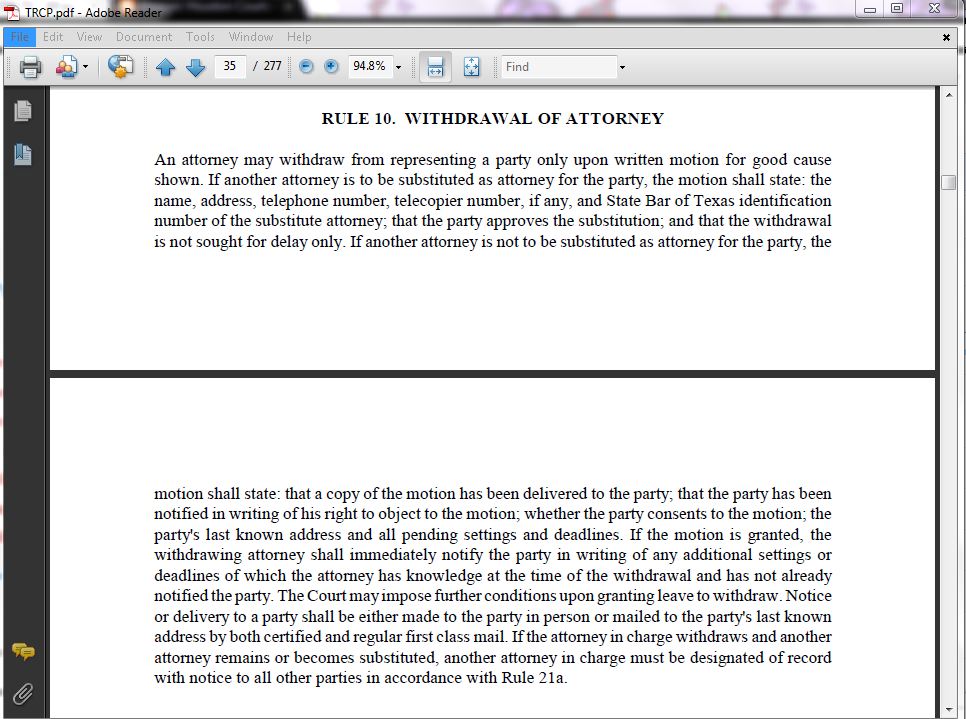
EXCERPT FROM
SUBSTITUTE OPINION BY JUSTICE BOYCE
[names of parties replaced with “WIFE” and “HUSBAND”]
Standards Governing Withdrawal and Continuance
An attorney may withdraw from representing a party only upon written motion for good cause shown. See Tex. R. Civ. P. 10. Texas Rule of Civil Procedure 10, entitled "Withdrawal of Attorney," does not define "good cause." Id. However, the Texas Disciplinary Rules of Professional Conduct articulate considerations relevant to the consideration of Rule 10 motions. See Tex. Disciplinary Rules Prof'l Conduct R. 1.15, reprinted in Tex. Gov't Code Ann., tit. 2, subtit. G, app. A (Vernon 2005); In re A.R., 236 S.W.3d 460, 474 (Tex. App.-Dallas 2007, no pet.) (op. on rehearing); In re Posadas USA, Inc., 100 S.W.3d 254, 257 (Tex. App.-San Antonio 2001, orig. proceeding). Thus, "[b]efore a trial court allows an attorney to withdraw, it should see that the attorney has complied with the Code of Professional Responsibility." Villegas v. Carter, 711 S.W.2d 624, 626 (Tex. 1986).
Texas Disciplinary Rule of Professional Conduct 1.15, entitled "Declining or Terminating Representation," provides, among other things, that a lawyer shall not withdraw from representing a client "unless withdrawal can be accomplished without material adverse effect on the interests of the client;" the client "fails substantially to fulfill an obligation to the lawyer regarding the lawyer's services, including an obligation to pay the lawyer's fee as agreed, and has been given reasonable warning that the lawyer will withdraw unless the obligation is fulfilled;" and the representation "will result in an unreasonable financial burden on the lawyer or has been rendered unreasonably difficult by the client." Tex. Disciplinary Rules Prof'l Conduct R. 1.15(b)(1), (5), (6).
When the ground for a continuance is the withdrawal of counsel, the movant must show that the failure to be represented at trial was not due to her own fault or negligence. Villegas, 711 S.W.2d at 626. Because the right to counsel is a valuable right, its unwarranted denial is reversible. Id. "[W]hen a trial court allows an attorney to withdraw, it must give the party time to secure new counsel and time for the new counsel to investigate the case and prepare for trial." Id.
Relying on Villegas, WIFE argues that the trial court should have (1) denied Nass's motion to withdraw; or (2) granted her motion for continuance after allowing Nass to withdraw. She contends that failure to be represented by counsel at trial was not due to her own fault or negligence.
Relying on Texas Disciplinary Rule of Professional Conduct 1.15 and In re Daniels, 138 S.W.3d 31, 33-35 (Tex. App.-San Antonio 2004, orig. proceeding), HUSBAND argues that the trial court acted within its discretion when it granted Nass's motion to withdraw because (1) WIFE failed to pay Nass's fees; (2) continuing "representation through a trial would have been financially burdensome" to Nass; (3) WIFE did not show she had tried to borrow funds to pay Nass; and (4) "[o]ver the course of two full years, from February 11, 2008, to February 10, 2010, neither WIFE nor Nass presented a motion to the trial court seeking the payment of fees beyond the $91,000 Nass had already received."
HUSBAND argues that the trial court acted within its discretion in denying a continuance after Nass withdrew as WIFE's counsel because (1) WIFE had 55 days' notice of Nass's motion to withdraw, the trial court granted Nass's motion to withdraw 40 days before trial, and WIFE received her file from Nass after his withdrawal; (2) WIFE never made a motion for interim fees or showed any effort that she attempted to borrow money to pay the fees; (3) the trial court was allowed to consider the history of this case and the fact that WIFE had retained six attorneys, including Nass, and "was not a novice at hiring lawyers;" and (4) WIFE was not deprived of her right to be represented by counsel at trial, but simply failed to secure counsel.
III. Application of Standards
A. Withdrawal of Representation
Nass filed a motion to withdraw as WIFE's counsel on January 26, 2010, asserting that "[g]ood cause exists for withdrawal" because WIFE "represents that she does not have the financial resources to satisfy the contractual obligation to pay the firm." On February 10, 2010, the trial court held a hearing on Nass's motion to withdraw. HUSBAND appeared at this hearing with his counsel, as did amicus attorney Hughes. Nass did not appear at the hearing. Instead, a firm associate, Courtney Hoff, appeared at the hearing to argue Nass's motion.
Hoff argued that the Nass firm had not been paid attorney's fees since February 2008, and stated that the firm was not in a position to continue representing WIFE. HUSBAND did not object to Nass's withdrawal, provided that the case proceeded to trial as scheduled on March 22, 2010. Amicus attorney Hughes also did not oppose Nass's motion to withdraw "provided it does not delay the trial setting."
WIFE strenuously opposed Nass's motion throughout the hearing. WIFE argued that she and HUSBAND had attempted to reconcile and had agreed that all attorneys would be paid. She stated that HUSBAND paid his attorney and WIFE's attorney from a joint account; according to WIFE, HUSBAND paid Nass about $90,000 for representing WIFE between January 19, 2007, and February 11, 2008. She stated that $5,000 remained to be paid to Nass.
WIFE also stated that, when she spoke to Nass in January 2010, he asked her to appear before the trial court and request that fees be awarded so he "would continue" to represent her. WIFE stated that "Nass was supposed to appear" at the withdrawal hearing and question her before the court. WIFE asked the trial court to award her interim fees from a Wells Fargo joint account so she could pay Nass. HUSBAND opposed the request for interim fees at the hearing because no motion for interim fees had been filed before the hearing; he asserted that the parties are "in the middle of trial" and fees "can be handled at the time of trial."
Hoff stated that she did not believe HUSBAND had paid the firm $90,000; she recalled that the parties entered into a Rule 11 agreement and believed that HUSBAND had paid the firm approximately $30,000. Relying on a docket sheet entry, the trial court stated that payment of $40,000 was ordered to Nass on February 5, 2008. HUSBAND confirmed that, on or before February 20, 2008, his attorney's fees were paid and WIFE's fees also were paid based on the invoices Nass submitted. HUSBAND stated he had not "heard anything about the fees until now."
The trial court asked WIFE if she disputed Nass's contention that she had not followed "the fee agreement or fee contract with Mr. Nass and his firm." WIFE responded that (1) she believed she had "followed" the agreement; (2) Nass "just wants money;" (3) HUSBAND had "total access and control to all our money, and that has kept [WIFE] from gaining counsel in a way that [HUSBAND] is able to;" (4) she had to borrow $40,000 from a friend to pay one attorney and had to borrow money from another friend to pay another attorney; (5) the parties "should have a level field of being able to pay our attorneys so hopefully we can bring finality to his case;" and (6) not having counsel "a month or six weeks before trial would gravely prejudice" her and the parties' children.
HUSBAND contended that "there has been a level playing field." He noted that Nass was WIFE's sixth attorney, and asserted that the case could not be resolved if WIFE was allowed to retain "a new lawyer and then that new lawyer obviously needs an opportunity to get brought up to speed." WIFE responded, "[HUSBAND]'s answer, that's what I'm arguing. I'm actually arguing [HUSBAND's] argument, that a new attorney not be placed on this case. Mr. Nass has an overwhelming amount of knowledge; and, again, I believe it's around about $90,000 that he was paid for three weeks . . . And it hasn't been a level playing field because I haven't had the money to hire my — to pay attorneys."
Hoff contended that the firm had not received payment from WIFE in two years, and that Nass did not want to withdraw sooner because "the case was put on hold for a period of time" and the firm wanted to give WIFE the "opportunity to figure out if she was going to be able to find the funds for us or if she was going to find another lawyer." Hoff did not know the exact amount WIFE owed the firm, but claimed that WIFE owed more than $5,000. Hoff did not present any unpaid invoices reflecting fees owed to Nass, nor did Hoff indicate what sum, if any, Nass had requested in order to continue representing WIFE in the divorce action.
The trial court granted Nass's motion to withdraw and ordered the parties to attend mediation. The trial court signed the order allowing Nass's withdrawal on March 2, 2010; the trial court expressly found that good cause existed for Nass's withdrawal as counsel.
To support his contention that the trial court did not abuse its discretion by granting Nass's motion to withdraw, HUSBAND argues that Disciplinary Rule 1.15 allows an attorney to withdraw for nonpayment of fees "even though the withdrawal may have a material adverse effect upon the interests of the client." However, Rule 1.15 addresses more than the nonpayment of fees; Rule 1.15 also provides that an attorney "shall not withdraw from representing a client unless the client fails substantially to fulfill an obligation" to pay an attorney for services. Tex. Disciplinary Rules Prof'l Conduct R. 1.15(b)(5) (emphasis added).
For two reasons, this record raises significant questions about whether WIFE substantially failed to fulfill her obligation to pay Nass.
First, it is unclear how much Nass had been paid at the time of the February 10, 2010 hearing. WIFE claimed that HUSBAND had paid Nass approximately $90,000 for services performed between January 19, 2007 and February 8, 2008. Hoff could not state the amount Nass had been paid, but stated that she "believed" HUSBAND's counsel "was saying that they had given my office" about $30,000. The trial court stated, "I see a docket sheet entry from February 5th, '08 ordering that Mr. Nass be paid $40,000 from some specific account." HUSBAND agreed with the trial court at the time and stated that he paid Nass according to the invoices Nass's office submitted. HUSBAND asserts on appeal that Nass already had received $91,000 at the time of the withdrawal hearing.
Second, it is unclear how much WIFE still owed to Nass and how much he required to continue participating in the case. WIFE claimed that she owed Nass $5,000. Hoff disputed that amount. When the trial court questioned her regarding the amount Nass was owed, Hoff answered, "I don't have the exact number with me." Hoff did not present any invoices. Hoff did not state how much money, if any, Nass requested for continued representation.
Again relying on Disciplinary Rule 1.15, HUSBAND contends that the trial court acted within its discretion by granting Nass's motion to withdraw because continuing the representation through a trial "would have been financially burdensome." Disciplinary Rule 1.15(b)(6) provides that an attorney "shall not withdraw from representing a client unless the representation will result in an unreasonable financial burden" on the attorney. Id. 1.15(b)(6) (emphasis added). Nass did not argue in his motion to withdraw that continuing to represent WIFE would result in an unreasonable financial burden. Nor did Hoff argue that continuing to represent WIFE would result in an unreasonable financial burden.
HUSBAND further argues that WIFE "provided absolutely no testimony of any nature indicating efforts she had made to borrow funds to pay Nass the fees he required for continued representation." He emphasizes that WIFE had borrowed money in the past from friends and family to pay attorney's fees. HUSBAND also emphasizes that neither WIFE nor Nass had presented a motion for payment of fees since February 11, 2008.
The case was called to trial on February 11, 2008; however, WIFE and HUSBAND almost immediately asked the trial court for a recess to attempt reconciliation. On May 11, 2009, WIFE and HUSBAND agreed to reset trial to March 22, 2010. During this period, the parties technically remained "in trial." The record is unclear as to how long the parties actually attempted to reconcile, whether Nass provided any services between February 2008 and February 2010, and what fees were owed for such services. Hoff argued that the firm had not "received any money from [WIFE] in two years; and since that time the case was put on hold for a period of time, and that's why we didn't withdraw sooner. We were giving her the opportunity to figure out if she was going to be able to find the funds for us or if she was going to find another lawyer."
Nass bore the burden to show good cause for withdrawal. See Tex. R. Civ. P. 10. Nothing in the record suggests that WIFE was unwilling to pay attorney's fees or was able to borrow funds for fees but unwilling to do so. WIFE argued that she had no access to funds because HUSBAND "has total access and control to all our money." Although the trial court had awarded interim fees on February 5, 2008, Nass did not file a motion requesting interim fees in connection with the March 2010 trial setting. The record indicates that instead of filing a motion for interim fees, Nass instructed WIFE to ask the trial court to award fees at the February 10, 2010 withdrawal hearing. HUSBAND opposed the request for an award of interim fees at the hearing because no motion for interim fees was before the court; he asserted that the parties are "in the middle of trial" and fees "can be handled at the time of trial."
The record does not reveal why no request for interim fees was filed. The trial court did not order interim fees on its own motion. See Tex. Fam. Code Ann. § 6.502(a)(4).
The upshot is that Nass was allowed to withdraw after invoking WIFE's lack of "financial resources to satisfy the contractual obligation to pay the firm" 40 days before a recessed trial was scheduled to resume in a highly contentious divorce involving substantial assets and a custody dispute. Neither the amount already paid to Nass nor the amount still owed to Nass ever was clearly established. No motion seeking interim fees was filed before the February 2010 hearing. While we are not prepared to say that allowing Nass to withdraw under these circumstances was an abuse of discretion, we note that allowing withdrawal in this instance approaches the outer limits of discretion.
The trial court's exercise of discretion in allowing Nass's withdrawal under these circumstances informs our review of the accompanying decision to deny a continuance following Nass's withdrawal — and, in particular, the analysis of whether WIFE was at fault for the withdrawal of her attorney shortly before the trial was scheduled to resume.
B. Continuance
WIFE argues that allowing Nass to "withdraw from representing her 40 days before trial against her wishes, and denying her subsequent motion for continuance" was an abuse of discretion. She contends that the trial court should have granted her motion for continuance because she demonstrated that Nass's withdrawal was not her fault or caused by her negligence.
After the trial court granted Nass's motion to withdraw over WIFE's objection on February 10, 2010, WIFE filed a motion for continuance on March 2, 2010. In her motion, she asserted that (1) she is a stay-at-home mom, and that HUSBAND had sole access and control over the couple's financial accounts out of which he paid his own attorney; (2) she "was astonished that Mr. Nash failed to appear at the [withdrawal] hearing after he informed her that he would personally appear so that he could petition the court by questioning [her] for additional fees;" (3) she requested interim attorney's fees at the withdrawal hearing but HUSBAND objected to her request and the trial court did not award her attorney's fees; (4) HUSBAND claimed that she delayed the February 2008 trial date but in fact HUSBAND asked for the trial date to be reset from February 2008 to September 2008 and then to June 2009; (5) she "counseled with several attorneys in an effort to retain representation before the March 22, 2010 trial date" but no attorney was willing to represent her without at least a six-month continuance; (6) good cause existed for a continuance because the absence of her attorney was not caused by WIFE or by her negligence; and (7) forcing her to represent herself at trial would impede her right to a fair trial.
In her motion for continuance, WIFE also recounted the list of attorneys who had represented her since HUSBAND filed for divorce. WIFE was represented by (1) Robert Piro from January 2006 to November 2006 for the purpose of obtaining a protective order; (2) Bobby Newman from November 2006 to March 2007; (3) Joan Jenkins from March 2007 to September 2007; (4) Michael Phillips from October 2007 to December 2007; (5) Bucky Allshouse from December 2007 to January 2008; and (6) Joel Nass from January 18, 2008, until the trial court granted Nass's motion to withdraw on February 10, 2010, and signed its order on March 2, 2010.
WIFE filed her first amended motion for continuance on March 8, 2010. In addition to asserting her previously asserted grounds for a continuance, WIFE argued that she had a right to be represented by qualified counsel and that she was not qualified to represent herself because she never practiced family law and "never participated in a trial as a lawyer." The trial court held a hearing on WIFE's motion for continuance on March 9, 2010. During the hearing, WIFE asked the trial court to grant her motion because she "fervently" had objected to Nass's withdrawal and had asked the trial court to award interim fees to pay Nass so he could remain her counsel and the case could proceed with trial as set. WIFE stated she had been unable to find another attorney to represent her on the eve of trial because the attorneys she contacted were afraid to "place themselves in a malpractice liability position" by taking her case.
HUSBAND opposed WIFE's motion for continuance, arguing that (1) it was not his fault that WIFE "has been through six lawyers;" (2) he and his counsel as well as amicus attorney Hughes had cleared their schedules to proceed with trial as scheduled; and (3) his witnesses and experts were ready to appear. Amicus attorney Hughes also opposed WIFE's continuance motion, arguing that the parties and the children needed finality. The trial court denied WIFE's motion for continuance and ordered the parties to attend mediation before the scheduled trial.
WIFE points to Villegas in arguing that she was entitled to a continuance to secure new counsel after the trial court allowed Nass to withdraw over objection shortly before trial because she was not at fault for causing Nass's withdrawal. See Villegas, 711 S.W.2d at 626. In that case, Villegas was represented by two attorneys; one attorney withdrew 22 days before trial and the second attorney was allowed to withdraw two days before trial. Id. at 625. Villegas asked for a continuance so he could retain a new attorney to represent him at trial, but the trial court refused Villegas's request for a continuance. Id. at 625-26. The supreme court held that "the trial court abused its discretion because the evidence shows Villegas was not negligent or at fault in causing his attorney's withdrawal" and too little time remained for Villegas to "find a new attorney and for that new attorney to investigate the case and prepare for trial." Id. Concluding that "the trial court should either have denied the attorney's motion to withdraw or granted the party's motion for continuance," the supreme court reversed and remanded for a new trial. Id.
HUSBAND emphasizes that trial counsel in Villegas withdrew two days before trial and refused to turn over the client's case file. According to HUSBAND, the "circumstances are not comparable to WIFE's case" because WIFE had 55 days' notice of Nass's motion to withdraw; the motion was granted 40 days before trial; WIFE received her file from Nass after his withdrawal; WIFE never made a motion for interim fees; and WIFE showed no efforts to borrow money from friends to pay her fees as she had done in the past. HUSBAND supports his argument by citing State v. Crank, 666 S.W.2d 91, 95 (Tex. 1984), Gillie v. Boulas, 65 S.W.3d 219, 223 (Tex. App.-Dallas 2001, pet. denied), and Van Sickle v. Stroud, 467 S.W.2d 509, 511 (Tex. Civ. App.-Fort Worth 1971, no writ).
Crank does not support HUSBAND's argument. The supreme court held that the trial court acted within its discretion when it denied Crank's motion for continuance after he "voluntarily discharged his attorney and reaffirmed the discharge after his requested continuance was denied." Crank, 666 S.W.2d at 94-95. The supreme court noted that counsel had not withdrawn voluntarily due to an emergency; rather, Crank knew of the scheduled hearing but waited until the morning of the hearing to discharge his attorney and ask for a continuance. Id. at 94. Here, in contrast, WIFE did not discharge Nass; she strenuously opposed Nass's withdrawal and filed a motion for continuance after trying without success to retain another attorney.
Relying on Gillie, HUSBAND argues that "WIFE was not deprived of her right to be represented by counsel at trial; rather WIFE failed to secure counsel." He misplaces his reliance on this case. In Gillie, the court of appeals held that the trial court did not abuse its discretion by denying Gillie's motion for continuance after allowing his counsel to withdraw because the "trial court allowed almost four months for Gillie to obtain new counsel and for the new counsel to investigate the case and prepare for trial." 65 S.W.3d at 222. Here, in contrast, the trial court did not allow WIFE four months to secure new counsel after allowing Nass to withdraw; WIFE had 40 days to secure new counsel.
Van Sickle does not support HUSBAND's contention that the trial court acted within its discretion by denying WIFE's motion for continuance "even assuming WIFE's claim of lack of fault." Van Sickle's trial counsel withdrew ten days before the case was called for trial. 467 S.W.2d 509, 511. Van Sickle failed to appear at trial. Id. Van Sickle later retained new counsel who filed a motion for new trial but never complained of the absence of counsel at trial. Id. The court noted that Van Sickle had been represented by four sets of attorneys and concluded he knew how to obtain counsel; yet, Van Sickle presented no evidence about why he "failed to make arrangements for counsel" once his trial counsel was allowed to withdraw. Id. The court concluded that, in the absence of evidence showing that Van Sickle was not at fault for his trial counsel's withdrawal and was diligent in finding new counsel, the trial court acted within its discretion in denying Van Sickle's motion for continuance. Id. Here, in contrast, WIFE unsuccessfully attempted to retain new counsel; none of the multiple attorneys she contacted would agree to represent her.
Nothing in the record suggests that WIFE was able to pay Nass's fees but refused to do so. Nothing in the record suggests that she was able to borrow money to pay Nass's fees but refrained from doing so. In assessing WIFE's level of fault, we note that a mechanism was available to allow Nass to seek attorney's fees and address the circumstances he invoked to justify his withdrawal. This mechanism was not used. The record contains no indication that this mechanism could not have been utilized and no explanation as to why this mechanism was unavailable. Nass filed a motion to withdraw claiming nonpayment of fees shortly before trial was scheduled and — according to WIFE — instructed WIFE to ask for fees at the withdrawal hearing. Nass did not appear at the withdrawal hearing.
The record does not reveal why a motion for interim fees was not filed in connection with the March 2010 trial setting even though the trial court had awarded interim fees in February 2008. See Tex. Fam. Code Ann. § 6.502(a)(4). When WIFE asked for an award of interim fees during the February 10, 2010, hearing, HUSBAND objected on grounds that no motion requesting such fees had been filed. This objection prompted the trial court to state: "Well, I can't consider a Motion for Fees at this time."
If fault is to be assigned for the failure to seek interim fees under these circumstances, we do not believe that such fault properly can be assigned to the client. We are not persuaded that WIFE was at fault because she failed to file a written motion for interim fees before the February 10, 2010, withdrawal hearing.[1] WIFE was represented by counsel before the hearing. WIFE stated that she followed Nass's instructions and asked the trial court for interim fees at the withdrawal hearing. She stated that she was "astonished that Mr. Nass failed to appear at the [withdrawal] hearing after he informed her that he would personally appear so that he could petition the court" for additional fees by questioning WIFE. These statements are uncontroverted on this record. Because nonpayment of fees was the stated reason for Nass's withdrawal on the eve of trial and because there is no contention that interim fees were unavailable, the absence of a motion for interim fees indicates that reasonable steps to avoid prejudice to WIFE were not taken. See Villegas, 711 S.W.2d at 626.
We are not persuaded by an argument that WIFE had more notice of her attorney's intent to withdraw and more time to find new counsel than Villegas did. Villegas requires that a party be given "time to secure new counsel and time for the new counsel to investigate the case and prepare for trial." Villegas, 711 S.W.2d at 626. Arguably, the circumstances here were even more prejudicial than the circumstances in Villegas; if the parties really were "in trial" during the February 10, 2010, hearing, then Nass was allowed to withdraw in the middle of trial. In any event, the timing causes concern even if March 22, 2010, is the operative date.
Forty days is a substantially shorter period than the almost four months allowed the client in Gillie to find a new attorney. See Gillie, 65 S.W.3d at 222. Unlike the client in Crank, 666 S.W.2d at 94-95, WIFE did not fire her attorney. Unlike the client in Van Sickle, 467 S.W.2d at 511, WIFE detailed her unsuccessful efforts to find a new attorney. Being mindful of the Texas Supreme Court's observation that "Villegas' attorney did not take reasonable steps to avoid foreseeable prejudice to the client" when he withdrew, we conclude that the holding in Villegas applies with equal force here: "The trial court should either have denied the attorney's motion to withdraw or granted the party's motion for continuance; it did neither." Villegas, 711 S.W.2d at 627.
HUSBAND also argues that the trial court was allowed to consider the history of this case and the fact that WIFE had retained six attorneys, including Nass. During the February 10, 2010, hearing, HUSBAND argued that an attorney substitution occurs "every time we get down here and get ready for trial."
Serial hiring and firing of attorneys for dilatory purposes would be a legitimate concern to be balanced against a requested continuance in appropriate circumstances. However, this record reveals no evidence that the case was delayed because WIFE had hired five attorneys before Nass. Nothing in the record establishes that a continuance was granted or requested in connection with the withdrawal of any of her prior attorneys. The record does not reflect that WIFE used the withdrawal of her attorneys as a dilatory tactic. The primary source of delay in this case appears to be an attempted reconciliation. WIFE's history of prior representation by other attorneys indicates that she could find attorneys to represent her under the circumstances in which they were retained; this history says nothing about her ability to retain a new attorney on the eve of trial after the withdrawal of her attorney based on the asserted nonpayment of fees.
Conclusion
Based on the record before us, we conclude that the trial court abused its discretion by denying WIFE's motion for continuance after allowing her trial counsel to withdraw over her objection shortly before trial based on nonpayment of an unspecified fee amount. Following Villegas, 711 S.W.2d at 627, we sustain WIFE's first issue. We affirm the trial court's divorce decree in so far as it grants the divorce, but we reverse the remainder of the trial court's divorce decree and remand for a new trial.[2]
[1] WIFE filed a written motion for interim fees on March 12, 2010, asking the trial court to award her interim fees because she is not "in control of sufficient community assets to pay attorney's fees and anticipated expenses." The trial court declined to consider the motion.
[2] In light of our disposition of WIFE's first issue, we need not address WIFE's remaining issues.

