Thursday, June 25, 2015

Massengale vs. Lehrmann: Primary-campaigner for Supreme Bench Takes Aim at Alleged Judicial Legislator


Conservativer than thou .... 
   
Challenger paints incumbent Texas Supreme Court Justice Debra Lehrmann as Liberal, not to mention as a Leftist Legislator 

On the conservative side of the political spectrum one of the worst things to say about a judge's job performance is that he or she legislates from the bench. Launching his bid for Place 3 on the Texas Supreme Court, sitting First Court of Appeals Justice Michael Massengale has done just that, promising that he will not be guilty of that offense, if elected.

But he is not taking on a wayward liberal ready to be knocked off the bench with gusto, Texas-style. The Texas Supreme Court is firmly in Republican clutches, and there are no easy pickings. The seat on the nine-member high-court he has set his eyes on is currently occupied by a fellow Republican, Debra Lehrmann, who has made it known that she loves the job and will fight to keep it.

Massengale's announcement: He does not mention Opponent
Lehrmann by name 
Massengale v Lehrmann is a judicial contest in which the Republican primary electorate will ultimately render judgment, and there won't be any findings of facts and conclusions of law to explain the outcome. Nor any appeal of the verdict. The election contest will be it, and the only thing that counts is winning. The appeals - including appeals to primary voters' preconceived notions of what makes for good and not-so-good judges -- come before the critical decision-making event, not after.

And Massengale is getting an early start.

But what does it mean to not legislate from the bench, and what is conservative justice, as a distinct genre? 

To legislate means to make law, and the specific term refers to such law-making by the legislature, one of the three branches in the separation-of-powers system. So, by definition, the Supreme Court does not legislate. Legislating from the bench is an insult meted out upon those judges whose decisions are disfavored, and who allegedly usurped the function of the legislature in making those decisions and justifying them in appellate opinions.

But that does not mean the Supreme Court is not a policymaker; does not make binding rules; does not make law.

Quite to the contrary.

The Texas Supreme Court makes law by announcing what the state's common law is, and occasionally modifying it.  And it does not just do so by press release. It does so by issuing opinions that have the force of binding precedent for the state as a whole. Case law that all lower courts have to follow, if they like it or not. And the same goes for declaring what constitutional law is and is not and how it applies, and what statutes enacted by the Texas Legislature mean, for that matter. Rather than calling it interpretation, lawyers and jurists merely use a fancier term: statutory construction.

The Supreme Court makes law through opinions it issues upon deciding the legal issues presented in cases it decides to review. That is its principal function.

The Supreme Court also promulgates, and periodically amends and revises, the rules of court, a recent example being the new Rules of Evidence. And that is not even an adjudicative function. It is a legislative function, albeit of the delegated variety. The Texas Supreme Court also oversees the State Bar and the attorney disciplinary system, and makes the rules by which it operates.

So, when Justice Massengale says he will not legislate from the bench, is he saying that he does not intend to do his job, should he be elected to the Texas Supreme Court, or that he does not understand the multiple roles the court of last resort in civil matters performs in this state's system of government?

Surely not.

Much rather, it is readily apparent that he is broadcasting buzz words to attract primary votes implying that his opponent is an out-of-control liberal. thereby hoping to counteract her incumbency advantage, and her already well-established record on the court to which Massengale now aspires.

Which just goes to show that judges are politicians, not just jurists, and that some are prone to stoop low when it comes to the exigencies of having to win an election, in this case a primary contest against an opponent deemed, for whatever reason, to be the most vulnerable of those up for re-election in the forthcoming season.

Not only are Massengale and Lehrmann both Republicans and bona-fide conservatives; they were both initially appointed to their respective appellate posts by Governor Rick Perry. So, in his rhetoric, Massengale is positioning himself to the right of Lehrmann, which puts him on a point of the ideological spectrum where he can paint her as a leftie, and as an activist judge. Massengale claims to be not merely more conservative than thou, but styles himself as the conservative choice in the primary race. Just what Republican primary voters need and deserve. What does that make Lehrmann? 

CASE-SPECIFIC CONSERVATISM: A TEST CASE - WHAT WOULD A TRUE CONSERVATIVE DO? 

So how would Massengale decide a case with a defining hot-button social values issue like same-sex divorce case disposed of by the Supremes last week?

How would Massengale tackle the issues in State v Naylor & Daly as a true conservative, and as a jurist who does not legislate from the bench? The case in which a majority of the current supreme court, in an opinion written by Justice Jeff Brown, ultimately concluded that the issue of same-sex marriage and legality of divorce could not be reached for jurisdictional reasons because the AG did not intervene in a timely manner and did not have standing to appeal?


State of Texas v. Naylor, No. 11-0114 (Tex. June 19, 2015)
("We agree with the court of appeals that the State lacks standing to appeal the trial court’s decree.").

Would Massengale hold the Attorney General to the same rules and standards that govern interventions in the trial courts that other would-be interlopers have to abide by, or would he join Justice Willett in amending the common-law to allow the Attorney General to appeal as a nonparty? Or would he join Justice Devine's dissent and address the merits of the federal constitutional arguments that Justice Willett complains the Attorney General was not even heard on?

What's a true conservative and a strict constructionist to do in such a messy case? 

Obviously, the current members did not come to a consensus, even though State of Texas v. Naylor & Daly had been lingering on the docket for years, and even though they ordered an additional round of briefing to address the implications, if any, of freshly decided federal cases.

Nor would the addition of Massengale even have made a difference. Justice Devine, whose strategy playbook for success in the Republican primaries Massengale appears to be emulating, found himself in a minority of one, and the majority of five in favor of jurisdictional dismissal would still have prevailed even if Lehrmann had participated in deciding the case, no matter how she would have voted. Unless Lehrmann -- or in her place Massengale -- could have persuaded the peers to switch their votes.

The same majority, or even a larger one, may yet reach the merits, - in one of the other two same-sex marriage cases that remain pending, assuming the U.S. Supreme Court does not take the burden of deciding them on their merits out of their hands. The case numbers in the Texas Supreme Court are 15-0139 and 15-0135 respectively. Both cases are styled In Re State of Texas because they are mandamus proceedings. 

But at least one of these pending same-sex marriage cases is procedurally messy also. The underlying lawsuit against the Travis County Clerk was nonsuited by the parties after they got their same-sex marriage license on orders of a Travis County district court judge. Goodfriend v. Debeauvoir, No. D-1-GN-15-000632 (Travis Cnty. Dist. Ct. Feb. 19, 2015).


And you can't normally appeal a nonsuited case because the nonsuit renders it moot. Not to mention mandamusing a trial judge to set aside a temporary restraining order that is no longer in effect.

So what would Massengale do were he already a member of the Texas Supreme Court? 
How would he put his credo into effect? 

Would he deny the Attorney General's petition as procedurally barred? Would he come up with a new ad hoc rule allowing the AG to attack a moot TRO citing "unique and extraordinary circumstances" (which Justice Lehrman and other thoughtful jurists might very well view as an exercise in legislating from the bench), or would he -- like Justice Devine -- simply write a dissenting opinion addressing the merits of the issue about which - as a self-declared true conservative - he presumably feels strongly: Same-sex marriage? -- Never mind mootness, jurisdiction, and procedural posture.


RELATED LINKS:

Justice Lehrmann's Official Bio and Pic on Texas Supreme Court Website
Justice Massengale's Official Bio and Pic on First Court of Appeals Website

Massengale to Challenge Lehrmann for Supreme Court Seat, by Ross Ramsey in The Texas Tribune June 16, 2015.


Sunday, June 7, 2015

Memorial Hermann seeks court-ordered deposition of local personal injury attorney over nonpayment of hospital liens resulting from treatment of accident victims


Memorial Hermann Health System does not just sue uninsured patients, as detailed in last week's Houston Press cover story written by Dianna Wray, it also goes after lawyers who represent accident victims treated in its hospitals; in search of its cut of personal injury settlement proceeds.

On Friday, June 5, 2015, MHHS brought legal action against Houston attorney Max F. Stovall in Harris County District Court to obtain information on a list of clients whom he allegedly represented in connection with car wrecks. Stovall's attorney profile page on the State Bar of Texas web site indicates that he is a member in good standing. He lists himself as a personal injury attorney. A search of Harris County Court records identifies him as attorney of record in 87 cases in district courts, but none of them recent. In the county civil courts at law Max Franklin Stovall has 132 to his name, with the last one filed in 2009. 

MHHS's petition, which was assigned to the 189th District Court, is based on Rule 202 of the Texas Rules of Civil Procedure, which allows a potential litigant to invoke the power of a court to order deposition of witnesses and production of documents in order to investigate facts for a possible lawsuit to be filed later. Such a proceeding is a vehicle to conduct what is otherwise called "discovery" without actually filing a lawsuit that seeks damages. It is also used to find out the identity of a party or parties that may be liable on a claim, but whose identity is not known or easily determined, -- in this case insurance carriers that may have made disbursements to settle Stovall's clients' claims, from which the hospital system says it was not paid its fair share. MHHS asserts statutory hospital liens for treatment it had provided and not been paid for (or not been paid for in full) ranging from a low of $219.72 to a high of $101,973.10 per accident victim. It names them in the pleading. MHHS says it requested the information on the status of these individuals' claims from Stovall to no avail. It now seeks to compel the information by court-ordered deposition and production of documents ("duces tecum").
 
Bringing a Rule 202 proceeding also allows the hospital  system to avoid directly accusing Stovall of any wrongdoing in claims settlement and disbursement, while still giving it a powerful tool to investigate Stovall's representation of claimants, assuming the judge approves its request at the required hearing.

The ten-page petition, titled "MEMORIAL HERMANN HEALTH SYSTEM'S VERIFIED PETITION TO TAKE DEPOSITION BEFORE SUIT" was filed by Sarah K. Payne, an attorney with the law firm of Sullins, Johnston, Rohrbach & Magers. This is the same lawfirm that sues uninsured patients who received treatment at Memorial Hermann hospital facilities over unpaid hospital bills, as recently reported - with in-depth case studies telling the stories of affected individuals - by the Houston Press.
  

EXCERPTS FROM MHHS' PETITION TO INVESTIGATE CLAIMS


TEXAS RULE OF CIVIL PROCEDURE 202
(AUTHORIZING PRESUIT INVESTIGATION OF POTENTIAL CLAIMS) 
TRCP 202 Petition to Investigate Claims and Perpetuate Testimony

Tex. R. Civ. P. 202 (providing for presuit depositions)


Monday, May 4, 2015

Slippery floor at hospital is not a medical condition after all - Texas Supreme Court (Comment on Ross v St Luke's Episcopal Hospital)


In 2013 a panel of the Fourteenth Court of Appeals found itself compelled to rule that injury sustained by a hospital visitor's fall on a slippery floor was a health care liability claim, and that the visitor's lawsuit had to be dismissed because the Plaintiff had not filed an expert report explaining how the wet floor constituted medical malpractice, or rather more specifically, how the wet floor departed from the applicable standard of medical care. 


Why did the panel reach the absurd conclusion that a wet floor is medical malpractice, and therefore required proof of malpractice by expert testimony under the Health Care Liability Act? It did so because it felt duty-bound to follow Texas Supreme Court precedent to the effect that a claim need not constitute a medical malpractice claim to be treated as such for purposes of a lawsuit brought against a health care provider, and therefore required a medical malpractice expert report. 

In the meantime, a doctor who owned cattle that had been allowed to wander onto a rural road causing a collision sought dismissal of the lawsuit that the injured driver brought against him because no medical-export report regarding the cow-car-collision and the applicable standard of care had been filed. The attorney for the doctor, too, was just relying on Texas Supreme Court precedent, and zealously protecting the interests of his client, who happened to be a doctor. Or so the story went. 
  
Finally, last Friday, the Supremes announced that an ordinary negligence claim is not a health care liability claim after all if it does not arise out of provision of healthcare. Therefore, the hospital visitor who slipped and fell was not required to file an expert report. Good grief. Why did it take so long for the Supremes to come to their senses and admit the obvious? Why did they only do so after the roaming-cow med-mal practice case had made the news, and exposed the level of absurdity of which tort reform, both legislative and judicial, had reached? 


But in Fourteenth Court of Appeals got reversed in the process, and told that they -- rather than the Supremes -- had gotten it wrong. 

The irony (if not absurdity): They were just following binding precedent from the Texas Supreme Court. As an intermediate court, they said, they did not have the authority to go against the Supreme Court. They were just following orders. They felt compelled to march in lock-step and become extras in a theater of the absurd. 

Perhaps the roaming cows would not have come home to roost had the underlings on the inferior court been brave enough to say that the emperors had lost their wits and had no clothes. The Supremes would have had to affirm them.

Perhaps the Fourteenth Court of Appeals should have mopped up the slippery-slope mess that med-mal litigation had become thanks to "tort reform", rather than merely griping, and -- in the case of the one justice on the panel who has since made it to the policymaking level and become one of the emperors with stare decisis powers - concur in the absurdity without writing a separate opinion. 


Affirmed and Memorandum Opinion filed March 19, 2013.

In The
Fourteenth Court of Appeals
NO. 14-12-00885-CV

LEZLEA ROSS, Appellant
V.
ST. LUKE'S EPISCOPAL HOSPITAL, Appellee

On Appeal from the 215th District Court
Harris County, Texas
Trial Court Cause No. 2010-75291

M E M O R A N D U M     O P I N I O N

Appellant Lezlea Ross appeals from the trial court’s interlocutory order dismissing her suit against appellee St. Luke’s Episcopal Hospital. The trial court dismissed the suit because Ross failed to file an expert report as required by Section 74.351 of the Texas Civil Practice and Remedies Code. See TEX. CIV. PRAC. & REM. CODE ANN. § 74.351 (West 2011).

The sole issue on appeal is whether Ross’s claim based on a slip and fall occurring on the Hospital’s premises is a ―health care liability claim (HCLC) to which the expert-report requirement applies. Compelled by stare decisis, we hold that this claim is an HCLC, and we affirm.

BACKGROUND

Ross slipped and fell in the lobby of St. Luke’s Episcopal Hospital after visiting a patient.

Ross brought this action against the Hospital and its maintenance and training contractor, Aramark Management Services L.P.

After the Texas Supreme Court decided Texas West Oaks Hospital, LP v. Williams, 371 S.W.3d 171, 179–80 (Tex. 2012), the Hospital filed a motion to dismiss because Ross did not file an expert report explaining how the Hospital had breached a standard of care, or an expert report from a physician demonstrating how said breach caused Ross an injury. The trial court granted the Hospital’s motion, decreed that Ross’s claims against the Hospital were HCLCs subject to Chapter 74, dismissed with prejudice Ross’s claims against the Hospital, and ordered that Ross pay attorneys fees of $1,000. Ross filed a timely notice of appeal from the trial court’s interlocutory order. See TEX. CIV. PRAC. & REM.CODE ANN. § 51.014(a)(10) (West Supp. 2012).

ANALYSIS

In a single issue, Ross contends the trial court erred by granting theHospital’s motion to dismiss because her slip and fall claim is not an HCLC within the meaning of Chapter 74.

Ross was not a patient at the Hospital; she did not have a physician-patient relationship with any health care provider at the Hospital. She was a visitor, injured in the lobby of the Hospital. Yet, the Texas Supreme Court instructs that these facts are irrelevant for purposes of determining whether Ross brings an HCLC.

The Hospital, a health care provider, is the defendant. The Hospital is a defendant because of the condition of its floors in the lobby, not because of any act or omission related to health care—unless the decision to have polished floors is health care—which the Hospital does not allege here. Yet, the Texas Supreme Court instructs that a connection between the act or omission and health care is
unnecessary for purposes of determining whether Ross brings an HCLC.

Ross likely never imagined that, under the Texas Supreme Court’s construction, the plain language of the Texas Medical Liability Act would swallow her garden-variety slip and fall case. But it has. And, having failed to file an expert report as required by the Act, Ross owes the Hospital $1,000 in mandatory fees.

Ross does not contest that an allegation that the floors are slippery is a ―safety-related claim. Ross does not attempt to remove her claim from the Texas Supreme Court’s construction of the requites of the Act: A claimant (plaintiff), a defendant health care provider, and a harm or loss (safety). Ross argues simply that this court should ignore Williams because to apply it demands that we affirm.
 
Because the result in this case is absurd, Ross urges, this court should resort to TEX. GOV’T CODE ANN. § 311.021(3) (West 2005) (stating that the Legislature is presumed to have intended a ―just and reasonable result), to disregard the TexasSupreme Court decision on point. We are without such authority. See Lubbock Cnty., Tex. v. Trammel’s Lubbock Bail Bonds, 80 S.W.3d 580, 585 (Tex. 2002) (―It is not the function a court of appeals to abrogate or modify established precedent.
That function lies solely with this Court. Generally, the doctrine of stare decisis dictates that once the Supreme Court announces a proposition of law, the decision is considered binding precedent. (citations omitted)). Thus, we must overrule her sole issue.

CONCLUSION

Having overruled Ross’s sole issue on appeal, we affirm the trial court’s order.

/s/ Sharon McCally, Justice

Panel consists of Justices Brown, Christopher, and McCally. (Brown, J., concurring without opinion).

Footnotes:

Ross testified by deposition that a man was buffing the lobby floor.

See Williams, 371 S.W.3d at 188–89 (citing TEX. CIV. PRAC. & REM. CODE ANN. § 74.001(a)(13) (West Supp. 2012)). ―[A] claim need not involve a patient-physician relationship for it to be an HCLC.2 Id. at 189.3

See TEX. CIV. PRAC. & REM. CODE ANN. § 74.001(a)(2).][3 See Williams, 371 S.W.3d at 186 (allegations pertaining to safety need not be ―directly related to health care‖).

See id. at 184 (holding that ―safety in the context of the Act has the broadest meaning: ―untouched by danger; not exposed to danger; secure from danger, harm or loss‖ (quotations omitted)).

See TEX. CIV. PRAC. & REM. CODE ANN. § 74.351(b)(1) (the trial court shall enter an order that awards fees and costs). During oral argument, the Hospital withdrew its request for fees on appeal.

FOR FURTHER READING

OUCH! THE EXPANDING DEFINITION OF HEALTH CARE LIABILITY CLAIMS UNDER THE TEXAS MEDICAL LIABILITY ACT AND WHY TEXAS TOOK IT TOO FAR


Friday, May 1, 2015

The Deed was not done for just $10, and parol evidence was not barred to show that the "other valuable consideration" had not been paid


Lopez v. Rivas, 
No. 01-14-00592-CV (Tex. App. - Houston [1st Dist] Apr. 30, 2015) 

In an opinion issued April 30, 2015, a panel of the First Court holds that the parol evidence rule did not bar testimony regarding an oral promise by one sibling and his spouse to pay the other two siblings $20,000 each for their respective shares of a house valued at $60,000 that they had jointly inherited from their parents. 

The general warranty deed recited that the conveyance was done for $10 dollars and other good and valuable consideration


General Warranty Deed: Recitation of Consideration 
In a memorandum opinion written by Justice Huddle, the panel holds that the testimony about the nature of this "other" valuable consideration did not contradict the language in the deed, and further holds that evidence of want or failure of consideration would be admissible anyhow. 
   
As for the acknowledgment of receipt and sufficiency thereof recited in the deed, the court concludes that it pertained to the promise to pay the $20,000 each, rather than the actual payment thereof. Therefore, the trial court did not err in entering judgment against the sibling who took the house and did not compensate the others for their respective shares. 
  
The liability of the sibling's spouse is not discussed separately. Huddle adds in a footnote that the statute of frauds had not been invoked as an affirmative defense to enforcement of the oral agreement regarding the two $20,000 payments for the two siblings' shares of the property.

Opinion issued April 30, 2015

In The
Court of Appeals
For The
First District of Texas
————————————
NO. 01-14-00592-CV
———————————
HUMBERTO LOPEZ, JR. AND OLGA LOPEZ, Appellants
V.
MAYRA RIVAS AND LINDA LOPEZ, Appellees
On Appeal from the 190th District Court
Harris County, Texas
Trial Court Case No. 2011-32028

MEMORANDUM OPINION

Appellees Mayra Rivas and Linda Lopez conveyed, by a general warranty
deed, their respective one-third interests in their deceased parents’ property to their
brother and sister-in-law, Appellants Humberto Lopez, Jr. and Olga Lopez. Two
years later, Mayra and Linda sued Humberto and Olga, asserting that Humberto

2

and Olga orally promised to pay them each $20,000, plus interest, for their
interests in the property in addition to the consideration of $10 recited in the deed.
After a bench trial, the trial court entered a final judgment awarding Mayra and
Linda damages in the amount of $20,000 each, plus interest. In their sole issue on
appeal, Humberto and Olga contend that the judgment must be reversed because
the parol evidence rule bars the trial court from considering Mayra and Linda’s
testimony concerning Humberto and Olga’s oral promise that contradicts the
express terms of the deed. We affirm.

Background

Humberto Lopez, Sr. and Delia Lopez were married and owned a home at
7833 Dayton Street in Houston, Texas. After their death, the Dayton Street
property devolved to their three surviving children—Mayra, Linda, and Humberto.
Each of the three siblings executed an “Affidavit of Distributees” in which they
stated that they each received a one-third interest in the property, which they
valued at $60,000.

Mayra and Linda conveyed their interests in the Dayton Street property to
Humberto and Olga by general warranty deed in April 2009. The deed recites that
Mayra and Linda granted, sold, and conveyed the Dayton Street property to
Humberto and Olga “for and in consideration of the sum of TEN AND NO/100
DOLLARS ($10.00) and other good and valuable consideration to the Grantor in

3

hand paid by Humberto Lopez and Olga Lopez . . . the receipt and sufficiency of
which is hereby acknowledged.”
Two years later, in May 2011, Mayra and Linda sued Humberto and Olga,
asserting breach of agreement, fraud in a real estate transaction, restitution, and
seeking attorney’s fees.1

According to Mayra and Linda, Humberto and Olga
orally agreed but failed to pay Mayra and Linda each $20,000 within one year, plus
3.5 percent interest for their respective interests in the property. Mayra and Linda
alternatively requested that in the event the trial court could not enforce their oral
agreement, the trial court restore the ownership interests they held before executing
the deed.2

The trial court conducted a bench trial at which Mayra and Linda were the
sole witnesses. They each testified that before signing the deed, Humberto and
Olga had agreed to pay Mayra and Linda each $20,000 within one year, plus 3.5
percent interest, and that they signed the deed in reliance on this promise to pay.
 1 Mayra and Linda also asserted a vendors lien under their “foreclosure” claim and
requested that the trial court (1) order Appellants to provide an inventory of all
inherited personal property and (2) “account for such personal property” that they
“took possession of after their mother’s death [and was] no longer in Defendants’
possession . . . .”
2 Mayra and Linda also requested that (1) the trial court order Humberto and Olga to
provide Mayra and Linda with an “accounting of all rental income and expenses
from the Property since June 22, 2008, and to award [Mayra and Linda] two-thirds
of the net rental income from the property” and (2) the trial court enter a
temporary injunction enjoining Humberto and Olga “from spending or using for
their own, personal benefit any of net rental income derived from the rental or
lease of the Property.” 
4
Mayra and Linda also both testified that Humberto and Olga admitted that they
were attempting to secure financing to make good on their oral promise.
Specifically, Mayra and Linda testified that they received the following letter in
which Humberto and Olga’s attorney stated:

Dear Mayra and Linda: March 2, 2011
It is my understanding that it will take several more weeks to
complete and fund the loan, as the broker is still shopping for the best
deal for them. Humberto wants to thank you for your patience and
understanding . . . . As soon as they obtain the loan, all of you will sit
down together to discuss how to amicably resolve any unresolved
issues with your mother’s estate.

The trial court admitted the letter.

On April 15, 2014, the trial court entered a final judgment in favor of Mayra
and Linda. The judgment states: “as a result of [Humberto and Olga’s] breach of
contract and fraud in a real estate transaction, [Mayra and Linda] have sustained
damages and that [Mayra and Linda] should recover damages and costs from
[Humberto and Olga] jointly and severally.” The trial court awarded Mayra and
Linda attorney’s fees and ordered Humberto and Olga, jointly and severally, to pay
Mayra and Linda $20,000 each with prejudgment interest at 3.5 percent interest
and post-judgment interest at 5 percent. Humberto and Olga filed a motion for
new trial, which was overruled by operation of law. See TEX. R. CIV. P. 329b(c).

5

Discussion

In their sole issue on appeal, Humberto and Olga contend that the trial court
erred in admitting parol evidence of an oral promise to contradict or vary the terms
of the general warranty deed. They argue that this error requires reversal because
it “was the only evidence offered in support of the trial court’s judgment.”

A. Standard of Review and Applicable Law

When parties reduce an agreement to writing, the law of parol evidence
presumes, in the absence of fraud, accident, or mistake, that any prior or
contemporaneous oral or written agreements merged into the final written
agreement. See DeClaire v. G & B Mcintosh Family Ltd. P’ship, 260 S.W.3d 34,
45 (Tex. App.—Houston [1st Dist.] 2008, no pet.). Any provisions not set out in
the writing are presumed to have been abandoned before execution of the
agreement or, alternatively, they are presumed to have never been made. Id.
Likewise, the parol evidence rule provides that the terms of a written contract
cannot be contradicted by evidence of an earlier, inconsistent agreement. Baroid
Equip., Inc. v. Odeco Drilling, Inc., 184 S.W.3d 1, 13 (Tex. App.—Houston [1st
Dist.] 2005, pet. denied).
The parol evidence rule is not a rule of evidence, but a rule of substantive
contract law. Jarvis v. K & E Re One, LLC, 390 S.W.3d 631, 638 (Tex. App.—
Dallas 2012, no pet.). Its applicability is a question of law that we review de novo.

6

Audubon Indem. Co. v. Custom Site–Prep, Inc., 358 S.W.3d 309, 316 (Tex. App.—
Houston [1st Dist.] 2011, pet. denied).

B. Analysis

Humberto and Olga contend that the deed expressly states that the agreedupon
consideration was $10. Therefore, they argue, the parol evidence rule bars
consideration of evidence to contradict or vary that term. They contend that the
statement in the deed that the consideration’s “sufficiency . . . is hereby
acknowledged” supports their claim that the trial court could not consider evidence
of the oral promise.3

 In contrast, Mayra and Linda contend that the trial court
properly admitted parol evidence to show the amount of consideration referenced
in the deed by the words “other good and valuable consideration.” We agree with
Mayra and Linda.

The parol evidence rule does not bar evidence of a consistent collateral
agreement. Ledig v. Duke Energy Corp., 193 S.W.3d 167, 179 n.10 (Tex. App.—
Houston [1st Dist.] 2006, no pet.). Thus, parol evidence may be used to clarify or
explain the agreement. Tex. Builders v. Keller, 928 S.W.2d 479, 481 (Tex. 1996).
In addition, we may consider parol evidence “‘to show want or failure of
consideration, and to establish the real consideration given for an instrument.’”
Audubon, 358 S.W.3d at 316 (quoting DeLuca v. Munzel, 673 S.W.2d 373, 376
 3 We note that Humberto and Olga did not raise the statute of frauds as a defense in
the trial court or on appeal.

7

(Tex. App.—Houston [1st Dist.] 1984, writ ref’d n.r.e.)); see McLernon v.
Dynergy, Inc., 347 S.W.3d 315, 335 (Tex. App.—Houston [14th Dist.] 2011, no
pet.) (“[P]arol evidence is admissible to show want or failure of consideration and
establish the actual consideration given for the instrument.”). Thus, we may
consider parol evidence “to determine if consideration exists even though the
parties have reduced their agreement to a writing which appears to be a completely
integrated agreement.” Audubon, 358 S.W.3d at 316 (internal quotations and
citations omitted).

Here, we conclude that Mayra and Linda’s testimony concerning the oral
promise was admissible to show the actual consideration given for the deed
because it did not contradict or vary the deed’s terms. The deed states that, in
addition to $10, “other good and valuable consideration” was given for the deed.
Deeds ordinarily embody such recitals of nominal consideration and “other good
and valuable consideration.” See, e.g., Averyt v. Grande, Inc., 717 S.W.2d 891,
898 (Tex. 1986); Tatum v. Tatum, No. 14-11-00622-CV, 2012 WL 1795112, at
*2–3 (Tex. App.—Houston [14th Dist.] May 17, 2012, no pet.); Troxel v. Bishop,
201 S.W.3d 290, 294 (Tex. App.—Dallas 2006, no pet.). Therefore, evidence that
establishes what the “other” consideration was is admissible to establish the true
consideration given in the consistent collateral agreement and does not contradict
or vary the terms of the deed. See ERI Consulting Eng’rs, Inc. v. Swinnea, 318

8

S.W.3d 867, 875–76 (Tex. 2010) (testimony of consideration was proper under
exception to parol evidence rule because “if the parties agreed that the lease
obligation was to be additional consideration for the buyout, then such an
agreement was a consistent collateral agreement. Nothing in such an agreement
would contradict the written contracts.”); Deluca, 673 S.W.2d at 376 (parol
evidence admissible to explain provision of release concerning consideration);
Tarrant v. Schulz, 441 S.W.2d 868, 869–70 (Tex. Civ. App.—Houston [14th Dist.]
1969, writ ref’d n.r.e.) (where deed recited consideration of “$10 and other good
and valuable consideration . . . parol evidence was admissible to show the true
consideration or that there was no consideration given”).
Humberto and Olga rely on Johnson v. Driver, 198 S.W.3d 359 (Tex.
App.—Tyler 2006, no pet.), to support their contention that evidence of the oral
promise was inadmissible. In Johnson, the defendant argued that the deed, which
stated that the property was “granted, sold, and conveyed” “in consideration of ten
dollars and other valuable consideration,” evidenced a gift. Id. at 361. The court
of appeals held that the appellant could not introduce parol evidence to show that
the conveyance was a gift, rather than a sale, where appellant did not argue
ambiguity. Id. at 363–64. But, here, Mayra and Linda did not offer parol evidence
to prove that the conveyance was a gift; rather, they offered evidence to show that

9

the phrase “other consideration” in the deed referred to a consistent collateral
agreement. See id. Accordingly, Johnson does not support reversal here.
Humberto and Olga also contend that evidence of the oral promise was
inadmissible because the words “the receipt and sufficiency of which is hereby
acknowledged” “memorialize[d] the grantor’s admission that the consideration,
while not disclosed, was nevertheless satisfactory.” According to Humberto and
Olga, these words also mean that Mayra and Linda acknowledged receipt of all the
consideration they were provided and, therefore, no consideration can be
outstanding. But, as Mayra and Linda point out, the consideration that was
deemed sufficient and of which receipt was acknowledged was the promise to pay
Mayra and Linda each $20,000 plus interest for their respective interests in the
property. Therefore, we conclude that the phrase “the receipt and sufficiency of
which is hereby acknowledged” does not render evidence of the oral promise
inadmissible. We hold that the trial court did not err in admitting Mayra and
Linda’s evidence of Humberto and Olga’s oral promise.

We overrule Appellants’ sole issue.

10

Conclusion

We affirm the judgment of the trial court.

Rebeca Huddle
Justice

Panel consists of Justices Jennings, Higley, and Huddle.

THE STATUTE OF FRAUDS WAS  NOT RAISED IN THE ANSWER 


CASE STYLE ON APPEAL: Humberto Lopez, Jr. and Olga Lopez v. Mayra Rivas and Linda Lopez., No. 01-14-00592-CV (Tex. App. - Houston [1st Dist] Apr. 30, 2015) (Memorandum Opinion by Justice Rebeca Huddle
TRIAL COURT CASE INFO:  Mayra Rivas and Linda Lopez vs. Humberto Lopez, Jr. and Olga Lopez; Harris County District Clerk Cause No 2011-32028; Judgment for Plaintiffs signed by Judge Patricia J. Kerrigan, presiding judge of the 190th District Court,


Tuesday, April 28, 2015

I thee talaq! x3 - First Court of Appeals passes judgment on validity of Pakistani Divorce; rejects arguments for non-recognition


Opinion issued April 28, 2015

In The
Court of Appeals
For The
First District of Texas
————————————
NO. 01-14-00329-CV
———————————

FARIHA ASHFAQ, Appellant
V.
MOHAMMAD ASHFAQ, Appellee

On Appeal from the 246th District Court
Harris County, Texas

O P I N I O N

In October 2011, Fariha Ashfaq petitioned for divorce from Mohammad Ashfaq in a Harris County district court. With his answer, Mohammad proffered a Pakistani divorce decree and sought dismissal of the divorce action for want of jurisdiction based on the parties’ earlier divorce in Pakistan. After a bench trial, the trial court ruled that the Pakistani divorce was valid, dismissed the divorce action for want of jurisdiction, and treated the remainder of Fariha’s pleading as a post-divorce petition for division of assets, upon which it entered a judgment dividing the parties’ assets.

Fariha appeals, contending that the trial court erred in dismissing her petition for divorce because: (1) Texas courts have sole jurisdiction over the parties’ divorce; (2) the Pakistani divorce should not be recognized in the United States as a valid divorce; and (3) Mohammad failed to comply with Pakistani law in procuring the divorce. She does not contest the division of assets. Finding no error, we affirm.

Foreign marriages and divorce recognition as matter of comity 

Background

Fariha and Mohammad were married in Pakistan in December 2007. After the marriage, Mohammad spent a few months with Fariha in Pakistan, then returned to his home in Fort Worth. Fariha remained in Pakistan until June 2009, when she was granted a visa to join Mohammad and traveled to the United States. Fariha and Mohammad then lived together in Fort Worth as husband and wife.
The union was not a happy one. In November 2009, Fariha and Mohammad went to Pakistan to attend a family wedding. Once they arrived, Mohammad had Fariha’s parents take Fariha to their home.

3

Fariha and Mohammad disagree about what happened after the separation. Mohammad testified that eight days later, he announced to Fariha his intent to divorce her, then informed the Chairman of the Union Council that he had divorced his wife. Mohammad had a divorce decree prepared and sent to Fariha’s parents’ home, where her brother received it. Fariha denied that Mohammad gave her timely notice of the divorce, but admitted to having received the divorce papers on November 23, before the divorce was final. Mohammad returned to the United States in late November 2009. He went again to Pakistan in September 2010 to marry another woman, who has since been admitted entry into the United States and lives with him in Fort Worth.

Fariha returned to the United States in April 2010. She has resided in Houston ever since and did not have any contact with Mohammad before filing the divorce petition.

At trial, Mohammad adduced evidence of the Pakistani divorce laws through an expert in Pakistani family law who was licensed to practice in Pakistan. The expert witness testified about the procedural requirements for divorce in Pakistan.

An English translation of “Proceeding of Union Council under Muslim Family Law Ordinance 1961(7),” in evidence before the trial court, explains that, after the husband pronounces “talaq” (“I divorce you”) three times:

4

1. He provides a copy of the divorce deed to the wife.
2. He gives notice to the Chairman of the Union Council, along with the
divorce deed, that he has divorced his wife.
3. The Chairman shall supply a notice for reconciliation to the wife.
4. The Chairman shall constitute an Arbitration Council within thirty days for
the purpose of bringing about reconciliation between the parties.
5. The prescribed period is three months (90 days). The time period begins
when the Chairman of the Union Council receives notice. If the Chairman
does not constitute an Arbitration Council for reconciliation, or
reconciliation efforts fail, or either party does not want reconciliation, the
divorce shall become final after 90 days of such a notice.
6. The Chairman will issue a divorce certificate.
Mohammad’s expert testified that Mohammad complied with the Pakistani divorce
Ordinance and opined that his divorce from Fariha is valid.

Discussion

I. Applicable Law and Standard of Review

Subject-matter jurisdiction is essential for a court to have authority to decide a case; it is never presumed and cannot be waived or conferred by consent. See Dubai Petroleum Co. v. Kazi, 12 S.W.3d 71, 76 (Tex. 2000); Tex. Ass’n of Bus. v. Tex. Air Control Bd., 852 S.W.2d 440, 443–44 (Tex. 1993); see also Alfonso v. Skadden, 251 S.W.3d 52, 55 (Tex. 2008) (per curiam) (subject-matter jurisdiction cannot be waived and can be raised at any time). States, however, are not required to give full faith and credit to foreign country judgments; dismissal based on

5

comity is a matter of discretion. Acain v. Int’l Plant Servs., LLC, 449 S.W.3d 655, 659 (Tex. App.—Houston [1st Dist.] 2014, pet. filed); see Reading & Bates Constr. Co. v. Baker Energy Res. Corp., 976 S.W.2d 702, 714–15 (Tex. App.— Houston [1st Dist.] 1998, pet. denied). We therefore review the trial court’s ruling for an abuse of discretion. See Acain, 449 S.W.3d at 659.

Generally, a trial court abuses its discretion if it acts arbitrarily, unreasonably, or without regard to guiding legal principles. Id. (citing Wagner & Brown, Ltd. v. Sheppard, 282 S.W.3d 419, 428–29 (Tex. 2008)). Recognition of a foreign judgment in the absence of due process constitutes an abuse of discretion. “[D]ue process requires that no other jurisdiction shall give effect, even as a matter of comity, to a judgment elsewhere acquired without due process.” Griffin v. Griffin, 327 U.S. 220, 228, 66 S. Ct. 556, 560 (1946), quoted in In re E.H., 450 S.W.3d 166, 172 (Tex. App.—Houston [14th Dist. 2014, pet. filed); see also Litvaitis v. Litvaitis, 295 A.2d 519, 522 (Conn. 1972) (“A decree of divorce will not be recognized by comity where it was obtained by a procedure which denies due process of law in the real sense of the term . . . or where the foreign court lacked jurisdiction.”).

Because the parties tried the issue of the foreign decree’s validity to the bench, we review the propriety of the trial court’s evidentiary findings supporting the judgment, whether express or implied, through the standard applicable to those

6

proceedings. In a bench trial, the trial court determines the credibility of the witnesses and the weight to be given their testimony. Zenner v. Lone Star Striping & Paving, L.L.C., 371 S.W.3d 311, 314 (Tex. App.—Houston [1st Dist.] 2012, pet. denied); see also City of Keller v. Wilson, 168 S.W.3d 802, 819 (Tex. 2005). In resolving factual disputes, the trial court may believe one witness and disbelieve others, and it may resolve any inconsistencies in a witness’s testimony. Zenner, 371 S.W.3d at 314; McGalliard v. Kuhlmann, 722 S.W.2d 694, 697 (Tex. 1986).

In making credibility determinations, the factfinder “cannot ignore undisputed testimony that is clear, positive, direct, otherwise credible, free from contradictions and inconsistencies, and could have been readily controverted.” City of Keller, 168 S.W.3d at 820. The factfinder thus is not “free to believe testimony that is conclusively negated by undisputed facts.” Id. In matters involving factual disputes, however, a trial court does not abuse its discretion “if it bases its decision on conflicting evidence and some evidence supports its decision.” See Unifund CCR Partners v. Villa, 299 S.W.3d 92, 97 (Tex. 2009) (citing In re Barber, 982 S.W.2d 364, 366 (Tex. 1998)).

II. Validity of Pakistani Divorce

A. Effect of Texas domicile

Fariha contends that Texas had sole jurisdiction over the divorce because she and Mohammad were domiciled in Texas at the time Mohammad initiated the

7

proceeding. Although Texas law incorporates the concept of domicile, it is not universally applied the same way throughout the world. See Williams v. North Carolina, 325 U.S. 226, 229, 65 S. Ct. 1092, 1095 (1945) (“Under our system of law, judicial power to grant a divorce—jurisdiction, strictly speaking—is founded on domicil.” (emphasis added)). Because Mohammad adduced evidence of the

Pakistani divorce laws, any presumption that Texas law would govern the decree’s interpretation does not apply here. The question before the trial court was not whether the parties satisfied the statutory requirements to file a divorce petition in Texas, but whether to recognize the Pakistani divorce as a valid divorce that terminated the Ashfaqs’ marriage before Fariha filed her petition in Texas. Texas courts treat foreign law as a fact issue. Nguyen v. Nguyen, 355 S.W.3d 82, 89 (Tex. App.—Houston [1st Dist.] 2011, pet. denied). The party relying on such foreign law must therefore strictly plead and prove the law. Id.; see also TEX. R. EVID. 203 (providing that party who intends to raise issue concerning law of foreign country must give notice by pleadings or other writing and supply to all parties copies of any written materials that party intends to use at least 30 days before trial); see also In re Estate of Loveless, 64 S.W.3d 564, 575 (Tex. App.—Texarkana 2001, no pet.) (recognizing trial court’s right to take judicial notice of law of Honduras as evidence regarding validity of prior marriage,

8

based on selected provisions of Honduran law attached to purported wife’s motion for summary judgment, as requested by purported wife). With respect to residency, the Pakistani legal expert testified that the Ordinance applies to Pakistani residents. Residency, she explained, is satisfied as
long as the parties have not relinquished their Pakistani citizenship when the divorce occurred, regardless of whether they live in another country, “whether permanently or for a fixed time.” It is undisputed that Fariha is a Pakistani citizen, and Mohammad testified that he has dual U.S. and Pakistani citizenship. Fariha did not present any controverting evidence. We hold that the trial court did not err in concluding that the Pakistani Union Council had jurisdiction over the divorce proceeding between Mohammad and Fariha.


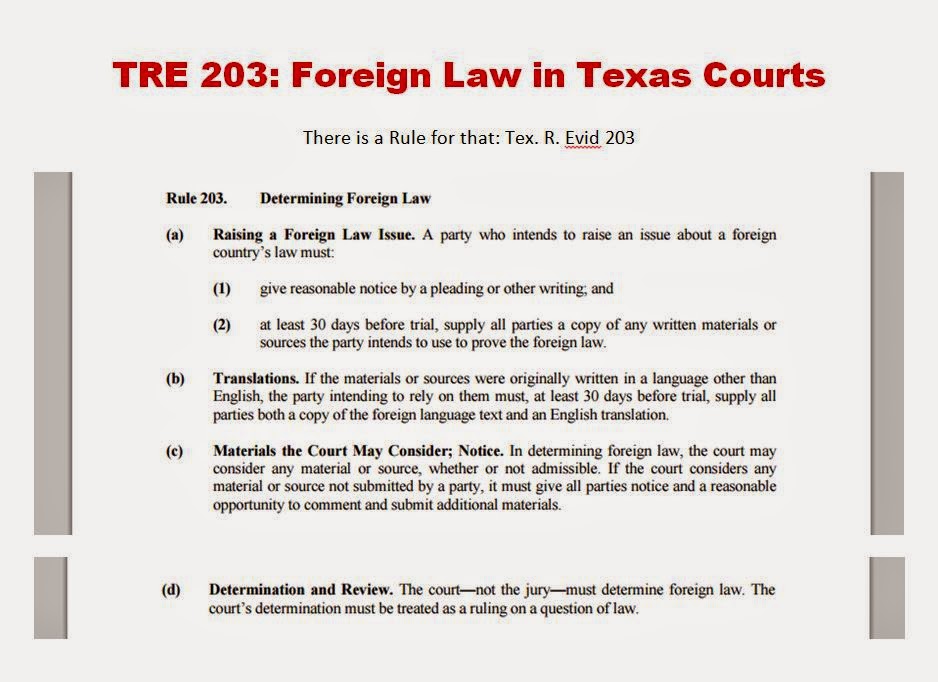
Tex. R. Evic. 203: Determination of Foreign Law
Texas Rules of Evidence TRE 203: Determination of Foreign Law 

B. Public policy

Fariha also contends that the trial court should have held that the Pakistani
divorce law is invalid because it denies due process and is fundamentally unfair.
Inherent in the right to due process is “notice reasonably calculated, under
all the circumstances, to apprise interested parties of the pendency of the
action . . . .” Mullane v. Cent. Hanover Bank & Trust Co., 339 U.S. 306, 314, 70
S. Ct. 652, 657 (1950), quoted in Peralta v. Heights Med. Ctr., Inc., 485 U.S. 80,
84, 108 S. Ct. 896, 899 (1988). Mohammad’s expert witness distinguished the
traditional Muslim talaq from the requirements for divorce under the Pakistani

9

Ordinance, which requires notice to the wife and the Union Council and authorizes
the imposition of criminal penalties for failure to comply with those requirements.
The Ordinance imposes a mandatory 90-day waiting period before the divorce is
final to allow for reconciliation efforts during that period and facilitates these
efforts by providing for constitution of an Arbitration Council for reconciliation
upon request. The record contains conflicting evidence as to whether Mohammad
timely served Fariha with notice of the divorce as required under the Ordinance,
but Fariha admitted to receiving the notice before the divorce became final. We
will not disturb the credibility determination supporting the trial court’s implicit
conclusion that the procedure prescribed by the Ordinance satisfied due process.
See Unifund CCR Partners, 299 S.W.3d at 97.

In contending that the Pakistani divorce should be considered void for public
policy reasons, Fariha relies on Aleem v. Aleem, 947 A.2d 489 (Md. App. 2008), in
which the Maryland Court of Appeals declined to recognize as a matter of comity
the validity of a divorce the husband obtained by appearing at the Pakistan
Embassy and performing talaq in writing without any advance notice to his wife.
Id. at 490. We find Aleem inapposite. Specifically at issue in Aleem was a dispute
regarding the division of marital property, which is not involved in this appeal.
Further, the Maryland appellate court decided that the talaq divorce was
inequitable in the apparent absence of evidence of Pakistan’s “Dissolution of

10

Muslim Marriages Act, 1939,” which permits women to divorce under certain
circumstances. See id. at 490 n.1 (explaining its understanding that “where that
Islamic law has been adopted as the secular law of a jurisdiction, such as Pakistan,
a husband has a virtual automatic right to talaq, . . . but the wife only has a right to
talaq if it is in the written marriage agreement or if he otherwise delegates that
right to her”). Through his legal expert, Mohammad proffered evidence of the
1939 Act, which permits women to initiate divorce based on, among other things,
the husband’s abandonment, polygamy, imprisonment, or mistreatment.
At least one legal commentator has characterized the Pakistani divorce laws
as providing an avenue beyond traditional Islamic law that can be used to
safeguard and promote “the fundamental rights guarantees of contemporary
constitutions and the modern ideas of social justice that have influenced them.”
Karin Carmit Yefet, The Constitution and Female-Initiated Divorce In Pakistan:
Western Liberalism in Islamic Garb, 34 HARV. J.L. & GENDER 553, 562 (2011).
We also note that the U.S. State Department considers a Pakistani talaq divorce
obtained pursuant to the Ordinance—as opposed to a “bare talaq”—as valid proof
of marital status for immigration purposes, and it presumably recognized the
validity of this particular divorce in approving the visa for Mohammad’s current

11

wife.1
 Accordingly, we hold that the trial court acted within its discretion in
recognizing the Pakistani divorce as valid as a matter of comity.
C. Compliance with Pakistani law
Finally, Fariha contends that the Pakistani divorce is invalid because
Mohammad failed to comply with the legal requirements for procuring it.
Mohammad’s expert witness testified to the contrary: she averred that the divorce
proceeding that Mohammad initiated complied with the law, and the divorce
became final November 15, 2009.

Mohammad testified that he (1) pronounced the triple talaq to Fariha,
(2) sent a copy of the divorce to Fariha’s family home, where it was received by
her brother, and (3) sent notice to the Union Council chairman before he left
Pakistan. Within the 90-day period before the divorce was final, Fariha’s parents
went to Mohammad’s family’s house and were given Fariha’s personal effects,
including the “maher,” a fixed dowry payment owed upon divorce, and the jewelry
also given as dowry. The expert witness testified that Fariha’s acceptance of the
maher payment equates to acceptance of the divorce.

For the first time on appeal, Fariha points to discrepancies in the dates and
other perceived flaws in the contents of the divorce documents. However, she did
not present any expert testimony in the trial court to support the conclusion that
 1 See U.S. DEP’T OF STATE, BUREAU OF CONSULAR AFFAIRS, Pakistan Reciprocity
Schedule: Documents—Divorce Certificates.

12

those flaws render the divorce invalid, nor is there any other evidence to controvert
the analysis and opinion from Mohammad’s expert witness that the divorce is
valid. Moreover, Fariha does not counter Mohammad’s argument at trial that
Fariha’s acceptance of the maher estops her from denying the validity of the
divorce. See Leedy v. Leedy, 399 S.W.3d 335, 339–40 (Tex. App.—Houston [14th
Dist.] 2013, no pet.) (party who accepts and retains benefits of judgment is
thereafter estopped to assert its invalidity); Richards v. Richards, 371 S.W.3d 412,
(Tex. App.—Houston [1st Dist.] 2012, no pet.) (same). We hold that the trial court
did not err in concluding that the divorce complied with the applicable legal
requirements.

Conclusion

We hold that the trial court acted within its discretion in dismissing the divorce action for lack of jurisdiction. We therefore affirm the judgment of the trial court.

Jane Bland

Justice

Panel consists of Justices Keyes, Bland, and Massengale.

First Court of Appeals April 28, 2015 Opinion Release Page (partial snip) 


Thursday, April 23, 2015

Cypress Creek EMS sues to get restraining order against Wayne Dolcefino over documents it says were released in error under the Public Information Act (updated)


Lawfirm for Cypress Creek EMS goes to court seeking emergency order to undo mistake in release of documents under the Texas Public Information Act (Open Records Act).

4/23/2015 11:53PM UPDATE: The application for temporary restraining order was heard by Judge Tad Halbach, serving as ancillary judge for emergency matters this day, who granted it, with hand-written changes, ordering Dolcefino to retain the package of documents mailed to him (rather than return them to the CCEMS's law firm), not to disclose or disseminated their content, and bring them to the temporary injunction hearing set for May 4, 2015 at 3pm. To make the TRO effective, CCEMS was required to post a $500 bond. 


CYPRESS CREEK EMS vs. DOLCEFINO, WAYNE & DOLCEFINO CONSULTING
Cause No. 2015-23275 in Harris County District Court

In its pleading, filed April 23, 2015, CCEMS says that unredacted confidential documents with sensitive information were mailed to Dolcefino in error by its lawfirm on Monday April 20, 2015, and asks the court to immediately prohibit Dolefino from opening the packages, and that he and his company be restrained from reviewing, discussing, copying, transmitting, disseminating, or publishing any information contained in the packages received since April 20. 


It appears that the documents relate to law enforcement activities and the entity's tactical unit ("Advanced Tactical Team"). CCEMS claims the documents sought by Dolcefino are excepted from disclosure and has sought a ruling by the open records division of the Attorney General's office, but sample documents submitted to the AG's office together with the request for a ruling to the effect that CCEMS may withhold the documents were mailed to Dolcefino also, - without redaction of the information claimed to be sensitive and protected.  

 Affidavit in Support of Application for TRO
against Wayne Dolcefino over SWAT records


Monday, March 2, 2015

Texas Judiciary FY 2014 Annual Statistical Report just released by OCA

The Annual Statistical Report for the Texas Judiciary has just be published as a single book-like pdf document (a little later in the year than the previous edition, but with enhanced features and improved, user-friendly presentation). It is available for download free of charge from the Texas Judiciary's new website. 

The Annual Report is published by the Office of Court Administration (OCA) and is a veritable treasure-trove of data on the Texas judicial system at all levels, including caseload trends in the trial courts, broken down by case type and type of court; appellate case disposition patterns and opinion production the courts of appeals; and outcomes of appeals taken to the Texas Supreme Court and Court of Criminal Appeals and decided on the merits. The reporting period is the fiscal year, not the calendar year.


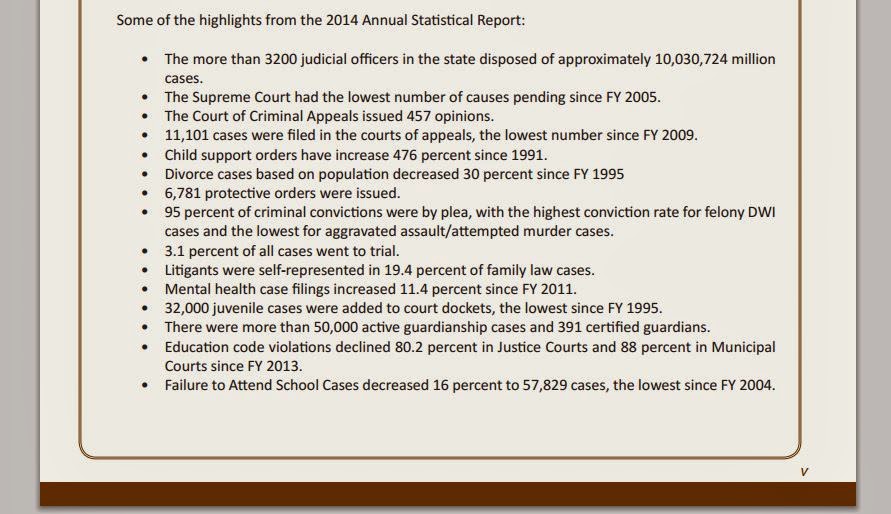
Highlights from this Year's Annual Report 


The Annual Report for Fiscal Year 2014 is 136 pages long and
 contains numerous high-quality graphics, tables, and 
charts that visualize the statistical information
and make it much easier to comprehend.

See examples below: Appeals and top counties from which they originate, and timeline chart of number of cases decided by the Texas Supreme Court over the last two decades.


SUPREME COURT PETITION FOR REVIEW GRANTS
HOUSTON COURT OF APPEALS IN SECOND PLACE
AFTER CORPUS CHRISTI 

Add caption
HOUSTON COURT OF APPEALS WORKLOAD STATS  


See prior blawg post for --> opinion production broken down by  
dissents and concurrences by justices of 1st and 14th Court of Appeals 
in comparison. 


Wednesday, January 21, 2015

Unopposed motion to transfer appeal to avoid conflict of interest denied by newest member of First Court of Appeals, Justice Russell Lloyd


In one of his first official acts as a member of the First Court of Appeals, freshman Justice Russell Lloyd on January 15, 2015 denied a motion to transfer a case from the First to the Fourteenth Court of Appeals, which was filed to avoid a conflict of interest. The motion was not objected to by the other party in the appeal. Both appellate courts sit in Houston, and hear cases from the same counties, which are assigned randomly to one or the other.  
 
Attorney Orjanel Lewis requested the transfer after an appeal in which his firm - RADACK AND BORUNDA, P.C. -  represents a medical malpractice plaintiff who had summary judgment entered against her by a Harris County District Court was assigned to the First Court of Appeals. The transfer was sought because Jeremy Radack, a name partner and shareholder of the law firm that handles the appeal for the unsuccessful plaintiff in the trial court, is the son of Sherry Radack, the First Court's Chief Justice.


In denying the motion in a short order, Judge Lloyd acted individually, rather for the court. He did not give a reason, other than to cite to the rules governing transfer, disqualification, and recusal.

Order Denying Motion to Transfer case issued by Justice Russell Lloyd

Image of motion to transfer appeal to avoid conflict of interest based on family relationship

 RADACK AND BORUNDA, P.C. - Public Information 

Attorneys are notoriously loath to file recusal motions against sitting judges because they do not want to question the impartiality of a judge before whom they may appear in the future, and make themselves unpopular.

Justice Russell Lloyd took office January 1, 2015, replacing Jim Sharp, who lost his re-election bid. Justice Lloyd does not yet have an official biography on the First Court of Appeal's website (as of 1/21/2015).  Attorney Russell T. Lloyd's profile on file with the State Bar of Texas was last certified on 04/17/2014 and reflects that he practiced law as a solo. He received his law license in 1978 after earning his law degree from the University of Texas that same year. Judge Lloyd's LinkedIn profile provides much more detailed information about his background.